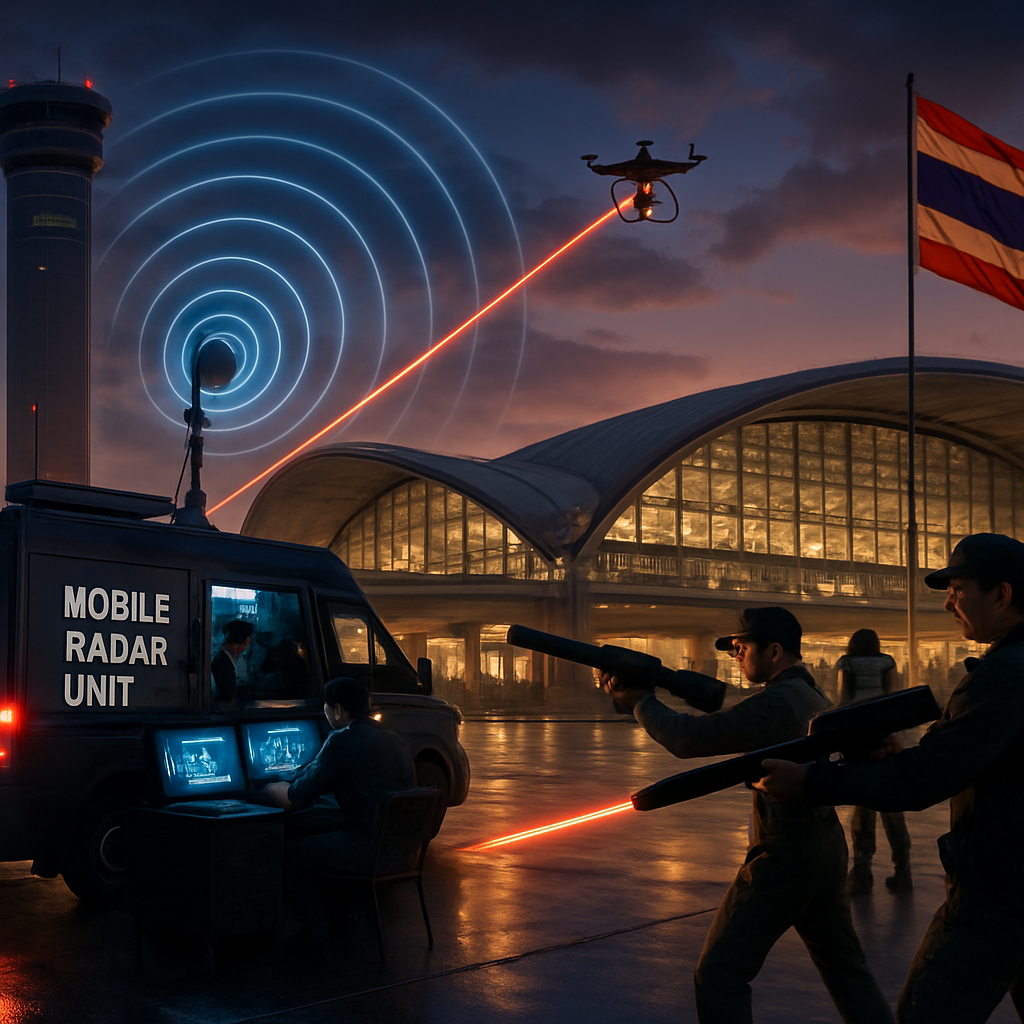
When a Drone Buzzed Suvarnabhumi: How Bangkok’s Main Airport Briefly Turned Into a High-Tech Standoff
On December 22, Suvarnabhumi Airport’s control room switched from routine hum to full-alert mode after a drone was detected skirting the airport’s outer perimeter. What followed was a rapid, tightly coordinated security response that read like a scene from a modern techno-thriller—minus the explosions and with significantly more paperwork.
The who’s who of the emergency meeting
Airport General Manager Kittipong Kittikachorn convened an urgent meeting at the Suvarnabhumi headquarters in Samut Prakan, drawing senior security officials from across Thailand’s protective services. Among those present were Police Lieutenant General Watthana Yichin (Region 1 Police Commissioner) and Police Major General Phumin Singhasut, alongside representatives from the Royal Thai Air Force, the army, national police and local authorities. The message was clear: the drone hadn’t penetrated the inner security zone, but its proximity was serious enough to warrant an all-hands response.
Immediate countermeasures: gadgets, guns and quick thinking
Rather than waiting for the weather to clear, officials moved fast. Last night the Royal Thai Air Force deployed temporary equipment designed to detect—and where necessary—disrupt unauthorized drones. The response mixed tech and tactical hardware: a Redsky-II counter-drone unit was mobilized, and personnel brought out drone-disabling firearms including a Drone Killer rifle, two Drone Defender guns, and even a Tomahawk shotgun loaded with 20 rounds. The Royal Thai Police supplemented the operation with a mobile anti-drone system, creating layered safeguards across the airspace.
It’s important to note the distinction here: these tools are not deployed for casual use. They’re part of a calibrated escalation plan intended to neutralize threats to aircraft and passengers while minimising collateral risk. Authorities repeatedly reassured the public that all measures were coordinated and focused squarely on safety.
Fast-tracking future defenses: AOT’s procurement plan
Beyond the immediate fixes, the event prompted a policy push from the top. Following directives from the Prime Minister and national security agencies, Airports of Thailand (AOT) has been given the green light to acquire advanced anti-drone systems capable of countering a wide spectrum of drone threats. Officials acknowledged procurement will take time, but promised the process will be expedited. In plain terms: temporary tech now, high-grade, longer-term systems on order soon.
Keeping travellers calm (and informed)
Airports aren’t just runways and terminals; they’re also trust ecosystems. To that end, authorities moved quickly to inform international travelers about the security protocols in place to protect the airspace and maintain confidence in Thailand’s airport safety standards. Suvarnabhumi shared an infographic — translated into English — explaining the Air Navigation Act of 2015 to help passengers understand legal boundaries and the airport’s powers when it comes to airspace violations.
What this means for passengers — and your wallet
While the drone scare has passengers thinking about safety, another development will affect wallets: the Civil Aviation Board recently approved a 53% increase in the Passenger Service Charge (PSC) at six major airports. International travelers flying from Thailand will soon face higher airport taxes, a separate but timely reminder that travel budgets and airport security policies are both shifting.
Why this matters
- Airspace safety: Even an unmanned drone in the outer zone poses a risk. Proximity can distract pilots, interfere with approach procedures, and in worst cases, lead to collisions with aircraft—so authorities treat any breach as significant.
- Systems synergy: The incident highlighted the need for both short-term tactical responses (detection and jamming) and long-term strategic investments (robust anti-drone platforms from AOT).
- Public assurance: Rapid, transparent responses help maintain traveler confidence—especially when incidents happen at high-profile hubs such as Suvarnabhumi.
The bottom line
December 22’s drone sighting was a wake-up moment for Suvarnabhumi—but it also showcased Thailand’s capacity to respond rapidly. From on-the-ground deployments like the Redsky-II and Drone Killer systems to a fast-tracked procurement plan, authorities moved with speed and intent. Travelers should expect visible security measures and clearer communication in the coming weeks, alongside an impending rise in PSC that will affect international departures. For now, officials insist the airport is safe and that these layered protections are designed to keep it that way—drone or no drone.


















A drone near an international runway is terrifying and they did the right thing to scramble countermeasures, but that Tomahawk shotgun line felt over the top to me.
Over the top or realistic? People forget a small drone can take down a plane in critical phases, so having physical options isn’t paranoia, it’s prudence.
Technically, kinetic responses near runways are dangerous too — jamming and capture systems reduce collateral risk if done correctly.
Fair point, Larry, but I worry about accidental damage from gunfire near terminals and aircraft — there has to be a clear escalation protocol.
Fast-tracking procurement without transparent testing standards is risky; anti-drone systems can interfere with legitimate comms and raise legal issues.
So you’d rather have nothing and risk a collision? Some systems are better than none while standards catch up.
I’m not saying do nothing, I’m saying test and certify. Poorly configured jammers could ground navigation aids and create bigger safety problems.
This shows Thailand can coordinate fast when needed, but the PSC hike feels like paying for the government’s security theater.
It’s not just theater — airports need integrated systems, but passengers always end up footing the bill and that’s a long-term trend.
Exactly, transparency on procurement costs and timelines would ease public frustration.
Why were temporary anti-drone tools not already standard at a major hub like Suvarnabhumi?
Budget cycles and procurement red tape, plus agencies resisting shared responsibility until something happens.
That sounds like negligence, not bureaucracy — airports are predictable threats now.
I fly often and I’d rather the airport be overprepared than not prepared, even if my ticket costs a little more.
Some people just accept price hikes without demanding accountability, though, and that’s the problem.
Accountability is fine but not at the cost of passenger safety — safety first.
From an aerospace safety perspective, rapid layered detection and non-kinetic mitigation (like capture nets, directed-energy capture) should be prioritized over firearms.
Directed-energy tech is promising but expensive and still in infancy for dense civilian airspace, which is why interim systems get bought.
Agreed that cost is a constraint, but procurement should be driven by risk assessment and interoperability standards rather than political urgency.
Honestly, I think this was probably a hobbyist pilot who lost control and didn’t intend harm; militarized responses scare me.
Intent doesn’t matter in aviation safety; a lost hobby drone near approach paths is still a hazard and must be treated as such.
I get that, but laws and public education about no-fly zones might prevent 80% of these incidents without guns and jammers.
Banning drones near airports is pointless — enforcement and tech are the only real solutions.
Enforcement plus geofencing firmware updates for consumer drones would help, but vendors and users must cooperate.
Exactly, make manufacturers liable for firmware that ignores geo-zones and we might see change.
The infographic translation was a nice touch, but who actually reads legal pamphlets at airports?
Not many, but making information accessible in multiple languages is a low-cost confidence builder for travelers.
Confidence-building is fine but enforcement and visible competence are what passengers remember when they book flights.
Deploying Redsky-II and mobile systems was textbook layered defense, but rules of engagement must be crystal clear to avoid escalation.
Rules of engagement and strict logging of interventions will be crucial if they want public trust and legal defensibility.
Exactly, every activation should be auditable with timestamps, video, and chain-of-command approvals.
Higher PSC right after a scare looks like milking the crisis for funding, and that stinks politically.
The PSC hike was likely in the works before the drone incident; timing is unfortunate but not necessarily causal.
Maybe, but optics matter. They should separate the security procurement budget from passenger fees and explain it clearly.
This incident underscores the need for international standards on counter-UAS near civil aviation hubs to avoid ad hoc practices.
International standards would help, but national sovereignty and differing threat perceptions make harmonization slow.
True, but ICAO and regional blocs could at least publish best-practice frameworks to guide procurement and ROE.
I worry about mission creep: airports becoming militarized zones where privacy and free airspace notions erode.
Safety trumps abstract privacy in cases where lives are at risk; balance is possible, but not at the expense of security.
Balance is easy to say until systems stay in place and get used for non-aviation surveillance later.
Someone will leak a video of the shooting and social media will rage; optics could be worse than the drone.
And that’s why strict protocols and public communication are essential — they need a playbook for the PR fallout.
Exactly, transparency and evidence release are better than secrecy in these cases.
As a frequent flyer from BKK, I appreciated the clear reassurance, but I want follow-up reports, not just press releases.
Follow-up reports with audits, costs, and incident reviews would definitely help restore and maintain trust.
Yes, and include passenger-facing metrics so travelers see improvements, not just jargon.
Public education on Air Navigation Act 2015 is good, but enforcement is where it counts — fines and confiscations should be real deterrents.
Fines are fine but repeat offenders who use drones maliciously need criminal penalties and quick investigation.
Agreed, criminalization for intentional endangerment is appropriate, but we should avoid sweeping measures that punish accidental mistakes.
Counter-drone rifles and jammers are stopgaps; the real future is mandatory geofencing and certified UAS traffic management integration.
UTM integration is promising but will require huge investments in comms infrastructure and cyber-resilience before we trust it.
Yes, but starting procurement now accelerates that transition; waiting costs more in the long run.
A lot of countries will watch Thailand’s procurement choices and copy them, for better or worse.
Which is why Thailand should prioritize interoperable, standards-based systems rather than vendor-locked proprietary gear.
If they do vendor-lock, expect price gouging and poor upgrades in 5 years, like many legacy defense buys.
The public response will split: safety-first folks versus libertarians who see creeping control, and both sides have points.
Exactly, the debate will rage and policymakers need to bridge it with clear legal limits and oversight.
Oversight and sunset clauses on any emergency powers would help defuse long-term civil liberty fears.
Will this make flights delayed more often? I booked cheap tickets and don’t want extra layovers because of security experiments.
Short-term deployments might cause some delays during incidents, but long-term integrated systems aim to reduce disruptions overall.
Hope so, because airlines and passengers pay the real price for mishandled responses.
If procurement is expedited, put a civilian oversight committee in place to review contracts and tech capabilities quarterly.
Civilian oversight is good, but include technical experts with aviation and RF backgrounds to avoid politicized vetoes.
Agreed, include independent auditors and publish non-sensitive findings for public trust.
I flew through BKK last month and noticed a lot of construction; maybe the airport is just upgrading and this incident sped things up.
They are doing renovations, and security upgrades fit that pattern, but the PSC hike timing is still frustrating for travelers.
Still, better infrastructure and security might make flights more reliable in the future.
I want to see the data: how many false positives, how many real threats, and the cost per prevented incident.
Agencies rarely publish that granular data, but aggregated incident reports, response logs, and cost breakdowns would be invaluable.
Then demand it — transparency reduces suspicion and pushes better procurement decisions.
The human factor matters: training, coordination, and quick decision-making won’t be fixed just by buying gizmos.
Training is indeed crucial; tools are only as good as the teams that operate them under stress.
Invest in joint exercises and simulations before hardware deployment so rules of engagement are second nature.
This makes me think about escalation: today a drone, tomorrow unauthorized air taxis — airports must future-proof now.
Exactly, anti-drone systems should be modular and upgradable to handle evolving airspace users and tech.
Modularity prevents sunk-cost traps and avoids repeating mistakes of one-off procurements.
I’m skeptical of military gear at civilian hubs, but I also don’t want to be on a plane that almost hit a drone.
That’s the tension — protect passengers without militarizing the terminal experience unnecessarily.
We need clear boundaries and transparency about where military assets are used and why.
If they’re buying expensive tech, they should commit to open RFPs and public timelines, not secret single-vendor deals.
Open RFPs are ideal but can slow urgent buys; a two-track approach — emergency temps plus open long-term procurement — might work.
Two-track is sensible if the long-term track is genuinely transparent and not a rubber stamp.