Thai Hotels Head Into a Thin May as Europe Fares and Middle East Fighting Cut Bookings
Hotels from budget inns to luxury resorts report weaker forward bookings from May, with Phangnga among the hardest hit after Europe airfares jumped.
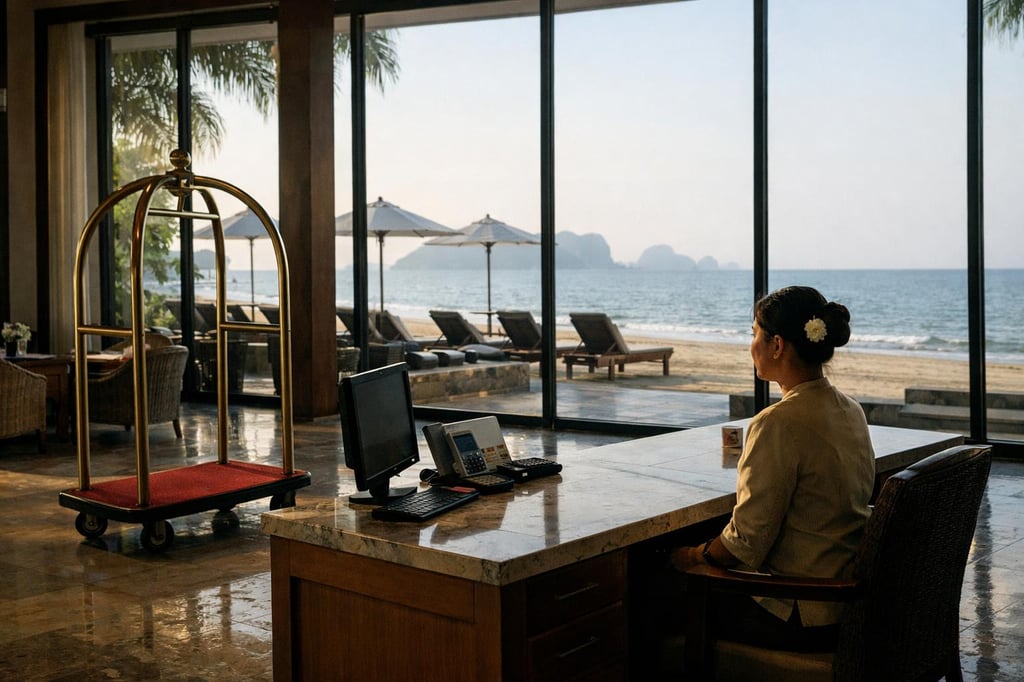
Hotels from guesthouses to five-star resorts across Thailand are entering the May-to-October low season with fewer confirmed reservations than a year earlier, according to the Thai Hotels Association. President Thienprasit Chaiyapatranun has linked the slump in forward bookings from May to Middle East fighting and the jump in long-haul airfares after airspace closures and hub suspensions.
The squeeze is sharpest in provinces that depend on European holidaymakers. Phangnga, on the Andaman coast, is among the hardest hit, with operators reporting declines of around 50 percent in the booking pipeline. Luxury properties in Phuket, Krabi, and Koh Samui are also looking at thinner May occupancy.
Where the booking book is thinning
The Thai Hotels Association (THA) says the softness runs through every price band. Thienprasit, listed as THA president on the Thailand Convention and Exhibition Bureau board, said first-quarter trading had met targets, but second-quarter forward bookings were weaker than last year. Most markets had not yet committed rooms for the second half of 2026.
Regional reports after a 1 April association meeting were uneven. Southern destinations that once drew Israeli guests, including Koh Phangan, lost that stream almost overnight, and some rerouted Europe fares were described as doubling. Eastern properties reported second-quarter bookings down 10 to 15 percent. In the north, Songkran occupancy sat around 50 to 60 percent as haze combined with the travel shock.
Luxury May occupancy is forecast around 40 percent, about three points below a year earlier, with Samui, Phuket, and Krabi missing leisure guests and airline crews. Phuket is holding a 40 to 60 percent occupancy band for May, while Phangnga properties are looking at 20 to 30 percent. European arrivals are already down about 17.5 percent in Phuket and 20 to 30 percent in Krabi. The Phangnga Hotel Association said in mid-March that more than 90 percent of its visitors were European and estimated provincial losses were approaching 1.7 billion baht.
Official arrival totals still look respectable
Headline visitor counts have not collapsed. The Tourism Authority of Thailand (TAT) said the country welcomed 9.31 million international arrivals in the first quarter of 2026, led by China at 1.49 million. On 8 April, TAT recalibrated its full-year outlook to about 30 to 34 million international arrivals, around 206 million domestic trips, and roughly 2.58 trillion baht in total tourism revenue, citing air-connectivity constraints, energy-price volatility, and an expected easing of the Middle East situation within one to three months.
The Ministry of Tourism and Sports said 7,489,983 foreign visitors arrived between 1 January and 11 March, down 4.40 percent from the same stretch of 2025, generating about 368.17 billion baht. Combined Europe and Middle East arrivals in the conflict window were 304,714, down 16 percent from a normal trend, with European visitors down 14 percent and Middle East visitors down 55 percent. Permanent Secretary Natthriya Thaweewong warned that if high fares lasted another two to three months, price-sensitive younger travellers would start to stay home.
Why Europe tickets got so expensive
The Civil Aviation Authority of Thailand (CAAT) said in early March that eight Middle Eastern airlines serving Thailand had suspended flights after Gulf hubs were disrupted. Those carriers had previously handled more than 10,000 passengers a day out of Thailand. CAAT said fares on available Europe routes had jumped by around 100 percent, with one-way Bangkok-London economy tickets on Thai Airways cited above 70,000 baht against a typical average near 30,000 baht.
Thai Airways later raised published fares by about 10 to 15 percent to reflect higher jet fuel, while reporting cabin factors of 80 to 90 percent on Europe-Thailand nonstops. IATA's March 2026 passenger analysis showed Middle East-Asia traffic down 55.9 percent year on year, while traffic between Europe and Asia surged 29.3 percent as travellers moved onto direct flights. Load factors on Europe-Asia routes reached 93.6 percent. Packed Bangkok-Europe aircraft and empty Andaman lobbies can therefore exist at the same time.
What This Means for Expats and Travelers in Thailand
Residents already in Thailand may find more choice and more willingness to negotiate on Andaman and northern room rates from May onward, especially in Phangnga, Krabi, and haze-hit Chiang Mai. That is a buyer's market for staycations, not a sign that Bangkok or Phuket has emptied. Anyone flying in from Europe should budget for a much more expensive ticket than in 2025, check whether the itinerary still transits a Gulf hub, and keep cancellation cover in place while airspace rules keep changing.
THA has asked the government to delay any new tourist entry fee, tackle northern PM2.5, and ease energy costs while the low season runs. The official visitor target of 30 to 34 million for 2026 still stands, but hotel cash flow in European-dependent provinces will be tighter until fares settle. Travellers who can shift a beach week into May or June are likely to get more space, and a better rate, than a year ago.

Comment verification
Step 1 of 3
Verify your email once to publish your comment. Your email is never shown publicly.
Enter the 6-digit code sent to .
Choose the display name shown next to your comments.