Thailand Eyes 2027 Commercial Drone Airlines
Thailand is targeting 2027 for the first commercial drone cargo airlines as CAAT rewrites unmanned aircraft rules, BVLOS approvals and low-altitude airspace management after registering more than 73,000 drones.
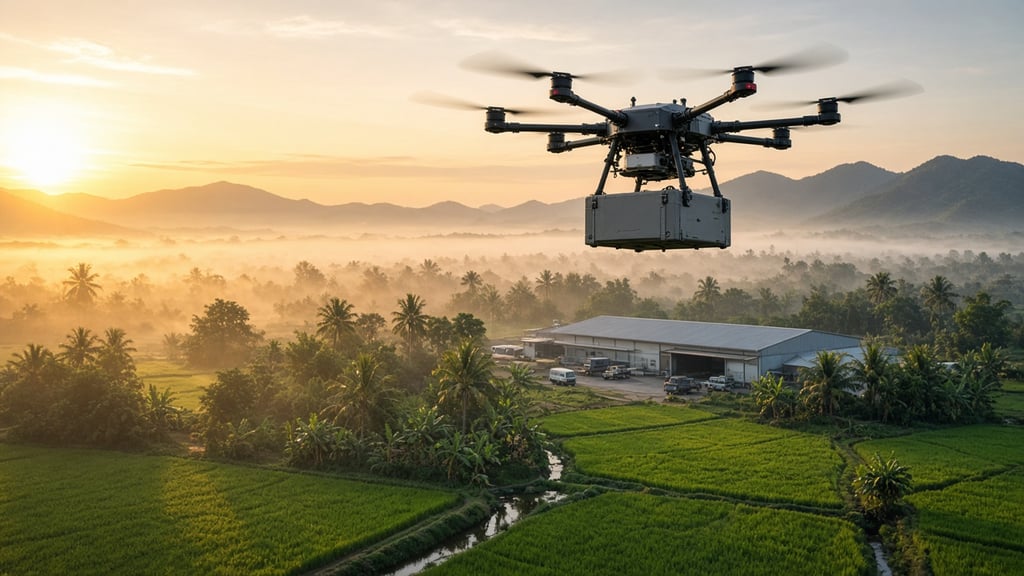
Thailand is preparing to treat commercial drone aviation as a regulated transport business rather than a hobby, with the Civil Aviation Authority of Thailand targeting 2027 for the first cargo drone airline services as it rewrites unmanned aircraft rules, radio-frequency policy and low-altitude airspace tools.
The regulator used a two-day media programme in Si Racha, Chon Buri, on 11 and 12 November 2026 to set out how unmanned cargo routes, medical deliveries and later advanced air mobility could sit beside conventional aviation. As of 10 November 2026, CAAT's UAS Portal listed 73,435 registered unmanned aircraft, 111,800 basic remote pilots and 16,270 advanced pilots.
The May 2026 commercial rulebook
New Specific Category rules took effect on 17 May 2026 for drones weighing up to 25 kilograms. The package covers medium-risk operations that go beyond the old 2015 visual-line-of-sight hobby conditions, including commercial work, filming, surveying and other missions that cannot follow the general limits.
Remote pilots must complete a CAAT-approved course covering air law, airspace rules, safety and operational risk, then hold operating privileges matched to the aircraft they fly. Aircraft must display a registration mark in the format XX-NN-NN-NNNN. Letters and numbers must be printed, contrast with the hull and stand taller than 0.3 centimetres.
Each Specific Category flight now needs an online plan through the UAS Portal stating purpose, date, time, area or coordinates, crew names and insurance papers. Third-party insurance remains at least 1 million baht per incident. Permits last five years instead of two, with renewal due at least 30 days before expiry. Existing 2015 permits remain valid until they expire, but any Specific Category mission still has to meet the new tests. CAAT can also demand an operations manual, a risk plan or a live demonstration. Drones heavier than 25 kilograms stay under a separate Ministry of Transport framework, last updated in June 2026.
BVLOS, delivery, farms and inspection
BVLOS, night flying, operations above 90 metres and flights within 9 kilometres of an airport require extra CAAT approval. The same extra gate applies to restricted or danger areas, flights closer than 30 metres to people, vehicles or buildings, and the carriage of dangerous goods. Holding operating privileges is not an automatic licence to fly those profiles.
Guidance for medium-risk missions sets a path for parcel delivery, emergency-response support and demonstration flights, with no passengers on board. Applicants file per operation using a JARUS Specific Operations Risk Assessment, plus containment and safety-management measures. Pre-defined assessments already cover BVLOS in sparsely populated areas at up to 90 metres, and between 90 and 300 metres, the envelope most agricultural spraying, infrastructure inspection and rural logistics would use.
That is the practical market today. Spray and mapping drones already work rice and corn fields from Pathum Thani to the Northeast, usually as a contracted service. Inspection drones are in wider use on power lines, industrial sites and land surveys. Urban parcel delivery remains at the sandbox stage: CAAT met Grab executives in March 2026 on a regulate-first basis, and Phuket has been scoping drone and electric vertical-takeoff links for airport, tourism and hospital runs once safety assessments pass.
Airspace tools, spectrum and the 2027 airline bet
Commercial drone airline services are targeted to begin in 2027, starting with cargo. One Thai operator has already applied to register a commercial drone airline, with two or three more preparing filings. CAAT is still writing the supporting law with partner agencies and is discussing spectrum for those routes with the National Broadcasting and Telecommunications Commission.
NBTC in April 2026 approved four draft notices that would move drone radio use beyond unlicensed line-of-sight bands, adding cellular and satellite frequencies, radar bands for obstacle avoidance, a possession licence for BVLOS-capable machines, and Remote ID so a drone can broadcast identity and position in flight.
CAAT is developing unmanned aircraft system traffic management to link with conventional air traffic management under a 2027 to 2029 UAS Portal roadmap. The July 2026 public hearing in Bangkok described a shift from a permit website into shared digital airspace for flight planning, live tracking and data exchange. Vertiports, charging and regional-airport test sites sit on the same infrastructure list.
Thailand's drone market is growing at about 10.3 percent a year. The global commercial unmanned aircraft market was about 27.9 billion US dollars in 2025 and is projected to reach 52.1 billion US dollars by 2034. Separate industry estimates put the Thai market near 8.6 billion baht, or about 260 million US dollars. CAAT is drafting a national unmanned aircraft and advanced air mobility master plan, and is using a regulatory sandbox for trials that pass safety tests. The International Civil Aviation Organization's Second Advanced Air Mobility Symposium runs from 1 to 3 December 2026 at IMPACT Forum Hall 4 in Muang Thong Thani, with about 1,500 regulators and operators expected.
What This Means for Expats and Travelers in Thailand
Holiday pilots and resident hobbyists remain under a two-agency system. NBTC registration covers the radio and ownership. CAAT registration through the UAS Portal covers the aviation side for camera drones of any weight and for machines over 2 kilograms, plus a basic remote-pilot certificate and third-party insurance. Flying without those papers can mean prison time and fines: up to five years and 100,000 baht on the radio side, and up to one year and 40,000 baht on the aviation side.
Standard recreational limits still apply unless CAAT grants a Specific Category approval: daytime, within visual line of sight, no higher than 90 metres, not within 9 kilometres of an airport, and not closer than 30 metres to people, cars or buildings. Brokers cannot legally sit the online knowledge test for you, and a Thai phone number is typically required to open the CAAT account. Check the UAS Portal and current no-fly notices before you fly, including any temporary security restrictions, because those can change faster than the commercial-airline timetable.



Comment verification
Step 1 of 3
Verify your email once to publish your comment. Your email is never shown publicly.
Enter the 6-digit code sent to .
Choose the display name shown next to your comments.