SRT Opens Rails to Private Operators in Dec
The State Railway of Thailand will publish 2027 track-access rules in December and aims to sign private tourist-train contracts by April 2027.
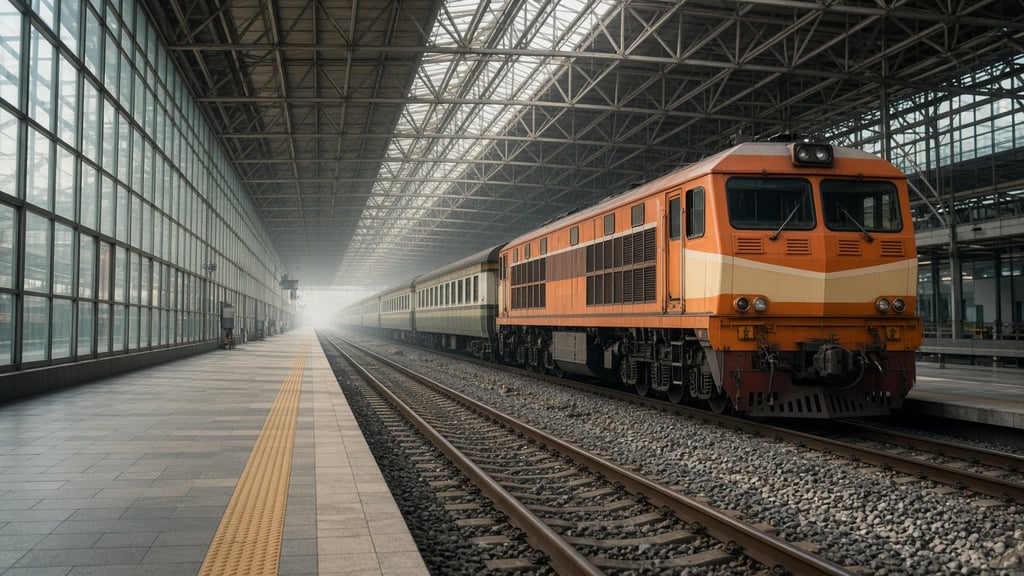
The State Railway of Thailand will open its national tracks to private operators from December, after the Prime Minister's Office confirmed that a 2027 network statement will be published this month and that tourist-train contracts are targeted for April 2027.
Deputy government spokesperson Ploytalee Laksameesaengchan said on 29 November 2026 that the Ministry of Transport and SRT are proceeding with an Open Access framework. Private firms would run ordinary passenger services, luxury tourist trains, and freight on existing rails, under published rules, rather than building new lines. Operators must still apply for a licence from the Department of Rail Transport.
How the Open Access framework works
The scheme sits under the Rail Transport Act B.E. 2568 (2025), which requires the infrastructure manager to publish a network statement so operators can see track capacity, charges, and conditions. SRT released its first statement on 25 June 2026. The railway keeps the rails. Private companies would buy timetable paths, not the network. A licence from the Department of Rail Transport is required before any private train can move.
On 25 September 2026, SRT's board (meeting 13/2569) approved three track-use charges that will sit inside the 2027 statement. Tourist trains would pay 46.02 baht per car-kilometre. Joint passenger services would pay 7.38 baht per car-kilometre. Freight would pay 0.12326 baht per tonne-kilometre. Safety standards and selection rules described as transparent and non-discriminatory are the public test for who gets a path.
December rollout and the 2027 contract calendar
SRT is revising the 2027 network statement to match the new charges, remaining track capacity, and operating conditions, with publication due in December 2026. Interested companies can then confirm in January 2027 that they want to use the tracks. For tourist trains, SRT expects to allocate route rights and appoint a selection committee in January, then invite applications in February. April 2027 is the target for tourist-train contracts. Ordinary passenger and freight deals sit on a slower calendar, with signatures aimed at September 2027.
Tourist trains are first in the queue because the railway already has a customer base and the capital outlay is lower than for freight or scheduled passenger services. Launch dates, ticket prices, and named routes have not been published. Hotel and tourism groups have already held talks with the railway, including Minor Group, which has discussed leasing rolling stock and packaging scenic itineraries.
Fees, revenue, and what operators would actually pay
SRT's own tourist-train revenue is currently about 80 to 90 million baht a year. Officials argue that opening paths to private operators could widen the market into luxury, meetings, culinary, and long-stay travel, rather than relying only on the railway's own excursion trains.
A four-car tourist train on a Bangkok to Hua Hin run would face a one-way track bill measured in tens of thousands of baht. That is a path fee, not a ticket price. Fare setting remains with the operator once a contract is signed. The Cabinet on 24 November 2026 approved in principle a ministerial regulation on rail interconnection, and the National Economic and Social Development Council has urged a freight fee ceiling that still covers infrastructure cost while remaining low enough to attract cargo operators.
Tourism and logistics competitiveness
Thailand's metre-gauge network spans about 4,044 kilometres and serves 47 provinces, with Krung Thep Aphiwat Central Terminal as the Bangkok hub. Only about 2 percent of Thai freight moves by rail. Road haulage still carries most of the load at a higher cost per tonne-kilometre. Private freight paths, if they materialise after September 2027, are the government's bid to shift boxes off highways toward Laem Chabang, Map Ta Phut, and inland dry ports.
For tourism, the wager is that hotel groups and specialist operators will package Kanchanaburi, Hua Hin, Chiang Mai, and other scenic corridors as paid experiences, while SRT continues its public timetable. Track sharing on a network that is still largely single-track is the operational risk. The Department of Rail Transport will have to licence crews, rolling stock, and paths without starving ordinary commuter and long-distance trains of slots.
What This Means for Expats and Travelers in Thailand
Ordinary third-class and sleeper services are expected to keep running on the public timetable. Do not expect a private luxury train to replace the cheap night sleeper to Chiang Mai or the fan car to Hua Hin. Book regular journeys through SRT's D-Ticket channel or station counters as usual.
Private tourist trains, if contracts are signed in April 2027, will sell their own packages, likely at hotel-tour prices rather than ordinary rail fares. Routes and start dates remain unpublished, so treat 2027 marketing as provisional until the December network statement lists actual paths. Freight customers and factory logistics teams should watch the January 2027 interest window, not the tourist-train sprint.
Comment verification
Step 1 of 3
Verify your email once to publish your comment. Your email is never shown publicly.
Enter the 6-digit code sent to .
Choose the display name shown next to your comments.