Laos-China rail hits 90m tonnes in 5 years
Five years after opening, the Laos-China Railway has moved more than 90 million tonnes of freight. Thai Commerce officers say the Nong Khai corridor is speeding fruit, rubber, and processed goods into inland China.
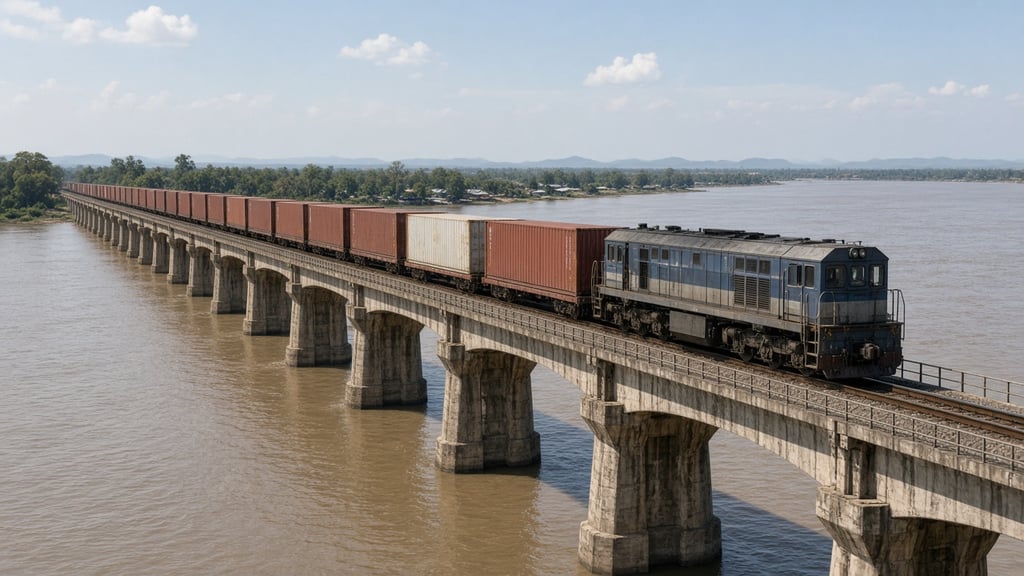
Five years after the first trains rolled between Kunming and Vientiane, the Laos-China Railway has carried more than 90 million tonnes of freight, a threshold Thai commercial officers in Yunnan now treat as evidence the corridor is a working export route into inland China.
The Thai Trade Centre in Kunming, reporting for the Department of International Trade Promotion, put cumulative cargo above 90 million tonnes as of 18 August 2026, including more than 21 million tonnes that crossed a national border. Passenger traffic has passed 75 million trips. China Railway Kunming Group published matching freight totals the same day, with first-half 2026 import-export cargo at 17.17 billion yuan, about 2.53 billion US dollars, up 33.8 percent.
A five-year freight surge
The line opened on 3 December 2021, linking Kunming with Vientiane over 1,035 kilometres. It is a single-track, electrified, 1.435-metre standard-gauge corridor, with passenger trains timed at 160 kilometres an hour and freight at 120. That design matches China's network at Mohan. It does not match Thailand.
Capacity has widened quickly. Cross-border freight trains have grown from two a day at opening to a peak of 23, and haulage per train has risen from 2,000 tonnes to 2,800 tonnes. Commodity coverage has expanded from about 10 categories to more than 4,000 and now reaches 19 countries, including Thailand, plus more than 31 destinations inside China.
In 2026 the railway was moving more than 67,000 tonnes a day on average. Monthly passengers climbed from about 600,000 early on to a peak of 2.25 million. By the end of 2025, more than 12,000 onward trains had connected the corridor into Central Asia, carrying more than 653,000 TEUs.
That gauge does not match Thailand's metre-gauge network, so boxes still have to be lifted at Thanaleng, on the Lao side of the Mekong, before they can roll south to Nong Khai. Road haulage remains the feeder that gets Thai produce from farms and factories to the nearest station.
What Thai exporters are shipping
Thai fruit is the cargo that has made the railway commercially real for Bangkok. Perishable consignments now receive a four-part fast track covering priority delivery, placement, loading, and release, on top of a customs cut from about 40 hours to two to five hours.
Those newer flows match earlier Commerce Ministry reporting. In the first five months of 2023, Thai exports to China through the railway already reached 2.8 billion baht, up 260 percent, led by durian at 2,073 million baht and mangosteen at 378.6 million baht, followed by transformers, longan, and processed pineapple.
The Kunming trade office said more than 200,000 tonnes of tropical fruit moved on the line in 2026. Durian volumes the previous year exceeded 160,000 tonnes, up 51.5 percent. Rubber, malt, fertiliser, consumer goods, and processed food now share the same northbound manifests, and the Transport Ministry has trialled rubber on the Laem Chabang to Nong Khai run.
The Office of Agricultural Economics has mapped the durian cold chain in more detail. Damage rates sit at 2 to 5 percent when temperature is held. A refrigerated box still costs 160,000 to 220,000 baht, a little above trucking. DITP's Chengdu office describes a four-day cold-chain run into Chengdu and Chongqing, against about ten days by sea then inland.
Rail from northeastern Thailand to Kunming takes 70 to 77 hours, or three to four days, against five to seven days by road. That window lets packers cut fruit closer to eating ripeness instead of picking early to survive a slower truck queue at the border.
State Railway of Thailand figures for October 2025 through September 2026 show 11,007 TEUs and 6,108 wagons across the Thai-Lao rail crossing. The mix was 6,063 TEUs of consumer and other goods, 3,262 TEUs of fruit, 1,312 TEUs of malt, and 370 TEUs of fertiliser.
The Nong Khai bottleneck
Freight still shares the 1,050-metre First Thai-Lao Friendship Bridge with road traffic. At Thanaleng Dry Port, boxes move from Thailand's metre-gauge wagons onto 1.435-metre Chinese-standard cars. Agricultural economists flag wagon shortages, a single-track main line, and reloading delays. Commerce Minister Suphajee Suthumpun, meeting her Lao counterpart in December 2025, pressed for fewer transshipment steps and a bilateral trade target of 11 billion US dollars by 2027.
The 167-kilometre Khon Kaen-Nong Khai double-track railway is scheduled to open in 2028. Phase two of the Thai-Chinese high-speed line, 357.12 kilometres from Nakhon Ratchasima to Nong Khai, has in-principle Cabinet approval and a 2033 target. A 25,000-square-metre loading yard at Nong Khai station is expected to run until September 2027, after which container storage is planned at Na Tha.
A new 735-metre Mekong railway bridge, drawn for four tracks in both gauges, is in detailed design, with earlier talks pointing to construction from 2027 and completion around 2030. Until those projects land, rail already beats the truck: Nong Khai-Vientiane-China takes about 30 hours, against 48 hours by road, and Laem Chabang through Nong Khai to Kunming is about 50 hours.
What Thai exporters need to prepare
The corridor only pays if Thai production, storage, and paperwork match a rail timetable. Exporters need cold-chain slots before the April-to-August durian peak, phytosanitary documents ready for the two-to-five-hour customs window, and a plan for the gauge change at Thanaleng until a new Mekong bridge and the Bangkok-Nong Khai high-speed link remove that lift. Goods still move from Bangkok or Laem Chabang to Nong Khai, across Friendship Bridge No. 1, through Thanaleng, then north toward Kunming, Chengdu, Wuhan, and Xi'an.
What This Means for Expats and Travelers in Thailand
There is still no through high-speed train from Bangkok to Kunming. Travelers change at Vientiane, cross at Nong Khai, and live with the same gauge break that cargo faces. Community threads already treat the Laos-China Railway as a popular passenger service inside Laos, while warning that booking freight often requires Chinese-language handling and payment in renminbi.
Nong Khai will get busier before it gets smoother. Yard works, a second rail bridge, and high-speed civil tenders through 2026 to 2028 will add construction traffic even as more fruit trains use the existing Friendship Bridge. Anyone shipping household goods or planning a rail trip toward Luang Prabang should treat the corridor as open and growing, but not yet a single-ticket ride from Bangkok into China.
Comment verification
Step 1 of 3
Verify your email once to publish your comment. Your email is never shown publicly.
Enter the 6-digit code sent to .
Choose the display name shown next to your comments.