Thailand posts fastest export growth in five years as 10-month total clears 10 trillion baht
October exports jumped 27.5% to $36.86 billion, the strongest monthly rise in five years, pushing the 10-month total past 10 trillion baht. Commerce officials raised the full-year target above 19% even as imports and the trade deficit hit records and the SET gained 25.85 points.
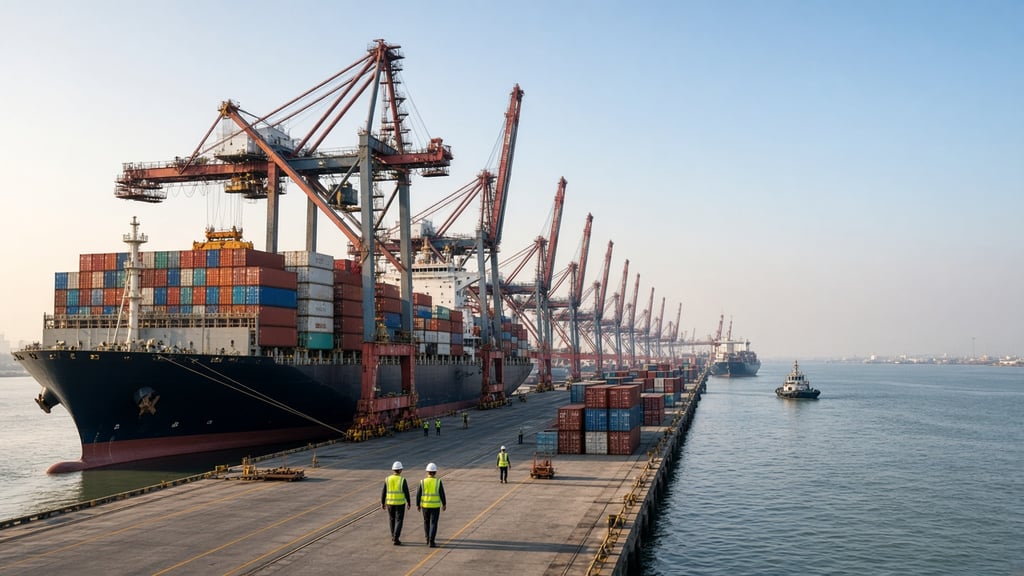
Thailand's export engine delivered its strongest monthly print in five years in October, according to Ministry of Commerce figures released on 27 November 2026. Outbound shipments rose 27.5% from a year earlier to $36.86 billion, or about 1.22 trillion baht, extending a 28-month streak of year-on-year gains. The Trade Policy and Strategy Office (TPSO) used the beat to lift its full-year growth call above 19%, even as imports and the monthly trade deficit both set records. Equity traders treated the upside surprise as a cue: the SET Index jumped 25.85 points, or 1.83%, to close at 1,440.29 on 27 November.
The 10-month running total is the number Bangkok will campaign on. Cumulative exports reached $341.45 billion, up 20.4%, or roughly 10.98 trillion baht, clearing the 10 trillion baht mark well before year-end. Core shipments, stripping out oil-related goods, gold, and munitions, still rose 24.5% in October and 20.3% over the first 10 months, so the boom is not only a commodity-price story.
A rare month when every category rose
October was the first month in 15 that agricultural, agro-industrial, and industrial exports all expanded together. Industrial goods did the heavy lifting, rising about 28% on computers, peripherals and parts, telephone equipment, and video-related products as Thai factories sit deeper inside regional technology and digital-infrastructure supply chains. Agricultural and agro-industrial shipments rose a more modest 4.1%, led by rubber, durian, longan, mangosteen, processed chicken, sugar, and pet food. TPSO director-general Nanthapong Chiralerpong presented the print as evidence that Thailand remains a working node in Asia's electronics build-out. That framing matters for 2027, because the same office already expects next year's growth to slow even if the artificial-intelligence investment cycle continues.
Record imports, and a deficit that keeps widening
The same briefing showed why the headline is not a simple surplus story. October imports jumped 53.2% to $49.20 billion, a fresh high after September's $44.30 billion. The resulting $12.34 billion monthly trade deficit was the largest on record and the 13th consecutive monthly shortfall, more than double September's $5.86 billion gap. For the first 10 months, imports reached $397.49 billion, up 39.6%, leaving a cumulative deficit of $56.04 billion, or roughly 1.97 trillion baht. TPSO argues the gap is less alarming than it looks, because much of the inbound cargo is raw materials, semi-finished goods, and capital equipment feeding export plants, with elevated energy prices inflating the dollar value. Households will still feel the other side of that ledger in fuel, electronics, and supermarket prices.
Front-loading, the US corridor, and a raised target
Shipments to the United States remain the swing factor investors watch most closely. Over the first 10 months, Thai exports to the US totaled about $84.5 billion, up 43.5% year on year, with a bilateral surplus near $57.5 billion. That acceleration, arriving while US Section 301 tariff settings and a still-unsettled ART framework hang over 2027, has traders asking how much of the 2026 boom is genuine restocking and how much is buyers pulling orders forward before new duties bite.
TPSO now expects full-year 2026 export growth above 19%, and said a print above 20% is possible if November and December hold near $31.7 billion a month. That path would put annual shipments around $404.9 billion, or about 13 trillion baht, an all-time high. Support includes AI-linked electronics demand and year-end seasonal orders. Offsetting risks include shipping disruption around the Strait of Hormuz, the electric-vehicle shift squeezing auto and parts shipments, and a slower 2027 profile. Commerce officials also flagged a 10th round of Thai-EU free-trade talks and a first round with Canada as insurance if US tariff terms harden.
The SET bought the beat, foreigners barely did
Domestic institutions led the 27 November rally with net purchases of about 975 million baht, while brokerage accounts added roughly 94 million baht. Foreign investors were slight net sellers (about 39 million baht) and local retail sold more than 1.03 billion baht into the bounce. Electronics names including Delta Electronics, KCE, and Hana Microelectronics led, with energy and bank stocks such as PTT, PTTEP, Kasikornbank, and Krungthai Bank also contributing. Consensus had looked for growth closer to 26.2%. Turnover reached 52.38 billion baht.
What This Means for Expats and Travelers in Thailand
For anyone paid in foreign currency, a strong export print is not automatically a cheaper month in Bangkok. A firmer growth narrative can support the baht and local asset prices, raising the local-currency cost of rents, school fees, and restaurant bills. Import-heavy household baskets (fuel, electronics, supermarket staples) can stay sticky because inbound prices are rising faster than outbound ones.
Investors should treat 27 November as a positioning day, not a regime change. Local institutions bought the surprise; foreigners and retail sold into it. Electronics exporters tied to AI hardware are the cleanest listed proxies; auto-parts names sit on the other side of the EV drag TPSO itself flagged. If a large slice of the US-bound surge is front-loading, order books can thin once duties settle, feeding back into factory overtime, Eastern Economic Corridor demand, and the baht. If Thailand locks in tariff treatment close to regional peers and keeps winning AI-related electronics work, the 10 trillion baht export run-rate becomes a floor rather than a spike. Residents with SET exposure, baht rents, or import-heavy businesses should plan for both paths.


No comments yet. Be the first to join the conversation.