Thailand's Uneven Property Recovery Forces Developers to Navigate Tight Bank Credit in Late 2026
Nine-month GDP grew 2.8% on exports and investment, but household debt at 85.2% of GDP and strict underwriting keep Thai homebuyers blocked while developers lean on promotions and foreign cash in a few tourist cities.
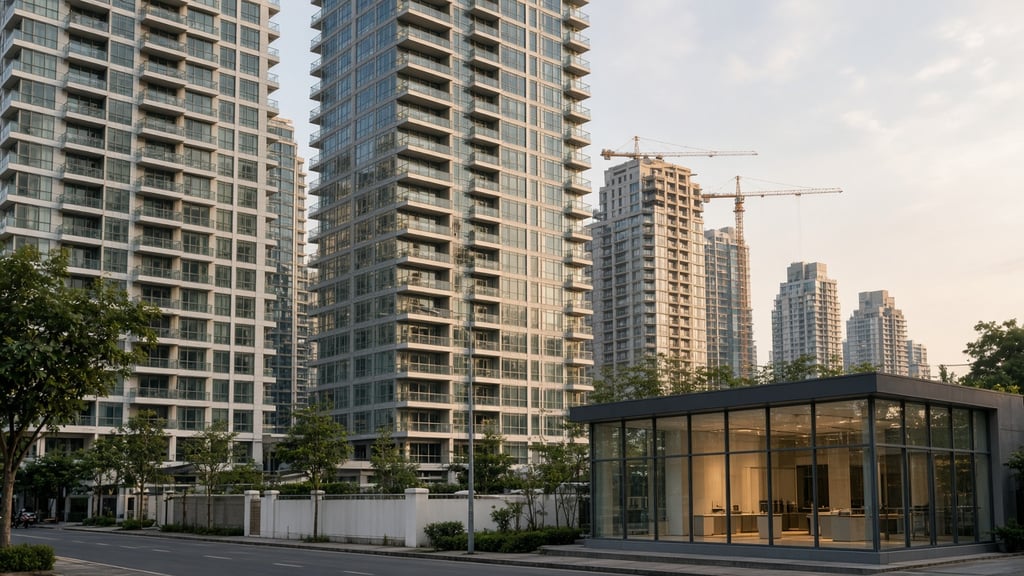
Thailand's economy expanded 2.8% in the first nine months of 2026, the National Economic and Social Development Council reported after a 2.9% third quarter. That print looks like a recovery. It is not the recovery housing developers need. NESDC still guides full-year growth at 2.5% and named real estate among the sectors that kept the rebound uneven. Third-quarter merchandise exports reached US$106.4 billion, up 23.6%. The Board of Investment approved 1,951 projects worth 1.51 trillion baht over nine months. Those flows are filling industrial estates. They are not clearing unsold condominiums in Bangkok.
The Bank of Thailand tried to help the housing side in May, extending a temporary 100% loan-to-value cap through 30 June 2027. Governor Vitai Ratanakorn framed the extra year as support for confidence while demand stayed weak, and stressed that banks remained cautious. Household debt was 16.43 trillion baht in the second quarter, or 85.2% of GDP, down from 86.0% only because output grew faster than borrowing. Outstanding housing loans were 5.13 trillion baht in the third quarter, barely above the prior quarter.
Why the transfer ledger looks healthier than the sales gallery
The Real Estate Information Center counted 243,525 nationwide ownership transfers in the first nine months, up 7.3%, worth 634.2 billion baht, up 2.7%. Condominium transfers rose 12.6% by unit. Second-hand homes did much of the work: 73% of low-rise transfers and 52% of condominium transfers were resales. The third quarter then dropped 10.1% in units after buyers rushed deals before fee-cut measures lapsed. REIC still projects a full-year total of 324,800 units, up 2.7%. New personal housing loans are seen near 564.6 billion baht this year, up just 0.2%, and more than 30% of recent bookings were refinancing, not a first purchase.
Agency for Real Estate Affairs data shows Bangkok developers answering weak mass demand by going upmarket. In the first 10 months they launched 29,792 units, down 15%, while the average asking price jumped 29.1% to 8.30 million baht. AREA forecasts about 36,100 newly launched units for 2026, down 13%. Cushman & Wakefield Thailand research draws the same split: residential demand stays tied to household debt and mortgage approvals, while industrial and data-centre assets track foreign investment. The IMF October 2026 outlook is more cautious than NESDC, putting Thai real GDP at 2.1% this year and next.
Foreign condominium transfers tell a geographic story, not a nationwide one. REIC recorded 9,618 foreign-buyer condo transfers in nine months, down 12.7% by unit. In the third quarter, Bangkok still led by value at 7.57 billion baht but fell 19.8%. Chonburi rose 14.3%. Phuket jumped 60.4% to 2.44 billion baht, with Russian buyers a large part of that lift. Chinese buyers remained the largest nationality by value even as their third-quarter total dropped 36.1%. The Bank of Thailand's third-quarter banking brief called the broader pattern a K-shaped recovery: system-wide loans grew 4.0% on large-corporate books, while SME and consumer loans contracted. Stage 3 non-performing loans were 535.2 billion baht, a 2.82% ratio.
What This Means for Expats and Travelers in Thailand
If you are shopping for a condominium as a foreigner, the long-standing 49% foreign-ownership ceiling under Thailand's Condominium Act still applies to the sellable area of each building. Cash buyers who can close without a Thai mortgage sit in a stronger position than many Thai salaried buyers, because banks are screening household debt more tightly than the LTV cap would suggest. Long-stay residents with work permits or documented retirement income sometimes obtain mortgages, but approval is not automatic even at 100% LTV on paper. Developers sitting on finished stock are offering furniture packages, transfer-fee subsidies, and payment plans, more often in oversupplied Bangkok corridors than in Phuket or parts of Chonburi.
Visitors should not read the 2.8% nine-month GDP print as a signal that condo prices are about to jump. AREA's launch mix is fewer, more expensive units, and REIC's transfer growth is padded by second-hand deals. Bangkok remains the deepest market and the one with the most unsold mid-tier stock. Beach and Eastern Seaboard projects that sell to Russians, Europeans, and some Indian buyers have a different 2026. Land freehold is still closed to most foreigners; a condo title or a long lease is the practical route. Check the remaining foreign quota before you pay a reservation fee.
Comment verification
Step 1 of 3
Verify your email once to publish your comment. Your email is never shown publicly.
Enter the 6-digit code sent to .
Choose the display name shown next to your comments.