Thailand two-tier Ft: homes stay, industry pays
Thailand's ERC is reviewing a two-tier Ft for January-April 2027 that would hold households at 3.86 baht a unit while factories pay 4.73.
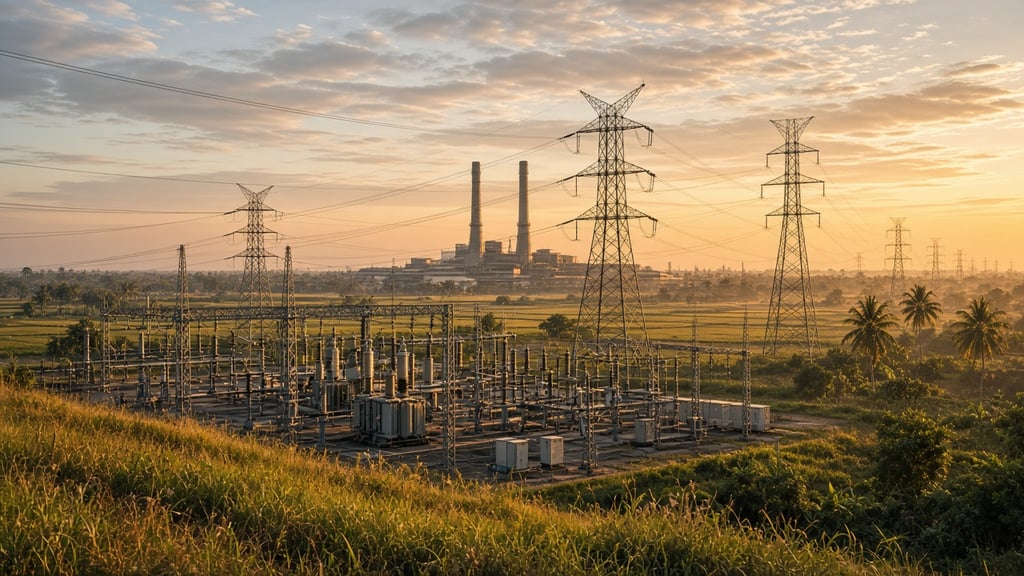
Thailand's energy regulator is weighing a two-tier fuel charge for January-April 2027 that would freeze household power bills while pushing factories, industrial estates and other large users onto a much higher rate. The EGAT draft follows a 13 November National Energy Policy Council decision to treat cheaper Gulf of Thailand gas as a scarce public resource.
The Energy Regulatory Commission reviewed the estimates on 17 November. Secretary-general Poonpat Leesombatpiboon said Gulf gas, after the separation plants, should go first to homes (category 1), small businesses (category 2) and farm pumps (category 7), in volumes meant to stop those bills rising from today's level.
Under that two-tier sketch, households, small businesses and agricultural water pumps would keep an average bill of 3.86 baht per unit. That is the 3.69 baht national base tariff, set under a 15 July council policy after public-service electricity is stripped out, plus a fuel adjustment of only 16.23 satang, the same Ft now printed on household invoices.
Medium-sized factories, large industrial users and specific-business accounts would instead see a fuel charge of 103.34 satang, lifting their average to 4.73 baht per unit. Both Ft figures exclude VAT. The gap of 87 satang per unit is the political core of the proposal: a shielded household band, and a commercial band that absorbs more of the imported-gas bill.
How the two-tier Ft would work
Thailand's Ft is the floating overlay on the base tariff: the fuel-and-purchase overrun (FAC) plus leftovers from earlier rounds (AF), spread across forecast retail sales. A single formula for every meter in early 2027 would set FAC at 78.64 satang and AF at 53.84 satang, a retail Ft of 132.48 satang and an average bill of 5.02 baht per unit.
The same briefing set the pool-gas assumption for January-April 2027 at 433 baht per million BTU, up 19.09 percent from 363.53 baht in the September-December 2026 period. Spot LNG is modelled at 23.40 dollars per million BTU, with the baht at 33.21. Clawback cash from earlier rounds is spent, so it cannot cut the January-April invoice.
Why the gas pool is being pulled apart
The Ft fight sits on top of a gas-price split that took effect on 1 January 2026. Power plants, NGV and general industry buy a Pool Price blending Gulf gas, Myanmar pipeline gas and imported LNG, while gas through the separation plants, including LPG feedstock, stays on the Gulf average. Factory and power users then faced a pool near 287 baht per million BTU against petrochemical offtake closer to 196 baht, a 46 percent gap the 433 baht pool now widens.
Who wins, who loses
The Federation of Thai Industries has already rejected both options. Its 23 November executive board called the two-tier Ft a cross-subsidy that dumps the household freeze onto manufacturers. Vice chairman Isara Rattanadilok Na Phuket said a home freeze should be paid from the budget or clawback funds, not factory invoices, and that data centres and other New Demand should bear the extra LNG they pull into the pool.
Independent power producers, by contrast, have told the regulator they can live with a two-tier Ft if the fuel-cost split is published and audited. The Private Power Producers Association, through vice president Don Thayathan, says a Gulf-gas allocation to homes is cost recovery if the volumes are public, and it wants comparable petrochemical users on the same Pool Price as steel, glass, ceramics and cement plants.
On a strict reading of the draft, households, corner shops and farm pumps win: their average stays at 3.86 baht instead of 5.02. Medium and large industry, including industrial-estate tenants, pay 4.73 baht. Petrochemicals keep an edge if Gulf-linked offtake survives. EGAT recovers part of its 36.43 billion baht from the industrial Ft. PTT sells both Gulf gas and LNG, so it is the pipe, not a simple winner. SPP and IPP plants that burn pool gas will pass the 433 baht assumption into factory bills.
What This Means for Expats and Travelers in Thailand
Anyone billed directly by MEA or PEA on a residential or small-business meter should, if the two-tier draft is adopted, see the same 3.86 baht average plus VAT. That is not a new 3 baht slab. The first 200 household units already carry a special energy charge of no more than 3 baht, set in September 2026, and the Ft sits on top of that structure.
Tenants in apartments and many small hotels will not automatically get that freeze. Those buildings often take a single utility feed and recharge rooms at a private rate. Bangkok and resort-town renters already report landlord markups of 7 to 12 baht a unit against a government rate still under 4 baht. A lower official Ft helps the master bill. It does not rewrite a lease that prices electricity as profit.
Offices, factories, data halls and other medium or large accounts should budget for 4.73 baht a unit excluding VAT if the two-tier path is chosen, or 5.02 baht if the ERC reverts to a single formula. The hearing closed on 24 November. Until the commission sets the billed rate and the gas-price method underneath it, the 3.86 / 4.73 split is a proposal, not an invoice.

Comment verification
Step 1 of 3
Verify your email once to publish your comment. Your email is never shown publicly.
Enter the 6-digit code sent to .
Choose the display name shown next to your comments.