Diesel Gate Cut of 1.73-2.14 Baht to 26 Dec
A Royal Gazette notice cuts diesel ex-refinery prices 1.73-2.14 baht a litre from 1 to 26 December. B7 stays at 2 baht; the pump is not automatic.
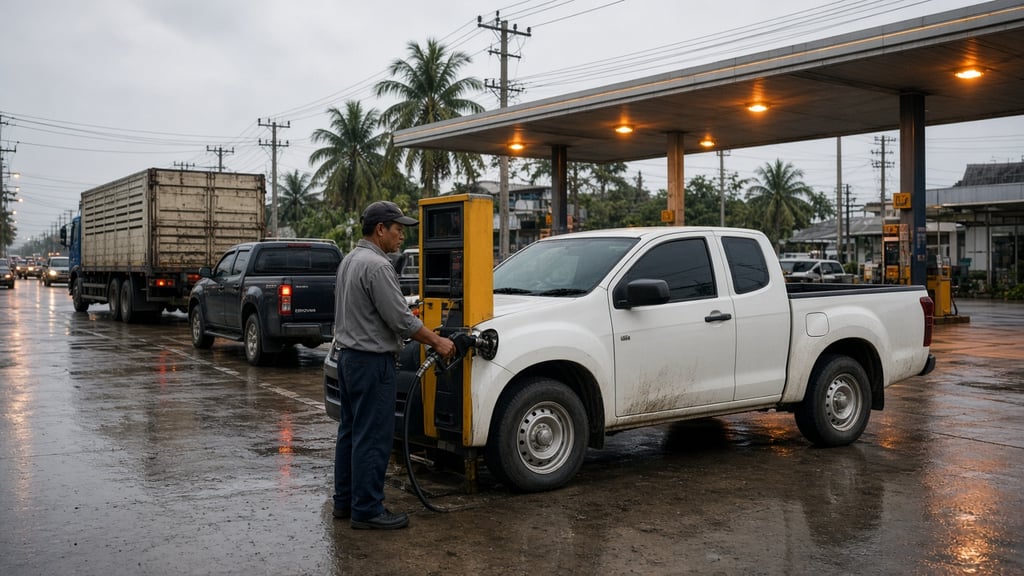
The Royal Gazette on 28 November posted a 26-day instruction to Thailand's refineries, not a sticker for the pump. From 1 December to 26 December, high-speed diesel leaves the gate cheaper by 1.73 to 2.14 baht a litre, depending on the blend. The Energy Policy Administration Committee voted the cuts on 25 November. Energy Policy and Planning Office director Wattanapong Kurovat signed the notice on 27 November.
Three grades sit in the order. B0, the unblended high-speed diesel rarely seen on a public forecourt, falls 2.14 baht a litre. Ordinary B7, the grade that fills most pickups and long-haul trucks, falls 2.00 baht. B20, the 20 percent palm-methyl-ester blend, falls 1.73 baht. November's notice was a flat 2.00 baht on all three. December is the first 2026 window to price the blends apart.
A Gate Cut Is Not a Pump Cut
Thai retail diesel is a stack. Refinery gate, excise, Oil Fuel Fund levy or subsidy, VAT, and a marketing margin all sit between the still and the nozzle. A 2.00 baht gate cut on B7 becomes a pump move only if the Oil Fuel Fund committee leaves its compensation rate alone and retailers pass the wholesale change through. Nothing in Friday's Gazette binds that second meeting.
Bangkok pump boards on 28 November already tell the gap. Standard B7 at PTT and Bangchak in the capital is 39.34 baht a litre after a 0.60 baht retail cut on 25 and 26 November. B20 is 32.90 baht. Premium diesel at 49.05 baht sits outside this notice. Those stickers are Bangkok figures before local fuel tax, and they pre-date 1 December.
If the fund holds November's subsidy path, B7's 2.00 baht gate relief could keep the 39.34 baht board from jumping when the previous 1 to 30 November 2.00 baht notice expires at midnight on 30 November. B20's gate relief shrinks from 2.00 baht to 1.73 baht, a 0.27 baht tightening that the fund would have to offset if the 32.90 baht B20 price is to hold. B0's extra 0.14 baht of relief matters more to industrial and fleet buyers than to a tourist in a rental car.
Emergency Powers, Rolled Over Again
The legal hook is Section 3(1) of the 1973 Emergency Decree on Remedy and Prevention of Shortage of Fuel Oil, plus clause 3(1) of Prime Minister's Order 15/2562 of 4 October 2019. EPAC has used that decree since April to claw refining margins back toward the pump. By late October the ministry said it had already done so eight times, recovering 31.786 billion baht of what it labelled excess refinery profit across 11.058 billion litres of diesel, on top of 64.355 billion baht spent by the Oil Fuel Fund. The 1 to 30 November flat 2.00 baht notice was the next round. Friday's Gazette is the one after that.
The stated reason is unchanged. Conflict in the Middle East among the United States, Israel, and Iran is still disrupting crude and product supply, and domestic fuel prices remain volatile and high. The notice frames the cut as a shortage-prevention tool. It does not add barrels. Bangkok's Bangchak Phra Khanong refinery is already offline after this week's fire, so December's instruction is a margin order in a tighter domestic system, not a supply fix.
The window is shorter than November's full month. December stops on the 26th, five days before year-end, which all but schedules another EPAC sitting before Christmas if the government wants a January successor. A September 4.00 baht gate cut, later halved to 2.00 baht for November, already knocked listed names such as SPRC and Thai Oil when it first printed.
What This Means for Expats in Thailand
Anyone driving a pickup, a camper, or a logistics chain in Thailand buys B7 or B20, not B0. A 2.00 baht gate cut on B7 is real money on a 70-litre tank only if it shows up on the board. Do not budget a 140 baht saving on 1 December until PTT, Bangchak, Shell, and PT reprint the price. Island ferries, fruit trucks, and construction diesel will move food and building costs more than a Bangkok taxi, which still runs on gasohol.
B20 remains the cheaper nozzle at 32.90 baht in the capital. The smaller 1.73 baht gate cut is the one to watch. If the Oil Fuel Fund does not top up the B20 subsidy, that 0.27 baht gap versus B7's relief is where a quiet retail uptick could appear. Provincial prices already differ by local tax and haulage. A Chiang Mai or Phuket sticker is not the Bangkok 39.34 baht figure.
The measure expires on 26 December. Anyone filling a generator, a yacht, or a farm tank for New Year should treat the discount as a 26-day instrument, not a 2027 policy. After 26 December the gate reverts unless EPAC gazettes again. That calendar matters more than the 1.73 to 2.14 baht range in the headline.

Comment verification
Step 1 of 3
Verify your email once to publish your comment. Your email is never shown publicly.
Enter the 6-digit code sent to .
Choose the display name shown next to your comments.