Thai court: NBTC chair Sarana already vacated
Thailand's Supreme Administrative Court says Dr Sarana Boonbaichaiyapruck has already left the NBTC chair, so no extra removal order is required.
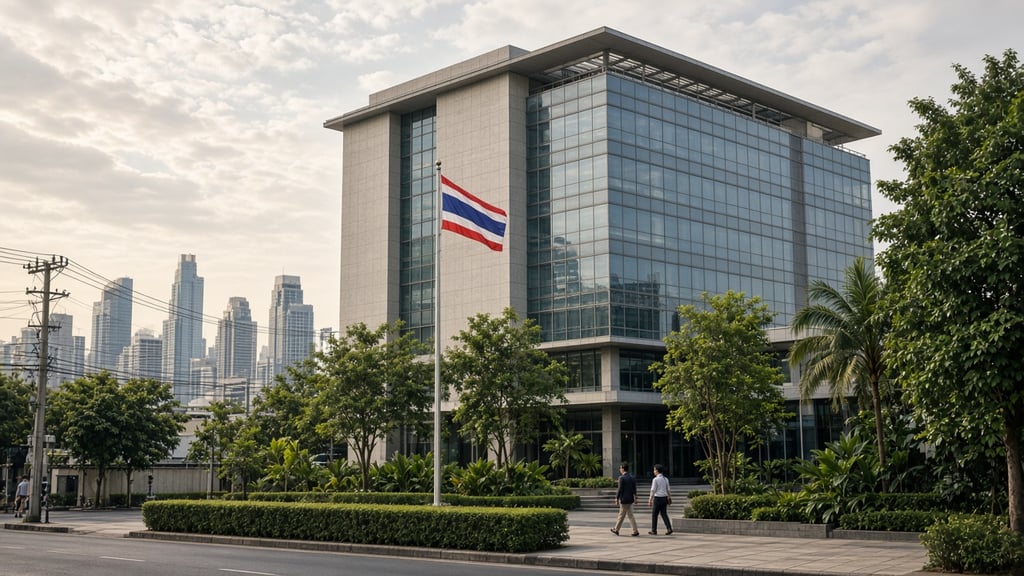
Thailand's Supreme Administrative Court treated the National Broadcasting and Telecommunications Commission chairmanship as already vacant on 27 November 2026. In black case A.1835/2569 it refused the NBTC selection committee's request for a second order telling Clinical Professor Dr Sarana Boonbaichaiyapruck to stop sitting as chairman. The judges said that extra instruction would duplicate work the law had already done.
The selection committee's Ruling No. 1/2569, dated 21 July 2026, had found a prohibited characteristic and treated Dr Sarana as having waived the consumer-protection commissioner seat that carries the chair. Once that ruling was notified to him, he could not keep acting as commissioner or chairman unless the ruling is revoked, expires, or otherwise falls away. Remaining commissioners may keep working. A new consumer-protection member still has to be selected under the statute.
How a hospital roster became a vacancy
The dispute turns on a short window in early 2022. The selection committee found that Dr Sarana, a cardiologist, continued hourly paid clinical work at Mahidol University's Faculty of Medicine Ramathibodi Hospital from 8 January to 12 April 2022. Royal appointment as NBTC chairman followed on 13 April 2022, after Senate approval. Under Section 8(2) of the 2010 Frequency Allocation Act, commissioners may not be employees or contractors of state agencies, nor sit as directors or advisers to those organisations.
The panel treated the Ramathibodi hours as a prohibited state-employee role and, under Section 18, as a waiver of the Senate-endorsed seat. Commissioners are expected to serve full-time. Public pay scales put ordinary commissioners at 360,000 baht a month and the chairman at 450,000 baht. Dr Sarana's appeal says Mahidol accepted his resignation effective 8 January 2022 and that leaving office still requires a royal command under Section 20. The Central Administrative Court dismissed his revocation lawsuit on 25 September 2026. That merits fight is still on appeal.
What Friday's order did and did not decide
The Supreme Administrative Court pointed back to its earlier order 952/2569. The July ruling is an administrative order under Section 5 of the Administrative Procedure Act B.E. 2539 (1996), and final at the administrative level under Section 15/1 of the Frequency Allocation Act. Once the selection committee notified Dr Sarana, Section 42 of the Administrative Procedure Act made the order binding unless it is revoked, expires, or otherwise falls away. Senate endorsement does not cancel a later finding of a prohibited characteristic.
Thai administrative litigation, as summarised in Thai Visa Centre's Administrative Court guide, reviews government orders in a forum separate from ordinary civil courts. A pending appeal does not, by itself, suspend the order. The selection committee asked for that extra freeze on 17 November 2026. The court declined it under Rules 76 and 116, because the July ruling had already done the work. Remaining commissioners may function as the commission.
The Constitutional Court track sits beside the appeal
On 21 October 2026 Dr Sarana asked the Supreme Administrative Court to pause the main judgment and send legal questions to the Constitutional Court. He argues that reading hourly clinic work as a state-employee ban restricts honest medical practice, and that the panel stretched its power by reopening qualifications years into the term. Friday's order did not decide those constitutional points. The chair is vacant as a matter of administrative effect today. The deeper fight over whether the July ruling was lawful remains open. Board votes taken by the remaining commissioners are the live track.
A board that has been meeting in fragments
Twelve board meetings since July collapsed when some commissioners refused to sit under Dr Sarana, citing the risk that later court findings would taint spectrum, satellite, and broadcasting votes. The remaining six have held special sessions, with Assoc. Prof. Dr Supach Supachalasai chairing on seniority. His own term is approaching the statutory age limit at the end of 2026, so even the acting gavel is on a clock.
Files in the backlog include satellite licensing around the Thaicom 4 / IPSTAR wind-down, later 5G spectrum steps, and leftover True-DTAC merger remedies. Wikipedia's NBTC entry records how the 2022 combination reduced Thailand's mobile market to a two-player field. Those files can now move under a board composed of whoever remains, even while the consumer-protection seat stays vacant.
What This Means for Expats and Travelers in Thailand
SIM registration, tourist-SIM rules, prepaid identity updates, and drone radio licences all run through the NBTC. A board that can meet again is more useful than a board arguing over who holds the gavel. Do not assume a pending appeal freezes an administrative order. Thai administrative orders typically take effect on notification unless a court grants a specific stay.
Watch the consumer-protection commissioner selection more than any unofficial acting-chairman title. That is the vacancy the court said must be filled under the statute. If you are waiting on an NBTC equipment permit, SIM re-registration, or a drone frequency filing, keep the paperwork live. The chairmanship fight is no longer a reason for the rest of the board to sit idle.


Comment verification
Step 1 of 3
Verify your email once to publish your comment. Your email is never shown publicly.
Enter the 6-digit code sent to .
Choose the display name shown next to your comments.