Chula DNA: tilapia spread from Phetchaburi
Chulalongkorn's second DNA paper maps blackchin tilapia's Central Thailand invasion to Phetchaburi and multiple introductions, not a single Samut Songkhram escape.
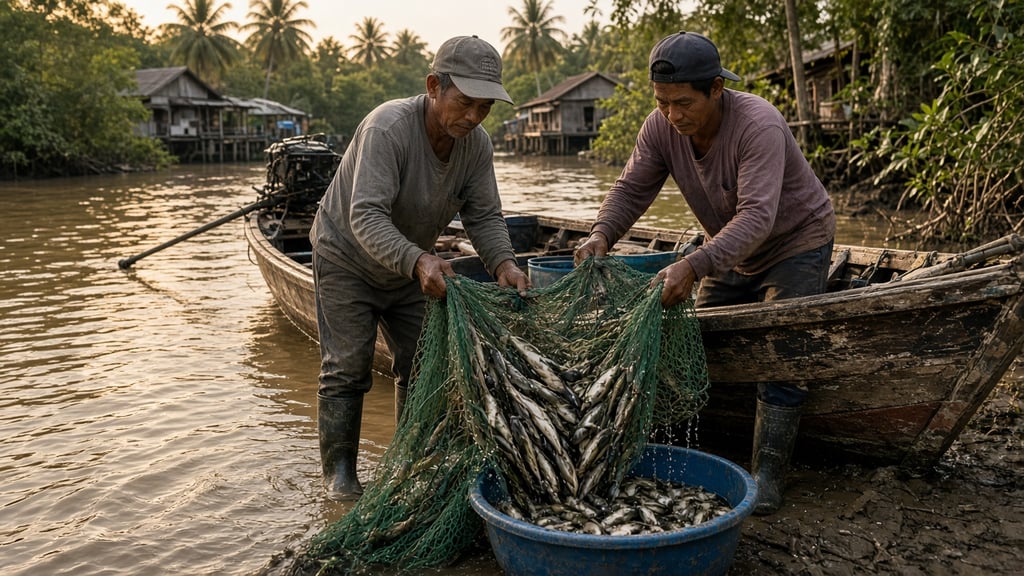
A second Chulalongkorn University DNA paper has redrawn Thailand's blackchin tilapia map. The fish crowding canals from Samut Sakhon through Bangkok and Samut Prakan did not simply drift from Samut Songkhram, where the invasion was first logged in 2012. Nuclear markers point to Phetchaburi, and to more than one introduction from West Africa.
The study appeared on 22 October 2026 in Conservation Genetics (volume 27, article 120). Lead author Porntep Punnarak, of the Aquatic Resources Research Institute, worked with Voranop Viyakarn, Suchana Chavanich, Piamsak Menasveta, Jessada Denduangboripant, and Sanit Piyapattanakorn. Denduangboripant flagged the paper to Thai readers this week. The genetics are public. Who moved the fish is still a live political fight.
Too mixed for one founder dump
Blackchin tilapia is a West African cichlid that lives in fresh, brackish, and coastal water and mouths its young. In Thailand it outcompetes native fish and wrecks shrimp and cockle ponds. A private company legally brought 2,000 fry from Ghana in December 2010 for trials at Yisan, Samut Songkhram. Most arrived dead. The rest were reported destroyed within weeks. Wild fish turned up around Yisan in 2012. That timeline still drives House hearings, a class-action case in the Bangkok South Civil Court, and public argument over Charoen Pokphand Foods.
A single small shipment should have left a bottleneck: few barcodes, almost the same genome everywhere. The wild stock does not look like that. Across 10 microsatellites the team scored 160 alleles. Forty-three sit in only one local population. Seventy-eight never appear in the Samut Songkhram sample. Mean allele counts run from 4.100 in Rayong to 8.100 in Samut Songkhram. Observed heterozygosity is 0.4450-0.6400. Genetic distance between populations is 0.060-0.344. Principal-coordinate, FST, and AMOVA tests all show strong structure.
COI from 26 fish matches S. melanotheron melanotheron. The team's first paper, using mitochondrial DNA from 466 fish at 20 sites, found 19 haplotypes, 13 private, with links to Ghana, Cote d'Ivoire, and other West African stock. Mitochondrial DNA is a maternal tag. Microsatellites read both parents. Together they describe several entries, not one leak.
The Phetchaburi corridor
Loci UNH216, UNH159, and UNH169 separate Samut Songkhram from its neighbours even though the waterways connect. Admixture clustering does not show those fish riding the tide across the gulf. The route that feeds canal populations, and stocks in Samut Sakhon, Bangkok, and Samut Prakan, tracks back to Phetchaburi.
Canal samples sit apart from provincial samples, then split into two canal subgroups. The authors read that extra mixing as a human fingerprint: ornamental trade, pond transfers, and other live-fish movement, not only floods. Prachuap Khiri Khan, Surat Thani, and Rayong also fail a simple swim-from-Yisan story. Limited farm transfers, including mixed shrimp culture, remain possible.
The Department of Fisheries banned import, export, and culture in 2018. By then ornamental exporters had shipped hundreds of thousands of fish abroad, and the wild front had reached the central plain, the east, and the upper south. A 2020 departmental screen with five microsatellites had already hinted at two or three genetic groups.
What the genes do not decide
DNA can show several West African sources, and that Phetchaburi is the better match for Bangkok's canal invasion. It cannot stamp a company name on each haplotype. The 2010 Ghana permit is still on record, as are Fisheries notes that 11 firms exported about 230,000 blackchin tilapia to 17 countries in 2013-2016, before the ban. CPF told a House panel the fry died, were chlorinated and buried, and that samples went to the department. The department has at times said it has no matching receipt.
Control work is on a different clock. Fisheries has been breeding sterile tetraploid (4n) fish so wild matings yield no recruits, and has used barramundi as a predator. Labs have tested environmental DNA that can flag a new canal early. The genetics paper argues for holding numbers down, because tropical water lets this species bounce back after a failed wipeout.
What This Means for Expats and Travelers in Thailand
Boat hires on the Phetchaburi, Mae Klong, and Tha Chin systems, and canal walks in Thonburi or Samut Prakan, sit inside an active invasion. The fish are edible and cheap in some markets. They are a farm pest, not an attraction. Do not move live fish, even as bait or aquarium stock, between canals or provinces. The 2018 ban still covers import, export, and farming.
If you keep ornamental cichlids, ask for legal species names and keep tanks closed. If you fish, kill and cook or bin blackchin tilapia rather than returning them. The second DNA paper changes the invasion map. It does not close the lawsuit, and it does not make Bangkok's klongs fish-free.


Comment verification
Step 1 of 3
Verify your email once to publish your comment. Your email is never shown publicly.
Enter the 6-digit code sent to .
Choose the display name shown next to your comments.