Songkhla police intercept live grenade in parcel
Chana investigators pulled a live South Korean K413 grenade off a Ban Na courier belt on 28 November after a Pak Nam waybill led to an empty house and a phone that went dead.
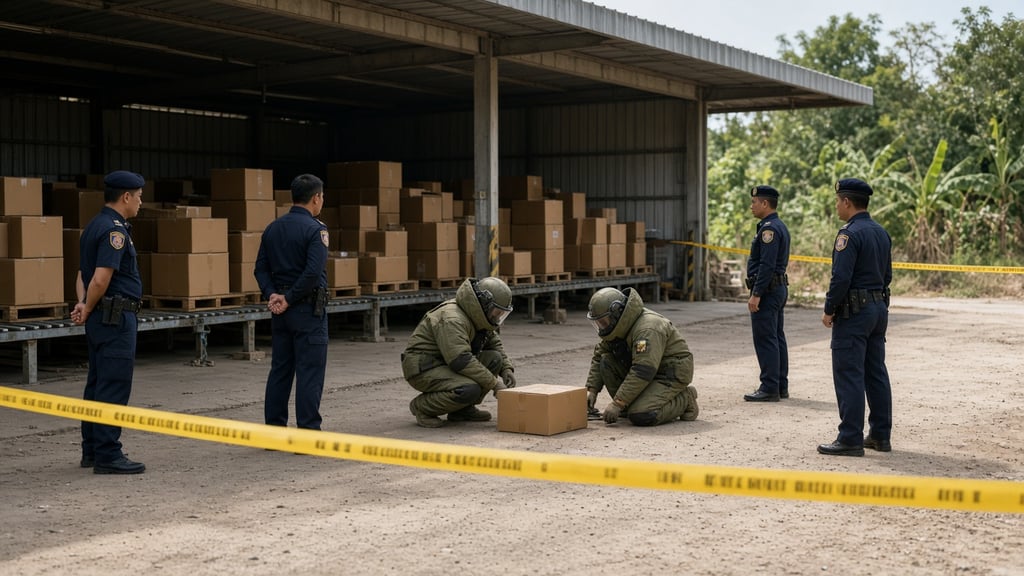
A private courier belt in Ban Na, Chana district, became a controlled bomb scene at about 11:30 on 28 November 2026. Chana investigators had a tip that an explosive was moving through ordinary parcels. At the local sort point they pulled one carton whose waybill began 05S-12171. The sender line named a shop in Mueang Samut Prakan, the river-mouth city still called Pak Nam. The addressee was a house in Chana.
Police in delivery kit took the box to that house. It was empty. The mobile printed on the label rang out, then shut down. Songkhla provincial EOD opened the carton under control and recovered one South Korean K413 fragmentation grenade, lot 24K601-001, classed as ready for use. The named recipient, listed as Kantayut, has not been found. The origin shop was partly redacted in public accounts as Suea. The hunt is now for both ends of the waybill.
How the intercept actually ran
This was not a random X-ray hit. A specific warning reached Chana's investigation desk, and officers went to the Ban Na depot looking for a marked box. Once they had it, they ran a controlled delivery instead of cutting the tape on the warehouse floor. They wanted the person who was supposed to sign, and they treated the contents as live before EOD confirmed the model.
The empty house and the dead phone are the operational facts that matter. Whoever booked the run either used a disposable address or got a warning in time to walk away. Either way, the parcel network had already carried a military-spec grenade from the gulf seaboard into a southern district that security planners still treat as distinct from Hat Yai.
A factory grenade, not a roadside charge
The K413 is South Korea's standard defensive fragmentation grenade, a lighter successor to designs related to the US M67. Technical sheets put it at about 260 grams, with a 62-gram Composition B fill, a K414 delay fuze of 4 to 5 seconds, and a casualty radius in the 10 to 15 metre band. Ready for use means this was not a dummy or a stripped souvenir. It was a fused round that should never have been on a commercial conveyor.
Lot 24K601-001 now sits at the centre of the tracing work, with the origin shop, the two phone numbers, and whatever identity scan the drop-off counter did or failed to do. A Korean-made military grenade in a Samut Prakan carton is a supply-chain problem as much as a local crime sheet. ISOC faced the same method in October 2025, when a Bang Klam courier hub in the same province intercepted 40-millimetre grenade rounds booked from Narathiwat toward Mae Sot under false names.
Why Chana is not Hat Yai
Songkhla's four southern districts, Chana, Thepha, Na Thawi, and Saba Yoi, have sat under Internal Security Act restrictions in official summaries, a notch below martial law. Foreign travel advice still splits the province: Hat Yai and Songkhla city are treated as ordinary tourist ground, while those four districts remain in the warned belt. Chana is the one of the four that does not share a border with Malaysia or Pattani, which is why a parcel arriving there from Pak Nam is a domestic pipeline, not a frontier smuggle.
Seventeen days before this intercept, bombs hit roadside power poles in Sadao, in Chana's Na Thap area, and on the Na Mom-Chana boundary. None of that proves who booked this grenade. It does explain why a live K413 on a Ban Na belt is a security event, not a lost industrial sample.
The ID-card rule that was supposed to stop this
Thailand Post has required senders to show a national ID, a card bearing a personal number, or a passport since 8 April 2016, after Cabinet narcotics notices pulled parcel operators into the same identity net as other high-risk businesses. The aim was to stop strangers borrowing cards to push drugs or weapons through the mail. Private couriers copied the paperwork, but not evenly. 7-Eleven's SPEED-D terms demand a real ID and a smart-card read. Kerry Express terms say a sender must hand over ID, yet the company's shop-drop FAQ still says ID is required at agent stores, not at KEX-owned counters.
That uneven door is the policy story. Either a counter scanned a real card for a shop that will now be easy to find, or nobody scanned anything useful and the waybill is a costume. Investigators have the origin line, the phones, and the lot stamp. What they do not yet have, in public, is a named sender in custody.
What This Means for Expats and Travelers in Thailand
Hat Yai hotels, night markets, and the Padang Besar or Sadao crossings are not this scene. Chana's Ban Na sort point is. If your itinerary stays in Hat Yai or Songkhla city, treat the four southern districts as a different security map, not a reason to cancel dinner. If you drive toward Pattani, expect more checkpoints, and do not linger beside them. Check insurance wording against your government's list; several advisers name Chana, Thepha, Na Thawi, and Saba Yoi even when they green-light Hat Yai.
Do not accept or open a parcel you did not order, in any province. If a courier asks you to take a box for a neighbour who is "not home," refuse. Staff at shops and 7-Eleven counters should keep asking for ID on outbound parcels. Report an abandoned carton to the shop, then leave the area. ISOC Region 4 still publishes 1341 as a round-the-clock tip line for the far south. The next facts that matter are the sender's ID scan, CCTV at the Pak Nam drop-off, and the person who was supposed to pick up the box.
Comment verification
Step 1 of 3
Verify your email once to publish your comment. Your email is never shown publicly.
Enter the 6-digit code sent to .
Choose the display name shown next to your comments.