Thai Navy Warns Over Frigate Tender Claims
The Royal Thai Navy denied political direction in a 17-billion-baht frigate retender and warned it will sue over unfounded claims.
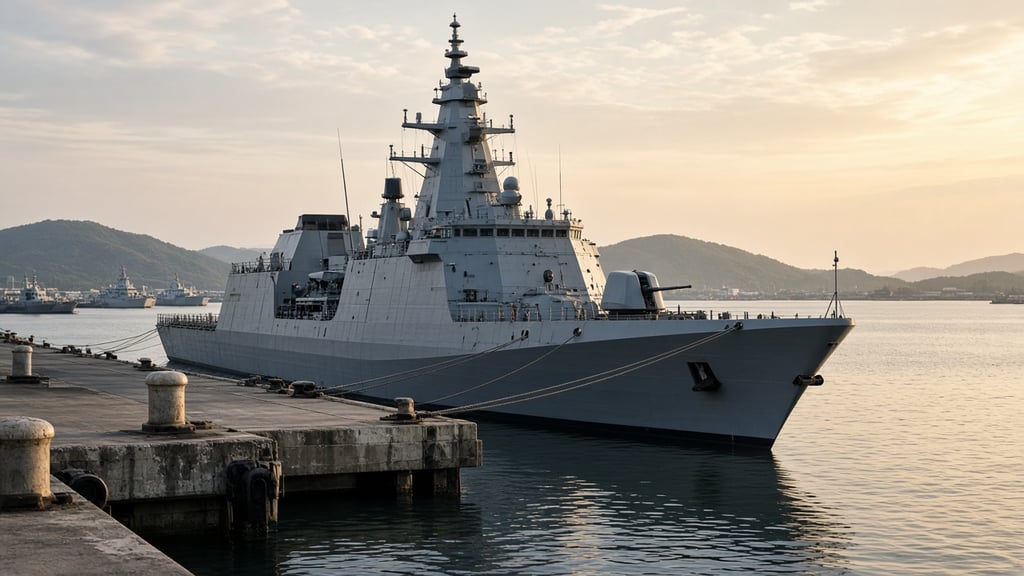
The Royal Thai Navy issued a rare public warning on Saturday, 28 November 2026, rejecting claims that its frigate purchase is being steered by political patrons. The service said it follows Thai procurement law, not private instructions, and reserved the right to sue anyone who spreads false or damaging claims about the programme or its commanders.
The warning landed after weeks of argument over a cancelled 17-billion-baht tender for one high-performance frigate. In September the Navy named South Korea's Hanwha Ocean as the selected yard at 16.73 billion baht. No contract was signed. A Finance Ministry appeals panel then ordered the round scrapped because the terms of reference failed to set a required value for bidders' previous shipbuilding work.
A legal reset, not a quiet kill
Under the 2017 Public Procurement and Supplies Administration Act, a Comptroller General's Department appeals ruling is final. The Navy has said it must obey that ruling. Finance circular Wor 214 limits any past-performance threshold on non-construction work. If a past-work value is set at all, it cannot exceed 50 percent of the budget, or 8.5 billion baht on a 17-billion-baht buy.
Navy spokesman Rear Adm. Chanin Sriyapai told the public in mid-November that the original paperwork asked yards only to show a prior frigate-building contract, without a baht figure. The service later accepted that this did not match the circular. Officers argued that no high-end frigate exists at 8.5 billion baht, so writing that number into the terms would have been empty. The appeals board still required a compliant rewrite.
The cancellation dissolved the old project, terms-of-reference, procurement, and offset committees. Adm. Nares Wongtrakul, the Navy commander, appointed a fresh project board chaired by Chief of Staff Adm. Tepparit Laplua. The first ship's budget must be committed before the fiscal envelope expires in September 2027, or the money returns to the Treasury.
Parliament, industry, and a Korean protest
House Military Affairs Committee chair Ekkarat Udomumnouy, a People's Party MP, has treated the reset as more than a paperwork error. His panel sent the Comptroller General's ruling to the National Anti-Corruption Commission and warned that a cancelled open tender could reopen a government-to-government path, the same channel that has shadowed the Navy's Chinese S26T Yuan-class submarine buy. Social pages also targeted the commander personally. Saturday's statement answered those attacks: criticism is welcome if it is factual; unfounded damage to the service or its leaders will be tested in court.
The contest is industrial as well as legal. Six yards bid: Hanwha Ocean and HD Hyundai Heavy Industries of South Korea, Spain's Navantia, Singapore's ST Engineering, and Turkey's TAIS and ASFAT. Rivals advertised much higher Thai-yard content than the 20 percent local-work floor in the original terms. Hyundai floated about 40 percent on the first hull. Navantia and the Turkish yards advertised a first ship built entirely in Thailand. Hanwha, which built HTMS Bhumibol Adulyadej at the old Daewoo yard, was the only remaining qualified bidder before the award was voided. A Thai industry consortium appealed. Hanwha has asked Thailand's Ombudsman to review the cancellation. The Navy says every qualified yard may bid again.
Three frigates, eight on the whiteboard
The Navy's long-term plan still talks about eight frigates. Parliament funded the first hull at about 17.5 billion baht in mid-2025. A matching second ship was stripped from the FY 2027 defence bill and pushed to FY 2028. Today the fleet has three frigates: Bhumibol Adulyadej, commissioned in 2019, and the 1995-vintage HTMS Naresuan and HTMS Taksin. Bhumibol Adulyadej spent years in the yard after diesel-engine trouble, a sore point because the same Korean builder just won, then lost, the follow-on hull. Commanders say the engines are back in. Critics on Thai forums still ask why a 15-billion-baht flagship needed a rebuild inside a decade.
That distrust sits on older ground. The 13.9-billion-baht S26T submarine ordered from China in 2017 missed its 2023 delivery after German MTU engines could not be supplied under a post-1989 embargo. Bangkok later accepted a Chinese CHD 620 engine, an eight-year warranty, and 200 million baht in compensation. About 7.7 billion baht has already been paid, with 5.5 billion still due from FY 2028. Saturday's legal warning is the Navy's attempt to stop the frigate file from becoming the next submarine-style political wound.
What This Means for Expats and Travelers in Thailand
This fight will not change visa rules, airport queues, or ferry schedules. It does matter for anyone who lives here, pays tax here, or moves cargo and people across the Gulf of Thailand.
Sattahip remains the Navy's main eastern base and the stated delivery point for the new hull. Visitors to Chon Buri and the eastern seaboard already share waters with patrol craft, commercial shipping, and weekend sailors. A delayed frigate does not close beaches, but it does stretch an ageing surface fleet that the Navy says is already short of combat ships for Gulf and Andaman duties, including search and rescue and fisheries patrols that sit alongside the high-end war-fighting case.
Taxpayers, including foreign residents who file in Thailand, are on the hook for 17.5 billion baht on the first ship and a second hull of similar size if FY 2028 funding returns. If the retender slips past September 2027, that first appropriation can lapse. If it is rushed into a government-to-government deal, the public argument will be about oversight, not just price. Neither outcome is a beach problem. Both are a governance problem in a country that still spends public money on ships while the Chinese submarine remains unfinished and the current flagship has only just returned to sea.


Comment verification
Step 1 of 3
Verify your email once to publish your comment. Your email is never shown publicly.
Enter the 6-digit code sent to .
Choose the display name shown next to your comments.