Anutin Sets Three ACMECS Priorities in Hanoi
Prime Minister Anutin used the Hanoi ACMECS summit to press missing road and rail links, joint action on toxic rivers and online scams, and a Mekong development fund as Thailand takes the 2027-2028 chair.
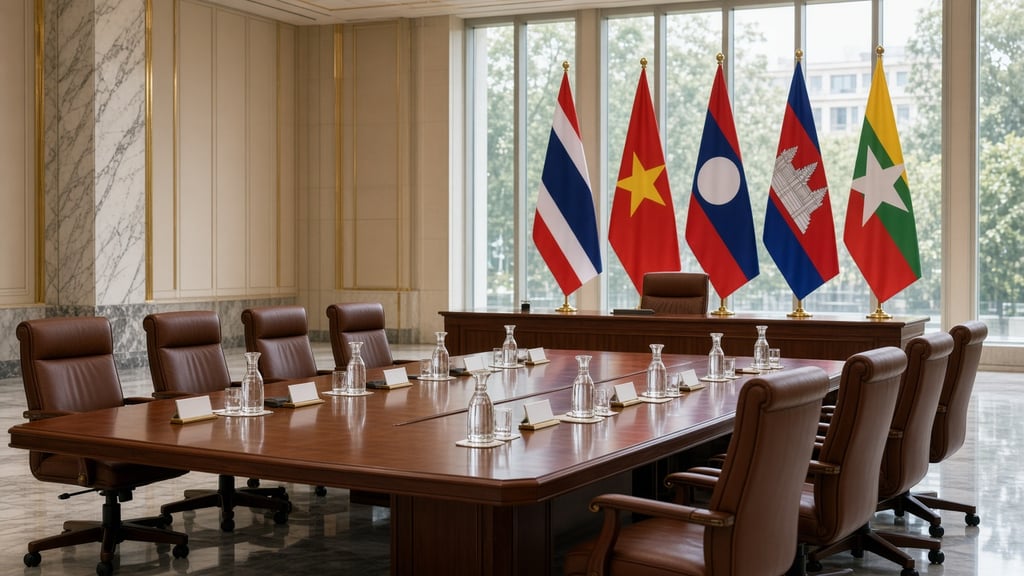
HANOI: Prime Minister Anutin Charnvirakul used Saturday's 11th ACMECS summit to tell Cambodia, Laos, Myanmar, and Vietnam that Thailand wants the Mekong club to close missing transport links, confront toxic rivers and online fraud together, and put money behind those pledges through a dedicated development fund.
The address came in meeting room 339 of the Vietnam National Convention Center, under the summit theme of strengthening socio-economic development toward a smart and sustainable ACMECS. Myanmar President Min Aung Hlaing, Lao Prime Minister Saleumxay Kommasith, Cambodian Prime Minister Hun Manet, and Vietnamese Prime Minister Le Minh Hung sat with the Thai leader as Vietnam hosted the session with Myanmar still holding the outgoing chair.
Thailand launched ACMECS in 2003 as a grouping of the Ayeyawady, Chao Phraya, and Mekong basins. Government House said the five states now have to set their own course while major-power rivalry reshapes trade and investment. Anutin, who is also interior minister, took the rotating chair for 2027 and 2028 after the leaders spoke. The summit then adopted the Nay Pyi Taw Declaration and terms of reference for an ad-hoc task force to review ACMECS priority projects.
Roads, rails, and a digital market
Bangkok's first cooperation track is physical and digital connectivity. The Prime Minister's Office said Thailand wants unfinished road and rail stretches closed so goods can move across the five borders with fewer breaks. A new ACMECS master plan is meant to help firms reach buyers through digital channels and to apply artificial intelligence to raise productivity. Anutin's briefing tied that market-opening work to security, arguing that trade corridors only hold if people trust them.
Vietnamese Prime Minister Le Minh Hung, hosting in Hanoi, pressed a matching connectivity agenda: linking production hubs, cities, ports, and border gates along the North-South, East-West, and Southern economic corridors. Leaders reviewed the grouping's three standing pillars of hard infrastructure, soft infrastructure, and people-to-people ties, which Thai officials said will stay in the next master plan.
Toxic rivers, haze, and scam syndicates
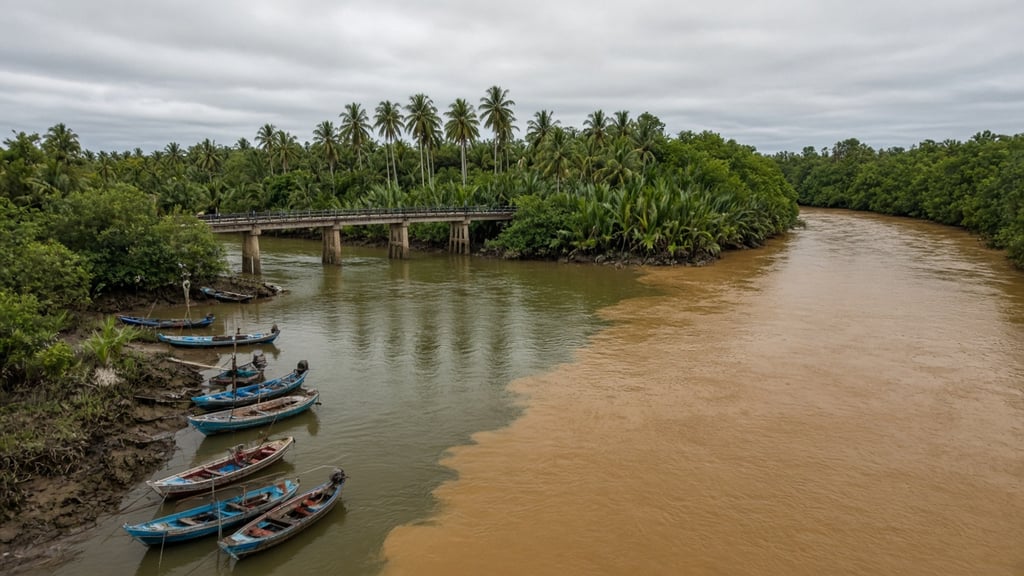
Cross-border water pollution is the second track, and the one that lands hardest in northern Thailand. The Prime Minister's Office put more than 20,000 households and more than 100,000 rai of farmland at risk. Thailand and Myanmar have agreed to install six water-quality stations on the Kok and Sai rivers, which enter Chiang Mai and Chiang Rai from Shan State. Bangkok asked ACMECS to work with national agencies, the Mekong River Commission, and development partners on joint monitoring, pollution detection, and a cross-border alert system, plus responsible mining to protect drinking water, livelihoods, and food safety.
The same chair brief treats seasonal haze, the PM2.5 that settles on Chiang Mai, Chiang Rai, and much of the north each dry season, as a shared file rather than a domestic nuisance. Thai officials said the next master plan should keep the three original pillars and add water management, transboundary smoke, transnational crime, and the digital shift as live problems the five governments cannot farm out to a single ministry.
The third cooperation file is online scam syndicates and the money that follows them. Thailand cited its role in helping more than 10,000 people from nearly 50 nationalities return home after raids on online-fraud compounds. Bangkok pointed to work with the United Nations Office on Drugs and Crime and to the Bangkok Blueprint, launched when the International Monetary Fund and World Bank met in the capital, which is meant to harden banks against fraud. Thailand proposed an ACMECS Taskforce on Online Scams to coordinate police work and trace illicit funds across the five borders.
A development fund and the 2028 double chair
As incoming chair, Thailand said it will finish a new five-year ACMECS master plan from 2028, building on a task force Myanmar set up during its term, and push for an ACMECS Development Fund so pledged projects can be financed rather than restated at the next summit. Bangkok also wants a stronger interim secretariat working with the Mekong Institute in Khon Kaen, plus a Bangkok Steering Committee of member-country embassies and development partners to keep work moving between leader meetings.
Thai officials added a clean-energy strand that would turn surplus farm produce into bioenergy, and said ACMECS should be a base for South-South work with ASEAN members and BRICS partners. In 2028 Thailand is due to chair both ACMECS and ASEAN, a coincidence Government House wants to use to tie subregional projects to the ASEAN Community Vision 2045. A later Mekong-Lancang meeting with China is already on the calendar for water, river toxins, and crime.
Sunday's programme sends Anutin into separate talks with the presidents of Myanmar and Vietnam before the delegation returns to Bangkok. Those two meetings are the first test of whether the Hanoi language on mines, money trails, and missing rail links survives contact with the governments that sit on the other bank.
What This Means for Expats and Travelers in Thailand
Visitors and residents in Chiang Rai and Chiang Mai should keep treating the Kok, Sai, and connected waterways as a live health story, not a closed environmental file. Rafting, river swimming, and riverside dining remain local judgement calls until monitoring data is public and consistent. Northern haze season is now an ACMECS agenda item, which does not by itself clear the air in February and March.
Cross-border job offers, crypto desks, and "easy work in a special economic zone" remain high-risk for tourists and short-stay workers who enter Thailand and are moved toward compounds in Myanmar or Cambodia. A regional task force, if stood up, would matter more for tracing stolen funds than for same-week rescue. Overland travelers using Mae Sot, Mae Sai, Chong Mek, or Aranyaprathet should not assume new rail or faster customs because leaders endorsed a master plan.
Comment verification
Step 1 of 3
Verify your email once to publish your comment. Your email is never shown publicly.
Enter the 6-digit code sent to .
Choose the display name shown next to your comments.