Ranong Democrats meet armed Myanmar troops
Democrat MPs inspecting Kra Buri mining runoff in Ranong were watched by armed Myanmar soldiers, then told to leave the bank as two-tone water still marked the border.
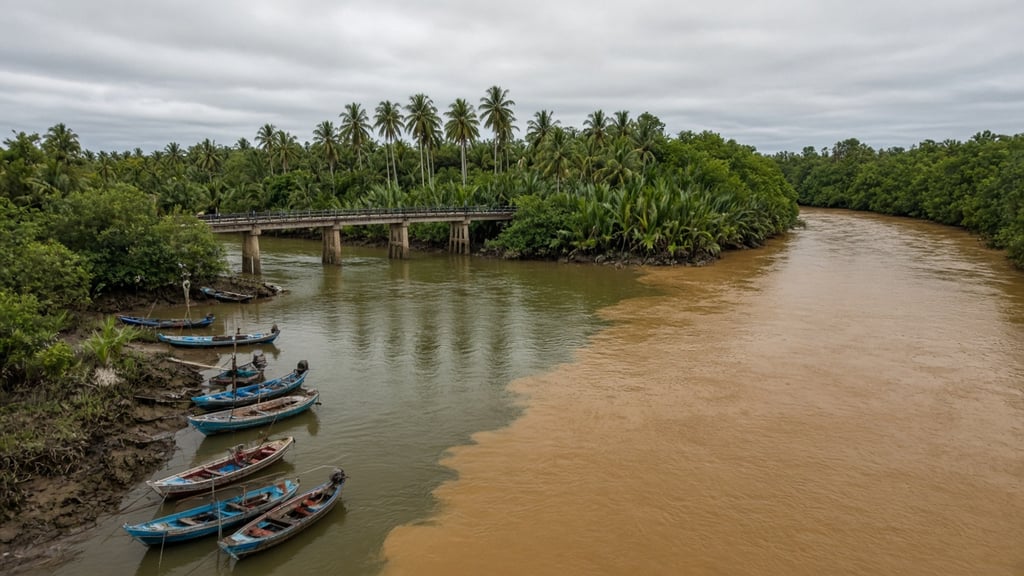
Democrat Party deputy leaders inspecting a six-year pollution complaint on the Kra Buri River were ordered off the Thai bank on 28 November after armed Myanmar soldiers appeared on a bridge across the water and chambered their rifles.
Around 12:30, party-list MPs Satit Wongnongtoey and Chaichana Dechdecho, Democrat deputy leaders travelling with spokesman Pongsakorn Khwanmueang and deputy spokesman Duangruthai Buakaew, stood at Pak Kra in Ban Hat Tun, Pak Chan subdistrict, Kra Buri district, Ranong. They were with Pak Chan chief Wirasingh Khotsingh, Mamu chief Chotichatchawan Limsaenguthai, villagers, and a Thai military escort. The stop was meant to show a two-tone confluence blamed on upstream mining near Kawthaung since 2019.
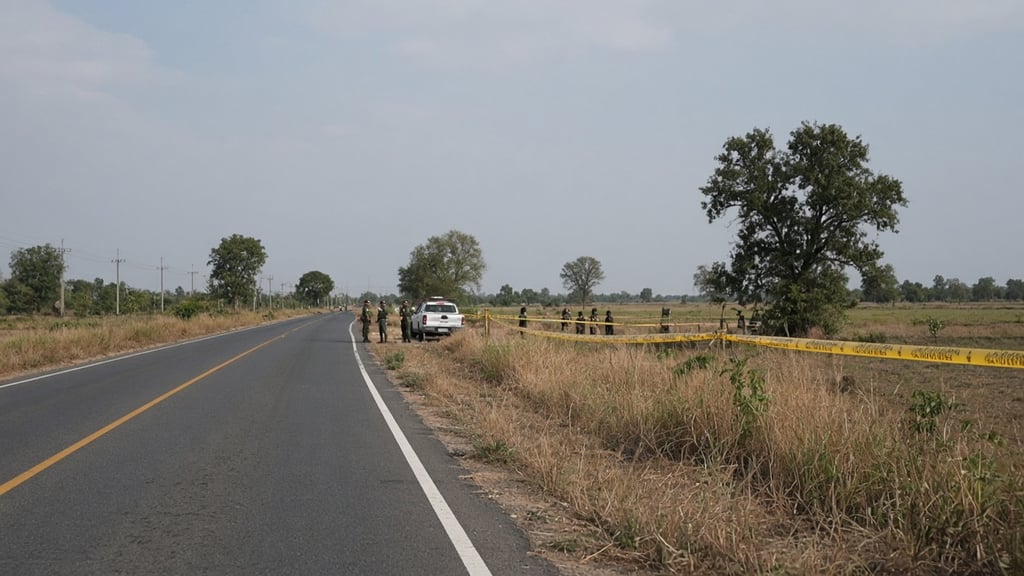
While Satit was still speaking to reporters on the Thai canal bank, Myanmar troops carrying AK-47 rifles and a rocket-propelled grenade launcher walked onto the opposite span, chambered their rifles, and took up a watch. Thai soldiers told everyone to leave. No shots were fired. The visitors departed at once. Thai troops said they had not seen a display like that at this crossing before. Satit said the group had been standing only a short distance from the Myanmar bank, and he could not tell whether the move was meant as intimidation or a signal. He asked the government not to shrug it off, given that former MPs and local chiefs with a Thai military escort had just been met this way.
Two-tone water at Pak Kra
Pak Kra is where Khlong Kranai, flowing on the Thai side from the Chumphon hills, meets a darker channel coming out of Myanmar. One arm still looks green and relatively clear. The other is a thick ochre plume. Once they mix, the stain continues down the Kra Buri, the Thailand-Myanmar boundary river that runs about 60 kilometres to a wide Andaman estuary between Ranong town and Kawthaung.
Local administrators say Kawthaung has acknowledged tin and antimony mining a few kilometres from the confluence, with opened hillsides shedding sediment into the creek. Ore, they say, has moved by boat into Ranong, then to Laem Chabang, then to China. Pak Chan's waterworks draws the same river for three villages and more than 700 households. Operators have had to raise alum dosing sharply, in some accounts from about 30 percent of the old load to 80 percent, clean filters daily, and dump batches when sludge breaks through. Durian growers worry about residues on fruit irrigated from the canal. Fishers in Mamu report stinging eyes, thinner shrimp catches, and buyers who no longer trust the local product. A community raft route that once sold two-country border trips is shut, and this year's festival is cancelled.
On the inspection day itself, villagers told the MPs the river looked clearer than usual, a change they said happens whenever senior officials arrive. They read that as proof the upstream discharge can be throttled.
Tests that do not agree
At 13:00 the same day, the Save Kra Buri River Network ran a Water Test Kit on Ban Hat Tun water in front of the Democrat group and the press. The field reading was 0.025 milligrams per litre of arsenic, 2.5 times Thailand's 0.01 milligrams per litre standard, which would make the raw river unfit to drink. Network members had trained with Chiang Mai University environmental scientists, including assistant professor Wan Wiriya of the Faculty of Science and staff from the Environmental Science Research Center, and were given kits to bag water and sediment for a confirming laboratory run. Earlier sediment tests cited by the same network ran far higher, in a 0.25 to 0.50 range. The Fisheries Department has taken molluscs, shrimp, and surface fish for lab work. Those results are not yet public.
That picture collides with the Pollution Control Department's last fully published round. In October 2025, after then-deputy prime minister Suchart Chomklin ordered closer watch, PCD director Surin Worakijthamrong said samples at Khlong Kranai, at Pak Kra, and 100 metres down the Kra Buri, plus Pak Chan tap water before distribution, did not show mercury, cyanide, arsenic, manganese, copper, cadmium, chromium, zinc, lead, or nickel above Thai limits. The official finding was turbidity, not metals. PCD said it would move to quarterly sampling in fiscal 2026 and push the file into the Regional Border Committee and the Foreign Ministry. A later visit, about ten days before the Democrat stop, still had no public numbers. Villagers said sediment was not collected that time.
Satit used the gap to argue for fresh tests of water, mud, and aquatic life, real-time stations, tighter checks on mining chemicals leaving Thailand, and customs scrutiny of ore coming in. After the 0.025 mg/L kit reading, he pressed Ranong and the government to confirm the number in an official laboratory and warn households at once, because the river feeds local tap water. Chaichana said the lab dispute is itself a reason to treat the river as a bilateral problem rather than a local filter bill.
A southern river left off the table
Villagers have been asking for help since 2019, a year before the better-known arsenic alerts on Chiang Rai's Kok, Sai, and Ruak rivers. Bangkok has since built a northern package of export curbs, shared sampling sites, and a planned pollution-control zone. Kra Buri is still missing from the Thai-Myanmar Joint Working Group on transboundary river quality. Satit said he had asked Deputy Prime Minister Yoschanan Wongsawat in the House and been told the southern river had not been added. He also said the prime minister should come to the bank himself, because Ranong is the hometown of the prime minister's wife, and a brief courtesy stop would not meet the scale of the complaint. The Ranong governor has a provincial committee that meets every four months, next on 1 December. Pak Chan chief Wirasingh Khotsingh said he would send the Ban Hat Tun result to the Pollution Control Department for a repeat official test, take the samples to a laboratory, and table arsenic at that meeting. Village notices so far have warned only about muddy water. He wants public-health and environment offices to tell residents that arsenic is now in the field data. Military officers have told local officials the mine sits in territory held by an ethnic armed group, which they say they cannot order Myanmar's army to police.
That is the political hinge. Chiang Rai now sits inside a Cabinet-level story. Ranong, a thin Andaman province whose river is also an international border, has had the same mining-runoff pattern for longer and almost no diplomatic slot. Democrats say they will table an environment motion on 3 December, press for Kra Buri to enter the joint working group, and seek a ministerial rule so ore passing through Thai ports needs a lawful producer certificate.
What This Means for Expats and Travelers in Thailand
The rifles were not at Ranong's immigration pier. Pak Kra is an inland confluence in Kra Buri district, well upstream of the town-and-Kawthaung boat run that many visitors still use for a same-day Myanmar stamp. Do not treat this dispatch as a closure of that ferry. Do treat armed men on a civilian bridge as a reason not to linger, photograph, or drone the bank. If Thai soldiers tell you to leave, leave.
Do not swim, dive, or eat wild catch from the Kra Buri around Pak Chan and Mamu until independent tests are published. Township tap water is treated, but the plants are straining on mud. If you stay in Kra Buri district, use bottled or filtered water for drinking and cooking. Ranong town sits on a tidal mangrove estuary further south, so its intake is not Pak Chan's, yet the river is one system and the caution is cheap. Watch the 1 December provincial meeting and the 3 December House motion. Two colours in the same river are the tell.
Related Coverage
All Thailand →
Revision History (3 versions)JSON API
- Rev 3THAI.NEWS Editorial Desk
Added Kom Chad Luek details that Myanmar troops chambered AK-47s and an RPG while Satit spoke to reporters, his call for a prime ministerial visit, and villagers' claim that the river clears when officials arrive.
− Democrat Party deputy leaders inspecting a six-year pollution complaint on the Kra Buri River were ordered off the Thai bank on 28 November after armed Myanmar soldiers appeared on a bridge across the water and raised their weapons.− While the group was still on Thai soil, Myanmar troops carrying AK-47 rifles and a rocket-propelled grenade launcher walked onto the opposite span and took up a watch. Thai soldiers told everyone to leave. No shots were fired. The visitors departed at once. Thai troops said they had not seen a display like that at this crossing before.− Armed Myanmar soldiers with AK-47 rifles and an RPG appeared on the opposite-bank bridge. Thai troops ordered a withdrawal. No shots were fired.− At 13:00 the same day, the Save Kra Buri River Network collected water and sediment at Ban Hat Tun with a Water Test Kit. The field reading was 0.025 milligrams per litre of arsenic, 2.5 times Thailand's 0.01 milligrams per litre standard, which would make the raw river unfit to drink. Network members had trained with Chiang Mai University environmental scientists, including assistant professor Wan Wiriya of the Faculty of Science and staff from the Environmental Science Research Center, and were given kits to bag water and sediment for a confirming laboratory run. Earlier sediment tests cited by the same network ran far higher, in a 0.25 to 0.50 range. The Fisheries Department has taken molluscs, shrimp, and surface fish for lab work. Those results are not yet public.− Villagers have been asking for help since 2019, a year before the better-known arsenic alerts on Chiang Rai's Kok, Sai, and Ruak rivers. Bangkok has since built a northern package of export curbs, shared sampling sites, and a planned pollution-control zone. Kra Buri is still missing from the Thai-Myanmar Joint Working Group on transboundary river quality. Satit said he had asked Deputy Prime Minister Yoschanan Wongsawat in the House and been told the southern river had not been added. The Ranong governor has a provincial committee that meets every four months, next on 1 December. Pak Chan chief Wirasingh Khotsingh said he would send the Ban Hat Tun result to the Pollution Control Department for a repeat official test, take the samples to a laboratory, and table arsenic at that meeting. Village notices so far have warned only about muddy water. He wants public-health and environment offices to tell residents that arsenic is now in the field data. Military officers have told local officials the mine sits in territory held by an ethnic armed group, which they say they cannot order Myanmar's army to police.+ Democrat Party deputy leaders inspecting a six-year pollution complaint on the Kra Buri River were ordered off the Thai bank on 28 November after armed Myanmar soldiers appeared on a bridge across the water and chambered their rifles.+ While Satit was still speaking to reporters on the Thai canal bank, Myanmar troops carrying AK-47 rifles and a rocket-propelled grenade launcher walked onto the opposite span, chambered their rifles, and took up a watch. Thai soldiers told everyone to leave. No shots were fired. The visitors departed at once. Thai troops said they had not seen a display like that at this crossing before. Satit said the group had been standing only a short distance from the Myanmar bank, and he could not tell whether the move was meant as intimidation or a signal. He asked the government not to shrug it off, given that former MPs and local chiefs with a Thai military escort had just been met this way.+ Armed Myanmar soldiers with AK-47 rifles and an RPG appeared on the opposite-bank bridge and chambered their rifles while Satit spoke to reporters. Thai troops ordered a withdrawal. No shots were fired.+ On the inspection day itself, villagers told the MPs the river looked clearer than usual, a change they said happens whenever senior officials arrive. They read that as proof the upstream discharge can be throttled.+ At 13:00 the same day, the Save Kra Buri River Network ran a Water Test Kit on Ban Hat Tun water in front of the Democrat group and the press. The field reading was 0.025 milligrams per litre of arsenic, 2.5 times Thailand's 0.01 milligrams per litre standard, which would make the raw river unfit to drink. Network members had trained with Chiang Mai University environmental scientists, including assistant professor Wan Wiriya of the Faculty of Science and staff from the Environmental Science Research Center, and were given kits to bag water and sediment for a confirming laboratory run. Earlier sediment tests cited by the same network ran far higher, in a 0.25 to 0.50 range. The Fisheries Department has taken molluscs, shrimp, and surface fish for lab work. Those results are not yet public.+ Villagers have been asking for help since 2019, a year before the better-known arsenic alerts on Chiang Rai's Kok, Sai, and Ruak rivers. Bangkok has since built a northern package of export curbs, shared sampling sites, and a planned pollution-control zone. Kra Buri is still missing from the Thai-Myanmar Joint Working Group on transboundary river quality. Satit said he had asked Deputy Prime Minister Yoschanan Wongsawat in the House and been told the southern river had not been added. He also said the prime minister should come to the bank himself, because Ranong is the hometown of the prime minister's wife, and a brief courtesy stop would not meet the scale of the complaint. The Ranong governor has a provincial committee that meets every four months, next on 1 December. Pak Chan chief Wirasingh Khotsingh said he would send the Ban Hat Tun result to the Pollution Control Department for a repeat official test, take the samples to a laboratory, and table arsenic at that meeting. Village notices so far have warned only about muddy water. He wants public-health and environment offices to tell residents that arsenic is now in the field data. Military officers have told local officials the mine sits in territory held by an ethnic armed group, which they say they cannot order Myanmar's army to police. - Rev 2THAI.NEWS Editorial Desk
Added the Save Kra Buri River Network's 13:00 Ban Hat Tun Water Test Kit reading of 0.025 mg/L arsenic, 2.5 times Thailand's 0.01 mg/L standard, pending lab confirmation, plus demands for a PCD re-test, 1 December provincial briefing, and a public-health warning beyond turbidity.
− Pak Chan officials reported turbidity around 209 NTU where Myanmar-side runoff meets clearer Thai water. Village arsenic kits, trained with Chiang Mai University staff, showed about 2.5 times the 0.01 mg/L water standard.− Complaints date to 2019, before Chiang Rai's Kok, Sai, and Ruak crisis, yet Kra Buri is still off the Thai-Myanmar joint water-quality agenda. A provincial meeting is set for 1 December. Satit plans a House environment motion on 3 December.− On the bank, a villager network demonstrated arsenic kits trained with Chiang Mai University scientists, including assistant professor Wan Wiriya of the Faculty of Science. The field reading came out at about two and a half times Thailand's 0.01 milligrams per litre water standard, which would make the raw river unfit to drink. Earlier sediment tests cited by the same network ran far higher, in a 0.25 to 0.50 range. The Fisheries Department has taken molluscs, shrimp, and surface fish for lab work. Those results are not yet public.− Satit used the gap to argue for fresh tests of water, mud, and aquatic life, real-time stations, tighter checks on mining chemicals leaving Thailand, and customs scrutiny of ore coming in. Chaichana said the lab dispute is itself a reason to treat the river as a bilateral problem rather than a local filter bill.− Villagers have been asking for help since 2019, a year before the better-known arsenic alerts on Chiang Rai's Kok, Sai, and Ruak rivers. Bangkok has since built a northern package of export curbs, shared sampling sites, and a planned pollution-control zone. Kra Buri is still missing from the Thai-Myanmar Joint Working Group on transboundary river quality. Satit said he had asked Deputy Prime Minister Yoschanan Wongsawat in the House and been told the southern river had not been added. The Ranong governor has a provincial committee that meets every four months, next on 1 December. Military officers have told local officials the mine sits in territory held by an ethnic armed group, which they say they cannot order Myanmar's army to police.+ Pak Chan officials reported turbidity around 209 NTU where Myanmar-side runoff meets clearer Thai water. At 13:00 the Save Kra Buri River Network's Water Test Kit at Ban Hat Tun read 0.025 mg/L arsenic, 2.5 times Thailand's 0.01 mg/L standard. Water and sediment samples are going to a lab for confirmation.+ Complaints date to 2019, before Chiang Rai's Kok, Sai, and Ruak crisis, yet Kra Buri is still off the Thai-Myanmar joint water-quality agenda. Pak Chan's chief will take the arsenic result to the Pollution Control Department and the 1 December provincial meeting, and wants public-health warnings beyond turbidity. Satit asked for an official lab check and a rapid public warning, and plans a House environment motion on 3 December.+ At 13:00 the same day, the Save Kra Buri River Network collected water and sediment at Ban Hat Tun with a Water Test Kit. The field reading was 0.025 milligrams per litre of arsenic, 2.5 times Thailand's 0.01 milligrams per litre standard, which would make the raw river unfit to drink. Network members had trained with Chiang Mai University environmental scientists, including assistant professor Wan Wiriya of the Faculty of Science and staff from the Environmental Science Research Center, and were given kits to bag water and sediment for a confirming laboratory run. Earlier sediment tests cited by the same network ran far higher, in a 0.25 to 0.50 range. The Fisheries Department has taken molluscs, shrimp, and surface fish for lab work. Those results are not yet public.+ Satit used the gap to argue for fresh tests of water, mud, and aquatic life, real-time stations, tighter checks on mining chemicals leaving Thailand, and customs scrutiny of ore coming in. After the 0.025 mg/L kit reading, he pressed Ranong and the government to confirm the number in an official laboratory and warn households at once, because the river feeds local tap water. Chaichana said the lab dispute is itself a reason to treat the river as a bilateral problem rather than a local filter bill.+ Villagers have been asking for help since 2019, a year before the better-known arsenic alerts on Chiang Rai's Kok, Sai, and Ruak rivers. Bangkok has since built a northern package of export curbs, shared sampling sites, and a planned pollution-control zone. Kra Buri is still missing from the Thai-Myanmar Joint Working Group on transboundary river quality. Satit said he had asked Deputy Prime Minister Yoschanan Wongsawat in the House and been told the southern river had not been added. The Ranong governor has a provincial committee that meets every four months, next on 1 December. Pak Chan chief Wirasingh Khotsingh said he would send the Ban Hat Tun result to the Pollution Control Department for a repeat official test, take the samples to a laboratory, and table arsenic at that meeting. Village notices so far have warned only about muddy water. He wants public-health and environment offices to tell residents that arsenic is now in the field data. Military officers have told local officials the mine sits in territory held by an ethnic armed group, which they say they cannot order Myanmar's army to police. - Rev 1 · OriginalKritika Wongsuwan
Original publication
Comment verification
Step 1 of 3
Verify your email once to publish your comment. Your email is never shown publicly.
Enter the 6-digit code sent to .
Choose the display name shown next to your comments.