Private tourist trains could share Thailand's state railway tracks from 2027
SRT plans to publish 2027 track-use rules in December and sign contracts with private tourist-train operators by April 2027, opening national rails under the 2025 Rail Transport Act.
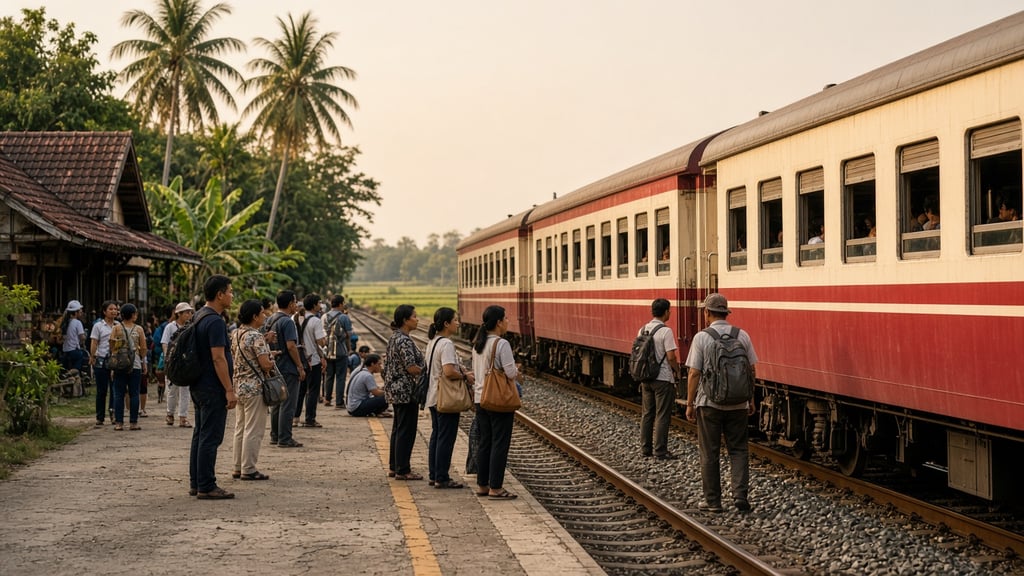
Thailand's national railway is preparing to let private tourist trains share tracks with ordinary passenger and freight services. The State Railway of Thailand (SRT) told its board on 18 November 2026 that a revised 2027 network statement should be released in December. Tourist operators are first: route rights and a selection committee in January 2027, applications in February, and track-access contracts targeted for April 2027. Ordinary passenger and freight contracts sit on a slower calendar, with signatures aimed at September 2027. Launch dates, fares and specific routes have not been named.
The opening sits under the Rail Transport Act B.E. 2568 (2025), which requires the infrastructure manager to publish a network statement so operators can see how tracks may be used. SRT issued the first such statement on 25 June 2026. The Department of Rail Transport, under the Ministry of Transport, frames open access as a way to put private trains on public lines without laying new rails. SRT still runs the existing timetable. Private firms would buy paths, not the network.
Open-access calendar and track fees
On 25 September 2026, SRT's board (meeting 13/2569) approved three track-use charges that will sit inside the 2027 statement. Tourist trains would pay 46.02 baht per car-kilometre. Joint passenger services would pay 7.38 baht per car-kilometre. Freight would pay 0.12326 baht per tonne-kilometre. Those rates are lower than the June 2026 statement, when tourism paths were listed at 77 baht per car-kilometre and freight at 0.2065 baht per tonne-kilometre. A four-car tourist train on the 229-kilometre Bangkok to Hua Hin run would now face a one-way track bill of about 42,150 baht, down from roughly 70,500 baht. Ticket prices remain unpublished.
Companies can confirm in January that they want to use the tracks. SRT says it will allocate tourist route rights that month and appoint a committee, then invite applications in February. Safety standards and what the railway calls transparent, non-discriminatory selection rules are the public test. Hotel and tourism groups have already held talks. SRT has not said how many licences it will grant, whether foreign-owned operators can bid, or whether private tourist trains will be limited to weekends when it already runs excursion services.
Tourist trains already exist
SRT already sells premium rides. Refurbished Japanese KiHa 183 diesel sets, gifted from JR Hokkaido, run day and overnight trips to Ayutthaya, Hua Hin, Chachoengsao and Nam Tok Sai Yok Noi. The Royal Blossom train, seasonal trips to Pa Sak Jolasid Dam, Kanchanaburi weekends and full-train charters sit in the same niche. They remain a thin slice of income: tourism-train ticket sales have been reported in the 80 to 90 million baht range against more than 2 billion baht a year from ordinary tickets. Private operators would bid for unused hours, not a blank map.
Capacity is the policy argument. Dual-track projects have widened paths on busy corridors, yet SRT has not bought enough rolling stock to fill every slot. Open access is meant to occupy idle windows without a full public-private partnership. Under the 2025 Act, track-sharing is a simpler access deal, not a multi-year PPP. That does not settle who gets the Saturday Hua Hin slot, or how a private dining car shares a single-track branch with a late freight. Those fights sit in the December statement and the January committee.
What This Means for Expats and Travelers in Thailand
If the April 2027 contracts stick, visitors could see hotel-run trains on the same lines as ordinary third-class seats. That may mean better toilets, English-language bookings and luggage space on routes that today need a van, a flight, or a slow stopping train. It may also mean peak-season fares aimed at package tourists rather than at retirees who now ride the Southern Line to Hua Hin for a few hundred baht. Until routes and prices are published, treat marketing as speculation.
Practical steps are modest. Watch SRT and the Department of Rail Transport in December for the 2027 network statement, then in February for the tourist-train invitation. KiHa and Royal Blossom trips are not being withdrawn. Ordinary long-distance trains are supposed to keep their paths under safety rules. Freight customers should note the cheaper tonne-kilometre tariff and the later September 2027 contract window.
Visa and long-stay readers should not expect a new immigration product. This is a transport opening, not a visa change. A Chiang Mai or Kanchanaburi weekender that now needs a car hire might later be sold as a hotel rail package. Keep ordinary tickets as the fallback until operators name cities, calendars and refund rules. The network still covers about 4,000 kilometres and 47 provinces. The open question is which of those provinces a private tourist train will actually reach in 2027, and at what price.
Comment verification
Step 1 of 3
Verify your email once to publish your comment. Your email is never shown publicly.
Enter the 6-digit code sent to .
Choose the display name shown next to your comments.