Patong Tesakit Officers Report Phone Threats After Beach-Chair Zoning Push
Two Patong Municipality officers recorded a 2.44am threat complaint at Patong Police after enforcing umbrella and sun-lounger zones. A same-day sweep found empty sand at the linked pitch.
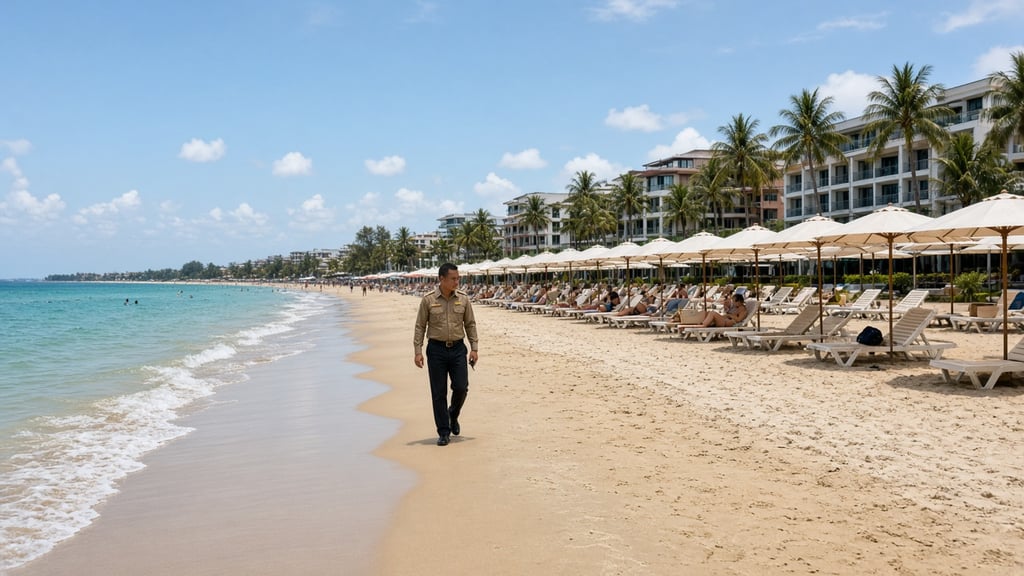
Two Patong Municipality tesakit officers walked into Patong Police Station at about 2.44am on 25 November 2026 and asked investigators to put a threat on the record. They said callers had promised physical harm after the officers enforced rules on beach umbrellas and sun loungers. They told police they were worried about their safety and their property. The provincial write-up named no suspect, printed none of the call wording, and did not identify the operator tied to the complaint.
Later that day, Phuket's provincial administration, Kathu District, and Patong Municipality put a joint team on the sand in tambon Patong. Governor Chotinarin Kerdsom ordered the check. A special-operations unit led by security officer Akkara Suwattikul walked the beach with municipal tesakit staff. Radio Thailand Phuket published that account on 26 November.
Inspectors told operators to pull umbrellas, sun loungers, chairs, and other kit off the open sand where it sat outside the marked zones. Commercial beach equipment belongs inside the province-approved zoning, not on the public strip in front of it. At the pitch tied to the threat report, officers found no umbrellas, loungers, or chairs set out that day.
Patong is Phuket's main west-coast resort, a hotel and nightlife strip behind a beach of about 2,850 metres in Kathu District, as Wikipedia's Patong entry notes. The sand in front of Thawiwong Road is public space. Licensed rows of umbrellas and loungers are a concession, not a title deed. When someone phones tesakit officers at night, the dispute is no longer only about furniture.
What the published zoning actually says
Phuket limits commercial umbrellas and sun loungers to designated service zones approved by the province. Equipment outside those zones is treated as an encroachment on public beach. In a 2022 Thai PBS World report, about 10 percent of Patong Beach was allocated to roughly 60 operators, a cap meant to stop furniture from covering the sea view. Teams still repeat the same instruction: chairs and umbrellas stay inside the marked zone.
The rule has been enforced in public. On 6 May 2026, Patong Municipality, Kathu District, and Patong Police fined seven people and seized 37 beach chairs for kit outside approved areas. On 28 April 2026, a Kathu-led inspection fined three operators and took 65 umbrellas, 42 chairs, and 36 tables. Operators already inside the zones were told to follow other published beach rules, including limits on selling alcohol on the sand.
The 25 November sweep followed that line. MGR Online and The Phuket News carried the provincial account: pull gear off the unmarked sand, keep inspecting. The operator mentioned in the threat file had nothing set up when officers arrived. Officials said they would protect enforcement staff and apply the rules evenly. On 20 November, Patong Municipality sat two parties down after a social-media clip about a beach-chair booking went sour.
What This Means for Expats and Travelers in Thailand
A legal lounger on Patong is one sitting inside a designated service zone, rented from the operator allowed to work that strip. It is not a chair that has crept toward the waterline, and it is not a row a tout can stretch by claiming the whole beach. If someone tells you the open sand is "theirs" and you must pay to sit on a towel, that claim does not match the published zoning. You can sit on public sand outside the concession rows. You can rent a chair inside them.
Do not hand cash to a tout who says they control the entire beach, or who tries to move you off open sand that is not inside a marked zone. If an argument starts, walk away and find municipal officers or the nearest police box. If anyone threatens you, an officer, or a vendor over a chair, treat it as a police matter, not a haggling tactic. The two tesakit officers went to Patong Police Station. Visitors can use the same station, or the national emergency number 191, which the Royal Thai Police publishes for immediate help.
High season on Patong is crowded and licensed rows fill up. Paying a premium for a legal chair in the zone is a tourist choice. Paying a shakedown for imaginary exclusive sand is how encroachment stays alive. The 25 November file is a reminder that the people enforcing the line can be targeted for doing it. If you see a threat, or you are on the receiving end of one, report it. The sand in front of the hotels is still a public beach. The chairs are not.
Comment verification
Step 1 of 3
Verify your email once to publish your comment. Your email is never shown publicly.
Enter the 6-digit code sent to .
Choose the display name shown next to your comments.