Anutin Makes Koh Phangan the Test Case Against Nominee Companies and Illegal Foreign Businesses
On his first visit to Koh Phangan, Prime Minister and Interior Minister Anutin Charnvirakul told officials to treat the island as a sandbox for breaking Thai-nominee front companies and illegal foreign-run shops, bars, and villas.
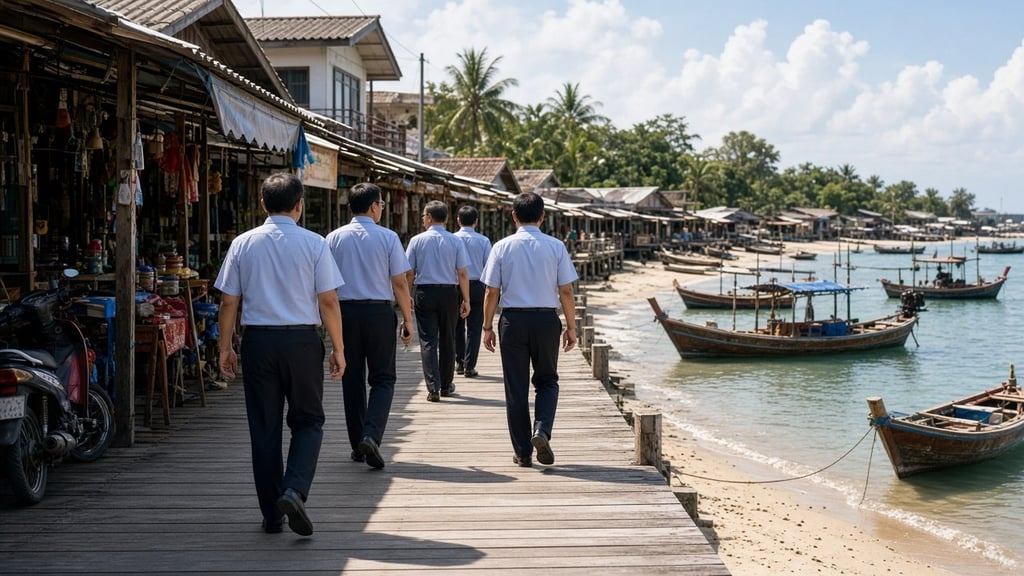
Prime Minister Anutin Charnvirakul arrived on Koh Phangan on 13 May 2026 holding both the premiership and the Interior Ministry, and he used his first visit to the Surat Thani island to put Thai-nominee front companies in the same frame as foreigners who run shops, bars, and villas they cannot lawfully control. Tourists who spend money and stay in licensed rooms remain welcome. Foreigners who use Thai names to hold land or operate island businesses do not.
Surat Thani Governor Jumphot Wannachatsiri hosted the 14.40 briefing at Koh Phangan Suksa School, with deputy governors, district chief Paisit Thongjoem, provincial officials, private-sector leaders, and residents in the hall. The travelling party included the Natural Resources minister, Interior deputies, the directors-general of the Department of Business Development and the Department of Lands, and a deputy national police chief. Company registries, title deeds, and immigration files are being read together.
Earlier, police walked the prime minister through a pool-villa case in Ban Chalok Lam, a northern village whose registered Thai company is under review as a possible nominee vehicle. That stop is the signal for operators: Koh Phangan is a live case file, not a one-day inspection tour.
Sandbox island, then the rest of the map
The Royal Thai Government readout is blunt. Anutin said islanders had complained that outsiders were capturing livelihoods that should stay with Thai residents. Beaches must stay open. Land and trading slots meant for locals must not be captured by companies and then sliced up. He labelled Koh Phangan a sandbox. If it can be put in order, the same template is meant to travel to Koh Samui, Phuket, Phang Nga, Chonburi, Rayong, Chiang Mai, and Chiang Rai.
Governor Jumphot reported three tracks already in motion: checks on land and buildings held in Thai names for foreigners, public-order and overstay work, and tighter watch on how foreigners enter and leave. The province has already opened 21 nominee-related cases on Koh Phangan, plus 133 cases under the alien working law, 29 immigration cases, and seven Hotel Act files. Officials have also flagged Thai names that repeat across large clusters of companies, the footprint of a shell mill rather than a genuine joint venture.
What the Foreign Business Act already says
Thailand does not forbid foreign capital. The Foreign Business Act draws the line at half the shares. Below 50 percent foreign ownership, a company is treated as Thai and can enter many List Three trades (restaurants, small hotels, tourism, most retail) without a Foreign Business Licence. The offence is not a 49 percent foreign stake. It is a 51 percent Thai stake that exists only on paper, while foreigners control the bank account, the booking engine, and the hiring.
Section 36 reaches both the Thai nominee and the foreigner who consents. Section 37 applies the same prison-and-fine range to a foreigner who operates a restricted business without a licence. A foreign-majority operator needs a DBD licence or a Board of Investment promotion. BOI hotel promotion is built for large new projects (at least 100 rooms, or 500 million baht excluding land and working capital), not a five-bungalow beach bar. Land sits on a second statute: a genuinely Thai-controlled company may hold titled land, and foreigners generally may not. Koh Phangan covers about 125 square kilometres around Thong Sala.
What This Means for Expats and Travelers in Thailand
Tourists who fly in, spend, and sleep in licensed rooms are not the target. Working is. Under the Working of Alien Act B.E. 2551 (2008), a foreigner needs a work permit for almost any labour or knowledge, paid or not. Tourist and transit stamps are ineligible. Serving drinks, running a yoga deck, managing an Airbnb inbox from a beach cafe, or "helping out" at a partner's bar without a permit is the same offence the province has already docketed 133 times.
Anyone buying or running a restaurant, bar, dive shop, or villa company should treat this week as a due-diligence deadline. Ask whether Thai shareholders paid for their shares from their own funds. If one Thai name appears on dozens of companies, walk away. Demand the latest DBD affidavit and shareholder list, proof of paid-in capital, a Hotel Act licence if rooms are rented by the night, and work permits for every foreigner with a role. BOI promotion, a Foreign Business Licence, or a properly documented Treaty of Amity company (for qualifying US investors) are the lawful routes to foreign control. A two-million-baht Thai company with a nominee is not a substitute.
Comment verification
Step 1 of 3
Verify your email once to publish your comment. Your email is never shown publicly.
Enter the 6-digit code sent to .
Choose the display name shown next to your comments.