Cabinet Instructs Fast-Track Deportation Rewrite for Foreign Offenders
After Tuesday's Cabinet meeting, Government Spokesperson Rachada Dhnadirek said Prime Minister Anutin Charnvirakul has tasked Deputy Prime Minister Pakorn Nilprapunt, the Immigration Bureau, and Interior with amending the 1979 Immigration Act so foreign offenders can be removed faster.
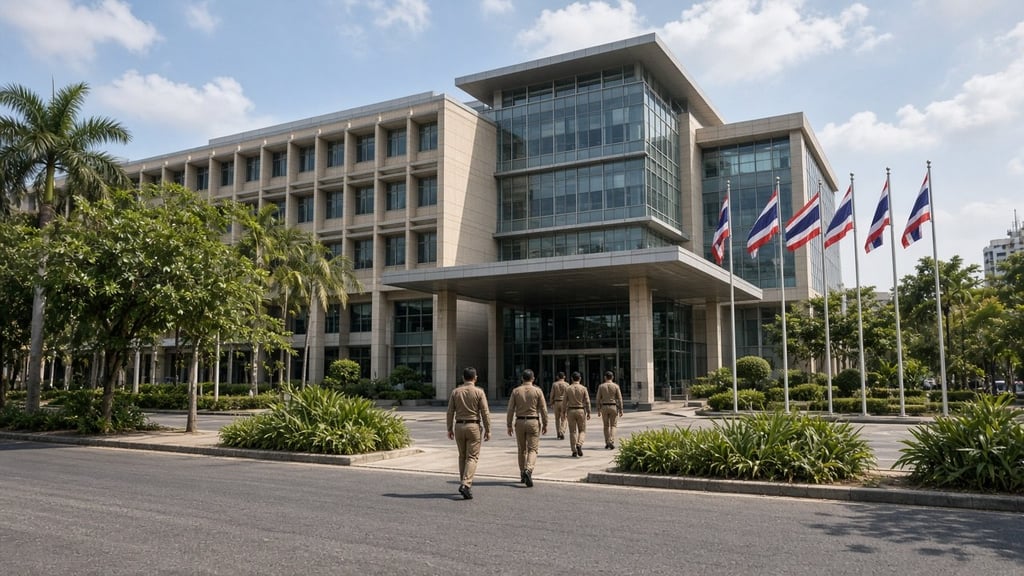
BANGKOK. Thailand's government has opened a legal rewrite aimed at a stubborn gap in immigration enforcement: foreign nationals who are arrested and charged, then remain long enough to resume the same offences while their cases crawl through court.
Government Spokesperson Rachada Dhnadirek, briefing reporters after the Cabinet meeting on Tuesday, 16 June 2026, said Prime Minister Anutin Charnvirakul has instructed Deputy Prime Minister Pakorn Nilprapunt, the Royal Thai Police Immigration Bureau, and the Ministry of Interior to review the Immigration Act B.E. 2522 (1979) and related regulations so deportation of foreign offenders is faster, more flexible, and more efficient. Anutin also holds the Interior portfolio, so the instruction lands on the ministry that already handles much of the paperwork after a removal order.
The problem, as Government House described it in its official Cabinet readout, is not a shortage of arrests. Officials say they have been pursuing foreigners tied to transnational crime, call-centre networks, nominee shareholding, and illegal business operations. The bottleneck comes after the handcuffs. A foreigner facing criminal charges in Thailand generally cannot be deported until the case is finished. Suspects may be released on bail if they surrender a passport, and authorities say some then slip back into the same criminal work. When a deportation order is finally issued, the person is typically held in an immigration detention centre until travel documents and escorts are arranged.
No draft bill was published on Tuesday, and no new regulation has been gazetted. What Cabinet issued is an administrative instruction: close the gaps that let convicted or charged foreigners linger, while still respecting national security, the public interest, and Thailand's international obligations.
The 1979 Act Still Governs Removal and Blacklisting
The Immigration Act B.E. 2522, signed on 24 February 1979, already gives officers broad power to send a foreigner out of the Kingdom. Section 54 allows a competent official to deport any alien who entered or stayed without permission, or whose permission has expired or been revoked. While waiting for removal, officers may require reporting with a bond, or detain the person as long as necessary, with detention costs charged to the foreigner. Section 55 lets officials choose the conveyance and route, and can shift the cost onto the carrier that brought the person in.
Entry bans sit in Section 12. A person imprisoned by a Thai or foreign court, other than for a petty or negligent offence, can be refused entry under Section 12(6). Anyone previously deported by Thailand or another government, or repatriated at Thai government expense, is generally barred under Section 12(11) unless the Interior Minister grants an individual exemption. Section 16 lets the Minister prohibit entry for the national interest, public order, morals, culture, or public welfare, a power that feeds the so-called blacklist even though that word does not appear in the statute. Criminal procedure, bail practice, and detention logistics still sit between a conviction and an outbound flight. The rewrite is meant to tighten that chain, not to invent deportation from scratch.
A Wider Crackdown Meets a Slow Exit Door
The instruction arrives two weeks after the Government Public Relations Department publicised a No Entry, No Stay, No Escape screening drive. That briefing cited 29,490 foreigners refused at the border for weak funds, missing itineraries, or suspected visa runs, 668 education visas revoked after holders were found skipping class to work, and 190 intelligence-led raids, 147 of them in Chonburi. Tourist provinces remain the places where foreign suspects can most easily blend into expat business networks.
Anutin's message to Cabinet, as relayed by the spokesperson, drew a bright line. Thailand is glad to receive tourists, investors, and honest operators, and it intends to prosecute and remove those who break the law or damage the country. Agencies were told to keep international obligations in view, including consular access, non-refoulement, and travel documents from origin states. Because Tuesday's decision is a direction to draft, Parliament would still have to consider any amendment to the 1979 Act. A Prime Minister's Office regulation could move faster than a statute, but as of 17 June 2026 none has been approved or published in the Royal Gazette.
What This Means for Expats and Travelers in Thailand
Lawful visitors, retirees, workers, and investors are not the target of this Cabinet instruction. The people in the crosshairs are those charged or convicted of crimes, plus those already removable for illegal entry, overstay, or permission that has been revoked. Until a draft is published, nothing in Tuesday's meeting changes how you enter, extend a stay, or report an address. Keep visa conditions clean. Illegal work, fake student status, nominee structures, and overstay already trigger removal under current law.
If you are on bail in a criminal case, assume passport surrender, reporting conditions, and a possible detention-to-deportation path if you are convicted. A deportation order commonly leads to a Section 12 blacklist, which can block re-entry for years unless the Minister makes a rare individual exception. Watch for the actual amendment text, not the headline. Closing the gap Cabinet described would mean less time in the community on bail after a serious charge, and a shorter wait in immigration detention after sentence. It would not turn a traffic fine or a missed 90-day report into automatic removal. Anyone with an active case should speak to Thai counsel.
Comment verification
Step 1 of 3
Verify your email once to publish your comment. Your email is never shown publicly.
Enter the 6-digit code sent to .
Choose the display name shown next to your comments.