Bangkok State Audit Office Collapse: Unraveling the Structural Mystery
In the bustling district of Chatuchak, Bangkok, amidst the constant wail and hum of excavators tearing through debris, a story unfolds that could rival even the most gripping drama. The recent collapse of the towering…
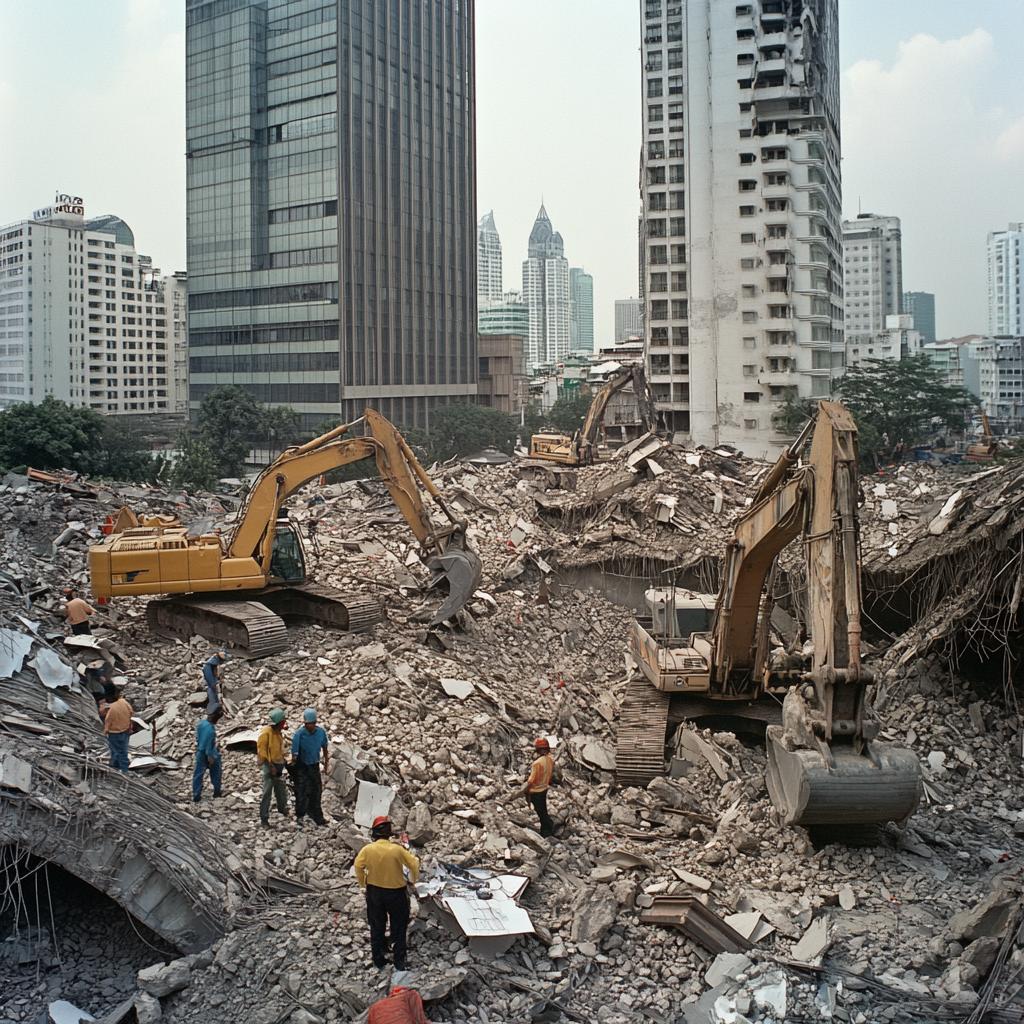
In the bustling district of Chatuchak, Bangkok, amidst the constant wail and hum of excavators tearing through debris, a story unfolds that could rival even the most gripping drama. The recent collapse of the towering State Audit Office (SAO) building—once a gleaming beacon of modern architecture—has sparked not just an architectural debacle but a full-fledged mystery. As the rubble is cleared, questions abound regarding the decisions that led to this unforeseen disaster.
The SAO, in a bid to shed light on the cataclysmic mishap, issued a detailed statement that unpacks the decision-making process behind one pivotal aspect—the thickness of the elevator shaft walls. Originally designed to withstand the trials of time and nature, the thickness of these walls was reduced to conform to interior architectural standards. The design and construction of this 30-story titan were entrusted to ITD-CREC, a formidable joint venture between the renowned Italian-Thai Development Plc and the industrious China Railway No.10 Thailand Co.
As complexities of construction intertwined with legal stipulations, the SAO turned to the expertise of the PKW joint venture for project supervision, while architectural brilliance was brought forth by a partnership between Forum Architect Co and Meinhardt (Thailand). The saga began when the construction contractor realized the original wall thickness combined with decorative nuances might breach a daunting regulation—a ministerial decree from the Interior Ministry coupled with the Building Control Act, no less.
Seeking counsel, the contractor consulted with both the overseeing supervisor and the visionary designers. In a stroke of architectural ingenuity or folly, the designers proposed an audacious remedy: reduce the wall thickness from a sturdy 30cm to a more lithe 25cm, fortified by an intrepid addition of steel reinforcements. This recalibration, as verified by the supervisor and designers, was sent to the contractor with the proverbial stamp of approval from the Auditor-General and the illustrious State Audit Commission.
Enter Justice Minister Tawee Sodsong, who voices the growing scepticism surrounding this structural sin. Could it be that these slenderized walls, a mere wisp at 25cm, bore the blame for the building’s demise? Pol Col Tawee worries aloud—a true wall should rival the bulk of a dungeon’s defenses, at a bold 60cm. A fact-finding mission, led by a crack team of engineers, is in the works to ascertain whether these decisions were the true harbingers of doom.
In the spirit of Sherlock Holmes, the investigation will pore over the original blueprints, seeking clues in the ink and paper that might explain the catastrophic chain of events. As the investigation progresses, international attention heightens, for this saga has transcended local drama. Given China Railway No.10 (Thailand)'s ties to a Chinese state-owned behemoth, Chinese authorities have been drawn into the intrigue, each wanting answers, each wanting justice.
As machinery wrests control from chaos, the question lingers in the dust-filled air: was this merely a sequence of well-intentioned decisions gone awry, or the birth of a modern architectural mystery? As the earth settles, we wait with bated breath, watching as investigators unravel a tale to leave even Agatha Christie envious.



Comment verification
Step 1 of 3
Verify your email once to publish your comment. Your email is never shown publicly.
Enter the 6-digit code sent to .
Choose the display name shown next to your comments.