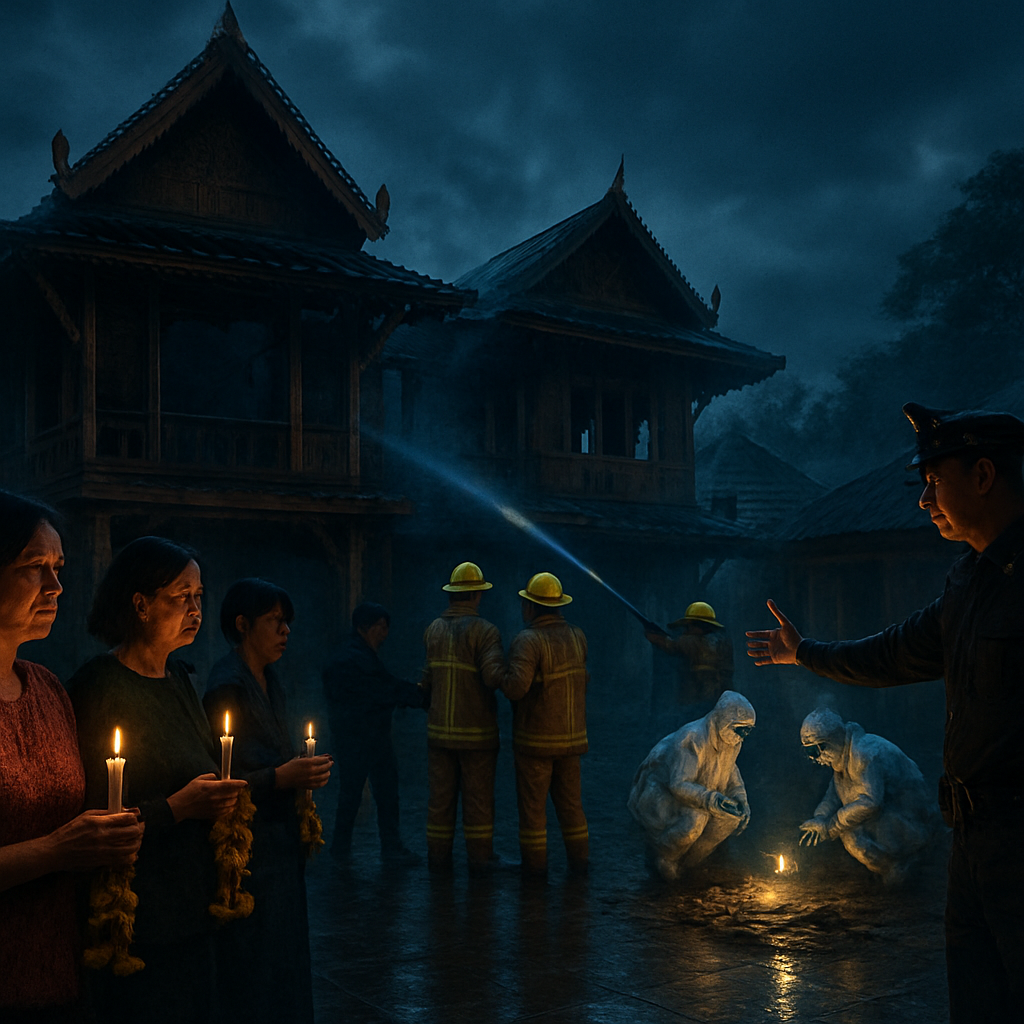
Police investigators in Chiang Mai have formally declared the devastating January 8 house fire that killed five members of a family to be an accident — and issued a sharp rebuke to media outlets that ran with unverifiable theories and sensational claims. The blaze, which tore through a two‑storey home in the Pa Dad sub‑district, claimed the lives of a husband, his wife, their twin five‑year‑old daughters and the man’s elderly mother. Authorities say smoke inhalation, not foul play, was the cause of death.
Tragedy at the family home
The victims were identified as 38‑year‑old Kawin and his wife, 38‑year‑old Warissara, their twin daughters Lalisa and Lalinda (both five), and Kawin’s 70‑year‑old mother, Sunee. First responders found all five family members unconscious on the second floor of the house. Despite frantic rescue efforts, they later succumbed to the effects of smoke inhalation.
In the wake of the tragedy, grief rippled through the local community and social media, while journalists and residents awaited the findings of a thorough investigation by police and forensic teams. That probe is now reported to be roughly 80% complete, with final autopsy results still pending at the hospital.
Speculation, social media and the search for answers
As is often the case after high‑profile tragedies, speculation filled informational gaps. Some outlets and commentators raised the possibility that the fire had not been accidental. These reports cited comments by certain rescuers who noticed what they described as two separate sources of fire inside the home — an observation some said was unusual. Other reports pointed to alleged family tensions over property and inheritance, and friends of the deceased told reporters that Kawin had received a threatening message prior to the incident.
Those fragments of information combined quickly into a narrative that suggested arson or even murder, prompting widespread concern and debate online. But police caution that early impressions and social‑media snippets are not substitutes for forensic evidence.
Police findings: no sign of criminal activity
Deputy Commander Thawatchai Pongwattanachai of Provincial Police Region 5 updated the public on January 12. He reiterated that investigators found no evidence to support claims of murder or deliberate arson. Investigators reviewed footage from eight CCTV cameras in and around the property and report no signs of suspicious visitors or activity before the fire. Forensic teams combed the scene and, so far, have not uncovered indicators of criminal tampering or deliberate ignition.
Thawatchai also acknowledged there had been some internal family disputes — but stressed these tensions dated from late 2024 rather than months earlier, as some reports claimed. He confirmed that investigators were aware a threatening message had been received by Kawin, but said the substance of that message and its relevance to the fire have not been proven to indicate criminal causation.
Responsible reporting and waiting for the facts
Beyond presenting findings, police used the update to admonish media outlets that published unverified or contradictory accounts. Thawatchai said such reporting had “confused the public” and risked inflaming unfounded suspicions about the case. He urged journalists to handle the tragedy with sensitivity and to respect the dignity of the victims and their grieving relatives.
The admonition highlights a broader challenge in the age of instant information: emotional events attract conjecture, and conjecture can harden into rumor long before investigators finish their work. For the police, the priority remains a careful, step‑by‑step forensic process; for the public, the most helpful response is patience and restraint.
What’s next
Investigators expect to complete the inquiry soon once final autopsy results are released. A formal press conference is scheduled next week, where police say they will present their full findings and explain how they reached the conclusion that the fire was accidental.
Until then, authorities ask the public, community leaders and media organizations to hold off on speculation. In cases like this — where families have been irreparably harmed and questions remain — verified facts and compassionate reporting matter more than the speed of a headline.
The Chiang Mai community will now watch for the official wrap‑up of the investigation, hoping that the final report brings both clarity and a measure of closure for a family and a neighborhood stunned by loss.


















My heart goes out to the family. The rush to accuse someone online without evidence is cruel and dangerous, and it distracts from proper investigation.
Why do people always jump to murder? CCTV shows nothing suspicious and police say accidental, so maybe stop with the conspiracy. Let the forensics finish.
As a forensic scientist I can say many fires that look suspicious are accidental. Still, investigators must follow every lead carefully and be transparent about methods.
Thanks for that professional note. Transparency would calm a lot of people and reduce harmful rumors.
Transparency is fine, but sometimes releasing too much detail can impede a case or cause more trauma to the family.
I read posts saying there were two separate ignition points. That alone sounds shady to me. Can forensic teams really rule out arson so early?
Two spots could be from drafts or burning items falling. It’s not proof of arson by itself and the police looked at CCTV.
Maybe. I still worry about bias in official reports though. Too many times authorities close cases quickly and people forget.
I get the mistrust, but in small communities everyone watches each other. If there was a real crime someone would leak info, right?
Five people gone. Whether accidental or not, this shows how fragile life is and how we should check smoke alarms and safety at home.
Simple safety measures would save lives. Can local authorities do campaigns about fire safety instead of only investigations?
Police are correct to admonish sensationalist reporting. Journalists must balance speed with verification, especially when families are grieving.
But when police have a history of covering up things, the press sometimes has to push harder. Not every reporter is a sensationalist.
There is a difference between investigative journalism and rumor-mongering. Responsible outlets should do the former, not the latter.
Inheritance fights were mentioned. If tensions existed recently, could someone have set a fire hoping to look accidental? It sounds possible to me.
Motives are not evidence. Investigators check for accelerants, ignition points, and opportunity. Until results are published, speculation is just that.
Fair point. I just want justice if foul play did happen, and closure if it didn’t. Waiting is hard though.
Anyone who benefits from such a tragedy should be examined, but don’t crucify people on social media without proof.
Police saying accidental might be quelling panic, but could also be protecting someone. We need independent oversight in sensitive cases.
Independent oversight sounds nice but who funds it? Also, baseless accusations can destroy innocent lives too.
Civil society and press freedom are checks on power. They should collaborate, not antagonize, but independence matters.
As a neighbor I saw rescue teams work quickly. No one was roaming around before the fire from what I saw. People online build stories out of nothing.
Eyewitness memory is unreliable under stress. CCTV helps, but only forensic reports will be definitive.
Why do media outlets keep running with unverified tips? Clicks over ethics is killing public trust.
Media ecosystems reward speed. Until we change incentives, some outlets will prioritize traffic over verification.
Then maybe readers should stop sharing everything instantly and demand better sourcing.
This family’s loss is tragic and the police tone sounds firm. Still, I worry about marginalized families getting less rigorous investigations.
Systemic bias in investigations exists globally. Scrutiny should be equal for all cases to maintain public confidence.
Exactly. The victims deserve equal rigor and dignity regardless of social status.
I saw a conspiracy thread saying the CCTV was doctored. That’s paranoid. What proof do they even have?
Conspiracy thrives when official accounts are concise. People want drama and extraordinary claims get attention, even without proof.
Forensic timelines matter. Autopsies and lab results can take time, and early statements must be cautious. Police saying 80 percent done is plausible.
But 80 percent done still leaves room for important surprises. I hope they publish full methodology at the press conference.
Yes, let’s ask for full disclosure of findings without jeopardizing sensitive details. That balance is essential.
Online sleuths pointing fingers ruin families. If proven accidental, those rumors should be corrected publicly and apologies made.
Agreed. Social media lacks accountability. People should think twice before posting allegations.
I can’t stop thinking about the twins. Reporting tone matters; sensational headlines about family fights traumatize survivors.
Humanizing victims instead of treating them like plot points would be a start. Journalists should include empathy in their industry standards.
If investigators conclude accidental, that doesn’t preclude civil disputes like inheritance being pursued. But criminal charges require evidence.
Exactly. Civil and criminal tracks are different. People confuse them and jump to conclusions.
Also, defamation claims against outlets that spread false theories are possible if damage is provable.
The police rebuke felt a little defensive. Maybe they were reacting to wild social media claims, but tone can matter for trust.
Public institutions often must remind media of responsibility, but the best approach is open dialogue rather than lectures.
Open dialogue would be ideal. Right now many people distrust both sides.
In my village rumor spreads fast and hurts real people. We should teach kids to wait for facts and show compassion.
I’m in 6th grade and I saw mean stuff online. Adults should set better examples about truth and kindness.
Well said. Children absorb our behavior; let that be patience and empathy.
If the final autopsy backs smoke inhalation only, those who pushed arson theories should issue corrections. Accountability is a two-way street.
I’ll believe corrections will happen when I see them. Too often retractions are tiny compared to the original sensational story.
True. Media must make corrections as prominent as the original claims when they were wrong.
Police looked at eight CCTVs. That’s thorough but does anyone know who owns those cameras and whether footage was altered?
Forensic video analysis checks metadata and tamper evidence. If police reviewed it, they would note inconsistencies publicly if present.
Okay I hope they publish an independent summary then so people stop speculating.
This case is a warning: fast news cycles plus social media equals misinformation. News literacy should be taught more in schools.
Yes please teach that in school. I want to know how to tell if something is real or fake online.
Start with checking sources and waiting for official statements, but also look for multiple credible outlets saying the same thing.
Back in my day reporters had editors who kept them honest. Now anyone with a phone can be an ‘expert’ and spread fear.
Platforms amplified unverified content quickly. Better platform moderation and media training could help.
Police asking for restraint is reasonable. Yet community leaders should also discourage vigilantism and rumor-fueled harassment.
Community leaders have influence. If they speak calmly and share verified updates, that could reduce panic.
Exactly. Calm leadership matters after tragedies.
I feel bad for reporters too; sometimes a tip seems credible and then falls apart. But speculation without confirmation is reckless.
Ethical training and newsroom standards can make a difference. Speed should not trump accuracy.
I hope the press conference lays out the forensic chain of custody and methodology. That will either settle doubts or raise new questions.
Publicizing methodology helps legitimacy, but investigators must also protect sensitive details that could compromise future prosecutions if any.
As someone who knew the family, this is horrible. Please stop speculating and let the family grieve in peace.
Respect for the bereaved should be front and center. Public curiosity can’t replace human decency.
This also shows the need for better emergency infrastructure. Faster alerts and clearer building safety rules could save lives.
Yes, investing in community safety is prevention, not just reaction.
One last thought: even when authorities clear a case, online narratives linger. We need systems to correct false viral stories more effectively.
Agreed. Platforms and media organizations should prioritize corrections and elevate them when initial coverage was misleading.