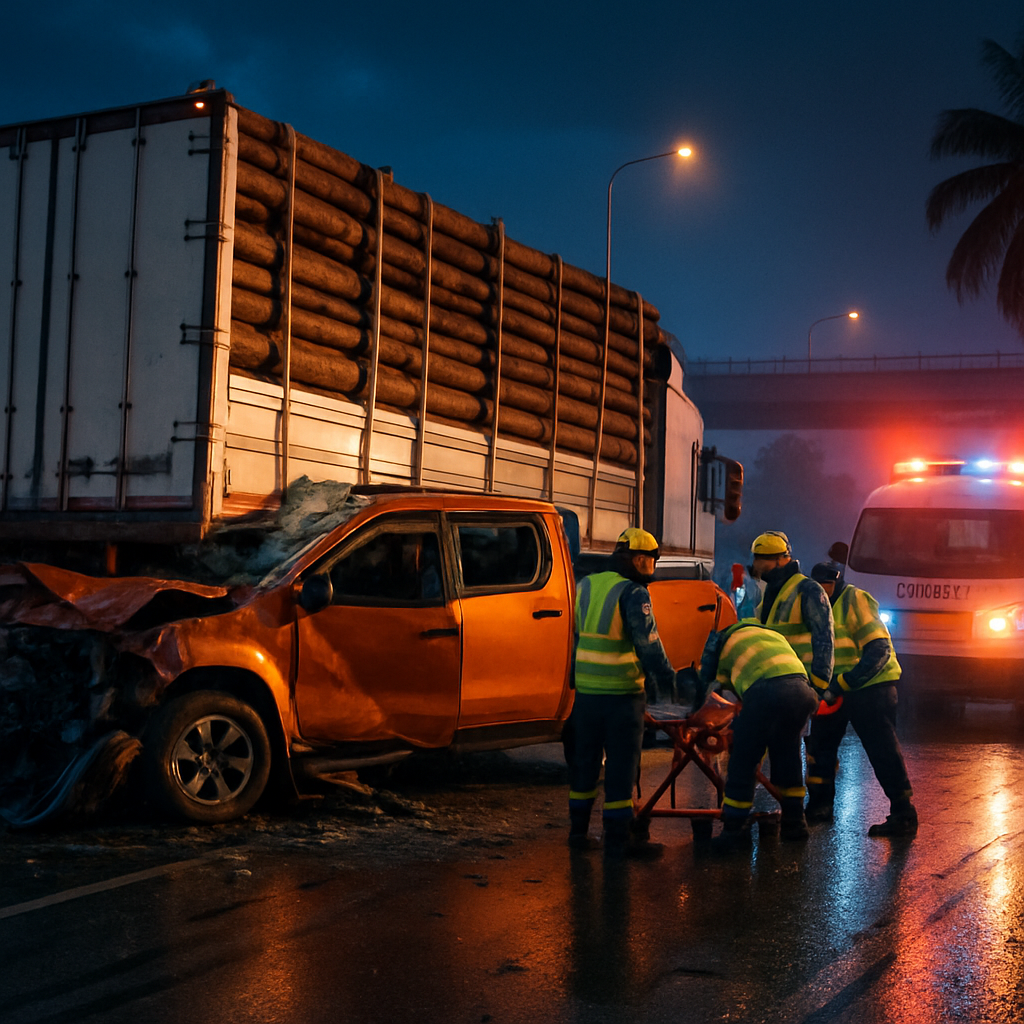
In the quiet pre-dawn hours of December 27, a routine drive turned into a scene of devastation on the Chonburi motorway. At 3:10 a.m., near the 91-kilometre marker on the Pattaya-bound lane in Bang Phra, Si Racha district, an orange four-door Nissan pickup rammed into the rear of a stationary 18-wheeler, killing four people and leaving one critically injured. The crash has left a community reeling and prompted renewed warnings about the dangers of drowsy driving on Thailand’s busy highways.
The wreckage and the rescue
By the time officers from Khao Khiao Highway Police Station and crews from the Pure Yeang Tai Si Racha Foundation arrived, the pickup was little more than a mangled shell. The white Hino trailer, hauling rubberwood bound for a Rayong factory, bore the blunt force of the impact but remained upright. Rescue teams worked under floodlights, their hydraulic cutters hissing as they pried metal apart to extract victims trapped inside the pickup.
Authorities identified the pickup driver as 34-year-old Nattasit. He suffered catastrophic injuries — a broken neck and multiple fractures — and was pronounced dead at the scene. A 48-year-old woman, Saphawadee, who had been seated in the front passenger seat, was also killed. Two other male victims were recovered from the wreckage but had no identification at the time and were transported as unidentified fatalities. One male passenger survived the collision but was seriously injured and rushed to hospital for emergency treatment.
What the truck driver says
The driver of the Hino 18-wheeler, 48-year-old Wattana, told police he was en route from Bangkok, carrying rubberwood destined for a factory in Rayong. He said he heard a sudden, violent impact from behind and initially assumed one of his trailer tires had blown. After pulling over, he discovered the pickup had smashed into the trailer’s rear — the moment that would later be confirmed as catastrophic for those inside the smaller vehicle.
Preliminary cause and ongoing investigation
Police believe the pickup driver fell asleep at the wheel, causing the vehicle to drift and collide with the heavy truck. Investigators are combing through CCTV footage from the motorway and nearby businesses, examining skid marks, vehicle telematics where available, and eyewitness accounts to reconstruct the final minutes leading up to the crash. Until the forensic work is complete, authorities are treating driver fatigue as the likely primary cause.
Night driving, fatigue and risk
Nighttime driving on Thailand’s long highways can be deceptively dangerous. Darkness conceals hazards and lulls drivers into a false calm; micro-sleeps — moments of nodding off that last just a few seconds — are enough to travel the length of a football field at highway speeds. When a light passenger pickup meets a loaded 18-wheeler, the physics are unforgiving. The tragic outcome on the motorway in Bang Phra is a sobering reminder of how quickly a short lapse in alertness can become fatal.
Community reaction and the way forward
Locals and road-safety advocates have expressed sorrow and called for stronger measures to prevent similar accidents. Suggestions range from better rest-stop facilities along busy routes to public campaigns reminding drivers about the risks of late-night driving without proper rest. Trucking companies and passenger vehicle drivers are being urged to prioritize sleep breaks, use co-drivers on long hauls, and avoid driving when fatigued.
For now, the families of those killed and injured are left to pick up the pieces while investigators finish their work. The identities of the two male victims are expected to be confirmed through forensic procedures and family notifications. Authorities have stressed the importance of collision data and CCTV in confirming the sequence of events and whether any mechanical failure or external factor contributed to the tragedy.
A final note
Accidents like the one on the Chonburi motorway often prompt a flurry of headlines and then fade, but the consequences linger for families and communities. As officials pursue answers, the clearest lesson is simple and universal: if you’re tired, don’t drive. Pull over at a safe lay-by, take a short nap, or switch drivers. It’s a small decision that can prevent a lifetime of grief.
Source: Khaosod.


















This is such a preventable tragedy; people who drive tired should face real penalties to stop this behavior.
Penalties might help, but if drivers are forced by schedules to push through fatigue, fines won’t fix the root cause.
I get that systemic issues matter, but without stronger enforcement nothing changes and more families keep dying.
We need proper rest stops and lighting on long stretches like that motorway so people have safe places to nap before they nod off.
Rest stops are fine, but who pays for them? Private trucking companies should be taxed to fund infrastructure improvements.
I agree private firms should contribute, and the government could incentivize safer routes with tax breaks tied to driver welfare.
Micro-sleeps are neurologically distinct from simple tiredness and can occur without warning; policy should treat fatigue like intoxication in enforcement terms.
Treating tiredness like intoxication sounds extreme and could be abused, especially against low-income drivers trying to make ends meet.
The intent is to measure impairment objectively and protect lives, not to punish poverty; regulations can be targeted and humane.
Objective measures would be good, but who decides the threshold and how do we avoid false positives that ruin careers?
That’s so sad, why would anyone drive if they were really tired? My teacher says sleep is important.
Kids understand the basics, but adults get pressured by jobs and deadlines, so education must be paired with better working rules.
I hope drivers read this and come home safe to their families. Schools should teach road safety too.
Rubberwood transport is nonstop at night; companies push schedules and drivers pay the price, not just the unlucky few.
If true, we need transparency from these firms and mandatory shift logs open to inspection by authorities and unions.
Exactly, and small audits can reveal patterns instead of waiting for a headline tragedy to act.
This hit too close to home, the way officials talk about ‘driver error’ often ignores company liability and economic pressure.
Families of drivers rarely win compensation because legal processes are slow and evidence disappears quickly, sadly.
We need faster forensics and mandatory black boxes in pickups too, not just in big trucks.
Black boxes are useful, but we must protect privacy and ensure data only used for safety and fair compensation.
I’ve driven that route many times; the temptation to speed between rest areas is real because commercial stops are scarce.
Media focuses on moralizing individual drivers but rarely covers the supply chain pressures that create dangerous schedules.
Supply chain critics are right, but customers also demand cheap goods, so it’s a shared responsibility up and down the chain.
True, consumer awareness campaigns could help shift demand toward ethically scheduled logistics.
CCTV evidence is important, yet sometimes footage is withheld for weeks; transparency would build public trust in investigations.
Authorities cite privacy and legal reasons, but protocols should allow faster review in fatal crashes to speed justice.
Then create an independent panel to handle sensitive footage so families get answers sooner and investigations stay fair.
We also need to stop blaming victims when systemic negligence is the real issue; slogans like ‘if you’re tired don’t drive’ aren’t enough on their own.
Automatic emergency braking and rear radar on pickups could mitigate such rear-end disasters, and regulations should mandate basic active safety tech.
Mandating tech is sensible, but retrofitting older vehicles is costly; subsidies or phased mandates would help adoption.
Agreed, targeted subsidies for low-income drivers and small fleets would speed retrofits without bankrupting them.
Why does it always take multiple deaths before we discuss practical solutions? Prevention should be continuous, not reactive.
Public attention fades fast after headlines drop, and budgets move on; institutional memory is weak unless laws force change.
Then campaign for legal reforms now, when outrage is high, so change isn’t seasonal but sustained.