Hat Yai floods: Paradon Prissanananthakul walks out after question on slow response
The Prime Minister’s Office got an awkward dose of live journalism yesterday, November 27, when Paradon Prissanananthakul — the minister who also leads the Emergency Flood Crisis Operations Centre — abruptly ended a…
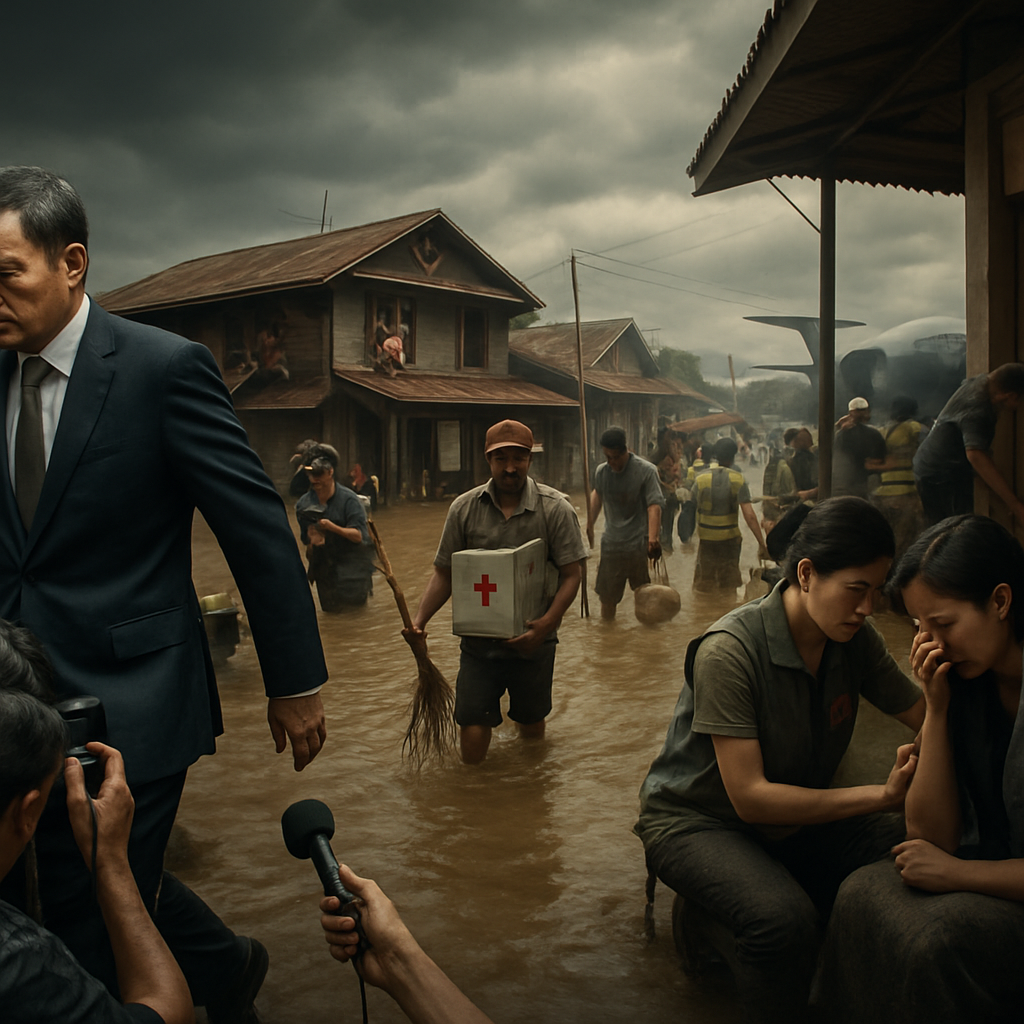
The Prime Minister’s Office got an awkward dose of live journalism yesterday, November 27, when Paradon Prissanananthakul — the minister who also leads the Emergency Flood Crisis Operations Centre — abruptly ended a press briefing after declining to answer a pointed question about whether sluggish government response had worsened losses from the devastating southern floods.
Paradon had been giving the expected updates from Hat Yai district, Songkhla, where floodwaters have wreaked havoc on homes, businesses and the daily lives of thousands. In a sympathetic note, he announced that the Ministry of Higher Education has postponed university exams nationwide — a recognition that many students are grappling with anxiety and family crises caused by the disaster.
He also outlined the logistics of the nationwide relief effort. A central donation hub has been set up at the Royal Thai Air Force Museum in Don Mueang, and donated goods will be ferried south on Lockheed C-130 Hercules aircraft. Practicalities matter: as waters begin to recede, large swathes of communities will need nothing glamorous — just the kind of elbow-greasing tools that mop up messes. Paradon specifically mentioned coconut brooms among the items in demand.
On the grimmer side, Paradon said Prime Minister Anutin Charnvirakul has ordered hospitals to speed up identification of victims and told the Public Health Ministry to expand storage capacity so bodies do not deteriorate further while families wait for confirmation. Those comments underscore the human toll behind the headlines — a toll that, for many, is painfully immediate.
Then came the microphone moment. A reporter asked, “Should the government admit that slow management caused this loss?” Paradon looked at the journalist, closed his microphone, thanked the media and walked out of the room without answering. The exchange — succinct, awkward and caught on camera — only added fuel to an already heated public conversation about how the crisis has been managed.
This was not an isolated flare-up. Siripong Angkasakulkiat, the centre’s spokesperson, insisted on November 26 that delays were not down to mismanagement and argued that evacuation warnings were issued in good time — even if some residents chose not to leave. Prime Minister Anutin has offered similar rebuttals; on November 25 he publicly maintained that the government mobilised resources immediately.
But official reassurances have done little to quiet public anger and grief. During a visit to a shelter at Prince of Songkhla University, a flood victim publicly confronted Prime Minister Anutin about delayed rescues. Video footage shared by ThaiRath shows her speaking while he nodded and then walked away, a moment that resonated widely on social media and in local commentary.
Numbers remain a source of contention. ThaiRath reported that 113 bodies have been found in Hat Yai since waters started to fall back. The Emergency Flood Crisis Operations Centre has not officially confirmed that figure; its last verified death toll was 55. Such discrepancies are common in fast-moving disasters, but they also magnify frustration for families and observers demanding clarity.
The economic fallout is staggering as well. Kasikorn Research Centre told MGR Online the Hat Yai flooding has caused around 25 billion baht in damage — roughly 1 billion baht per day at one point. The SEA Games host venue had to be relocated; 715 industrial factories were affected, with estimated losses of 1.282 billion baht. Songkhla’s tourism sector alone is expected to lose at least 5 billion baht, and analysts forecast Malaysian tourist arrivals could dip by 7–18%.
That constellation of human suffering and economic shock explains why tensions are high and why officials rapidly pivot between damage control and logistical triage. Setting up a central donation hub and flying in supplies is one thing; ensuring rescues happened early enough, identifying victims, and answering tough questions from the press are another.
For locals, the immediate priorities remain straightforward: safe shelters, clean water, fast identification for loved ones, and clear information. For officials, the balancing act is more complicated — equally urgent relief operations while fending off criticism and trying to maintain public trust.
As Hat Yai and nearby provinces move from emergency response into recovery planning, the public will be watching for transparency, speed and accountability. Videos of walkouts and uncomfortable encounters with reporters may make for viral headlines, but the more lasting measure of success will be whether families receive timely help, whether the dead are identified with dignity, and whether economic support reaches the businesses and tourism workers who face a bleak winter ahead.
Until then, the questions raised in that short, tense pressroom moment will linger: did response times cost lives and livelihoods, and if so, how will authorities learn from this? The answers — and not just the reassurances — will determine whether confidence can be rebuilt in the weeks and months to come.



Comment verification
Step 1 of 3
Verify your email once to publish your comment. Your email is never shown publicly.
Enter the 6-digit code sent to .
Choose the display name shown next to your comments.