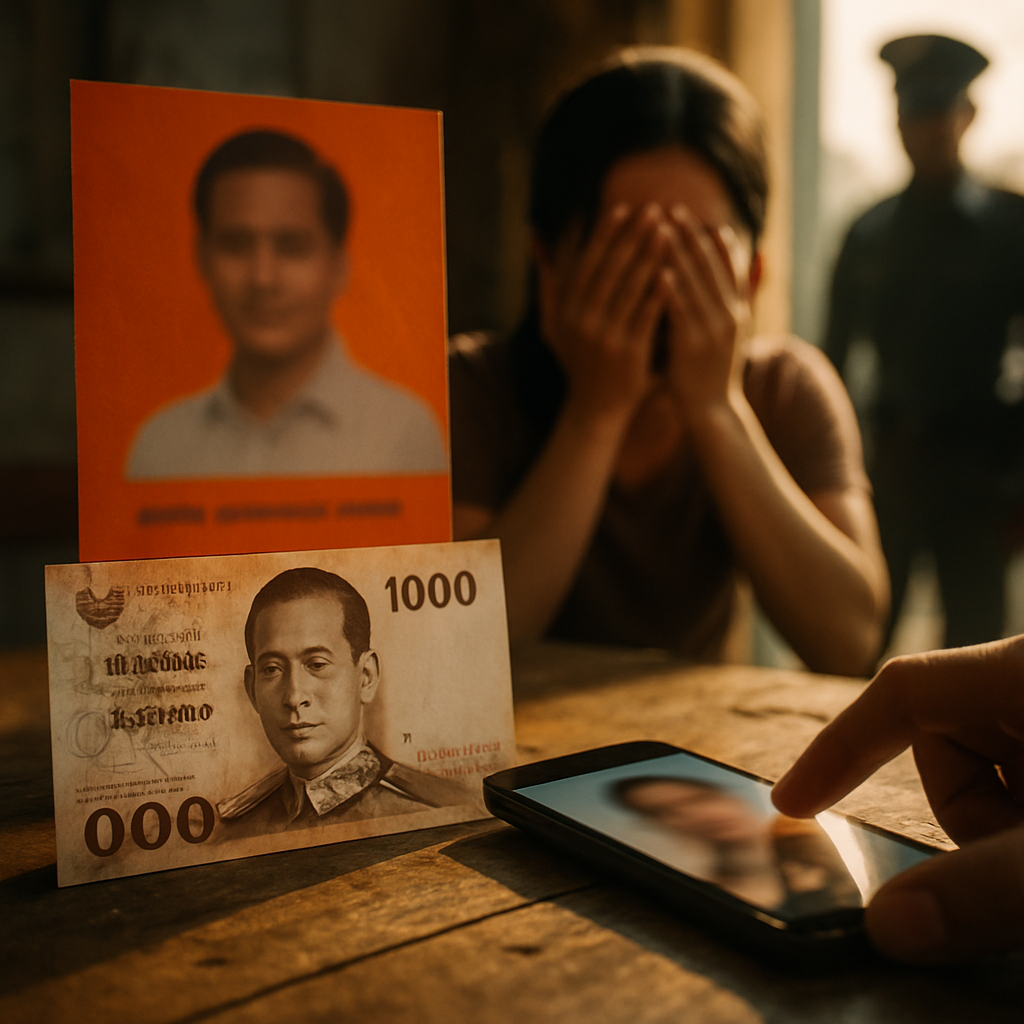
It started as an innocent scroll-and-laugh moment for one social media user — a staged photo, a cheeky caption, and the promise of a little harmless mischief. Seconds later, that same image exploded into a full-blown political controversy that landed a People’s Party parliamentary candidate in Saraburi in the middle of a rumor storm.
The actor at the center of the storm is Rungnapa Kotphuthorn, who posted a photo on Facebook showing a 1,000‑baht banknote propped next to a campaign leaflet for Pairoj Buapuean, a People’s Party MP candidate. The leaflet’s orange hues and the tagged location — Thap Sai sub-district, Pong Namron district, Chanthaburi province — were enough to spark social media outrage: viewers accused Pairoj of offering money in exchange for votes.
Rungnapa’s caption tried to defuse the scene with humor: “Awesome! Return home to see this. Just kidding. Don’t be drama.” But the internet didn’t take it as a joke. Comments and shares multiplied, and users demanded answers from Pairoj, accusing him of vote-buying — one of the most serious allegations in any election season.
Pairoj immediately denied the accusation, taking to his own Facebook to make one thing clear: he had never offered cash for votes. According to reports, the woman later reached out to him directly and admitted the photo had been staged purely for social media content. She deleted the original post and issued a public apology, but by then the damage to reputations and perceptions had already begun.
“I posted this picture. I staged it myself. You can complain me. I admitted that I’m wrong and reckless. I caused the issue myself, so I have to accept the complaints. My account is public and opened for the complaints. I would like to apologise to the party and everyone. I don’t have any intention to attack any candidates. I did it for fun and was too silly to aware that it would become this big issue. I’m truly sorry.”
Even a contrite apology, however, didn’t close the case. Pairoj decided to file a police complaint to protect his reputation and the People’s Party, forcing authorities to step in and question both parties. Police summoned Pairoj and Rungnapa for questioning; as of the latest reports, no formal charges had been announced.
Why the legal fuss? Thai election law takes false statements designed to mislead voters seriously. Under Section 143 of the Act on the Election of Members of the House of Representatives, deliberately making false claims that suggest a candidate has broken election rules can carry steep penalties: up to two years in prison, fines up to 40,000 baht, and suspension of voting rights for five years. That’s enough to turn a social-media prank into a potential criminal matter.
Former People’s Party MP Yanathicha Buapuean — who previously represented Chanthaburi’s constituency 3 — warned the public about those consequences, reminding everyone that election-related offenses are not a laughing matter. Her warning echoed across timelines, reinforcing a crucial point: in the fraught atmosphere of campaigning, misinformation can do real harm.
There’s a modern twist to this story that many will recognize. Social platforms incentivize shareable content; a staged photo designed “for fun” can quickly become a viral weapon. The Rungnapa incident is a textbook example of how a single post — intended as a joke — can be misinterpreted (or weaponized) and then amplified into a reputational crisis for a public figure. In an election cycle, where trust is fragile and scrutiny is high, the consequences can be disproportionate.
For Pairoj Buapuean, the decision to pursue legal action wasn’t just about clearing his name; it was also about drawing a line. Candidates and parties invest time, money, and trust in their campaigns. A staged image might be dismissed as a prank in one context, but in another it can have the power to swing voter sentiment or ruin a political career. Filing a police complaint sends a signal that false accusations won’t be tolerated — even when they begin as jokes.
For social media users, this is a cautionary tale about the ethics of content creation. A humorous or attention-grabbing post should be weighed against its potential fallout: who will be affected, how might it be understood by others, and could it distort the truth? The line between creative expression and actionable misinformation is thin — and when elections are at stake, crossing it can carry serious consequences.
At its heart, the Saraburi‑Chanthaburi episode is a modern parable about responsibility in the digital age. Whether you’re a voter, a candidate, or just someone scrolling through your feed, the lesson is the same: think before you post. A single staged photograph might win likes for a moment, but it can also start a legal process, damage reputations, and contribute to a climate where truth becomes negotiable.
As the investigation continues and the police determine the next steps, one thing is clear: jokes that touch on election integrity are rarely harmless. For Pairoj, Rungnapa, and the community watching this unfold, the incident has already left its mark — a reminder that in politics, the stakes of a “funny” post can be much higher than anyone imagined.


















This feels like political theater — a staged photo blown up to ruin a campaigner’s name. Social media mobs jump before facts show up, and that scares me. Filing a police complaint might be the only way to stop the rumor mill.
But isn’t filing a police complaint heavy-handed for what she admitted was a joke? The law is strict, yes, but context matters and intent should count.
Intent matters, I agree, but the damage was real and fast. When votes and reputations are at stake, candidates have to protect themselves and deter copycat stunts.
I get protecting reputation, yet criminalizing bad online behavior risks chilling satire and minor pranks too. There needs to be a proportional response.
People on Facebook are too quick to accuse without evidence.
This is a perfect example of how misinformation can weaponize a single frame. The law should punish deliberate deception, but we must preserve free expression.
Free expression is vital, but when a post targets electoral integrity, harms the candidate, and misleads voters, it crosses into a different category. There are standards for public speech especially during campaigns.
Section 143 is clear: false statements that mislead voters are penalized. Courts will have to weigh mens rea, or the intention, versus negligence in this case.
So should a prank be judged by intention or effect? I’m worried the legal system will be used to silence critics under the guise of ‘protecting integrity.’
Delete, apologize, move on. Why drag cops into jokes?
Because jokes can hurt people and change votes real fast.
An apology is good, but the candidate lost time answering allegations and the party had to spend resources clarifying. There are real costs beyond feelings.
Okay I see the costs, but police time is limited. Priorities matter.
I have never offered money for votes and the post was clearly staged, yet the accusation spread like wildfire. I filed a complaint to protect my name and the party’s integrity.
I admit I staged the photo for fun and I am truly sorry for the trouble it caused. I deleted the post and apologized publicly; I did not intend to hurt anyone.
Thank you for your public apology, but the damage still happened and I must ensure voters know the truth. I hope this is a lesson about responsible posting.
From a legal standpoint, prosecutors will look at whether the post was meant to mislead a voting group and the extent of its dissemination. Even retraction rarely erases the original harm under electoral law.
Election offenses are serious and can change careers. I urged caution because I’ve seen misinformation topple campaigns before.
Teach kids online responsibility: a post for a laugh can become a court case. Schools should include digital ethics in the curriculum.
We learn about cyberbullying but not about how political jokes can lead to legal trouble. That seems like a gap.
Exactly; the digital civics curriculum should cover real-world consequences and media literacy so students understand context and harm.
Section 143’s penalties reflect the legislature’s view that misinformation during elections has systemic harms. Theoretical debates about free speech are important but must be balanced against maintaining fair elections.
The broader policy question is how to deter malicious actors without chilling legitimate commentary. Clear guidelines and graduated sanctions might help.
Graduated sanctions sound reasonable, but who decides the level? Hard to trust impartiality in politicized prosecutions.
Why do so many people assume the worst online? It’s like everyone’s a prosecutor and a judge on their feed.
Because virality rewards outrage and algorithms push extreme takes for engagement. It’s a market failure of attention.
So we need platform responsibility, not just legal action against individuals.
In my day a prank stayed a prank. Now a photo can ruin a life. People used to think more before speaking.
Old rules don’t work the same way. We share first and think later; platforms are built for that speed.
Maybe education and slower habits are what we need, not only laws.
Local elections affect my village; lies like this make folks suspicious of everyone. Trust is fragile here.
Exactly — even a small rumor can swing a dozen votes in rural areas where news spreads by word of mouth. The stakes are bigger than online likes.
We need fast, clear rebuttals from candidates when rumors start, or misinformation gains ground too quickly.
But who watches the watchers? If candidates use police to counter every negative post, that could intimidate critics.