Patong Police Crack Down on Illegal Kerbside Parking in Phuket
It was a brisk mid-morning sweep in Patong that had locals doing a double take: at 10:30 a.m. on September 10, officers from Patong Police Station set out on a determined mission to reclaim the public way. What began as…
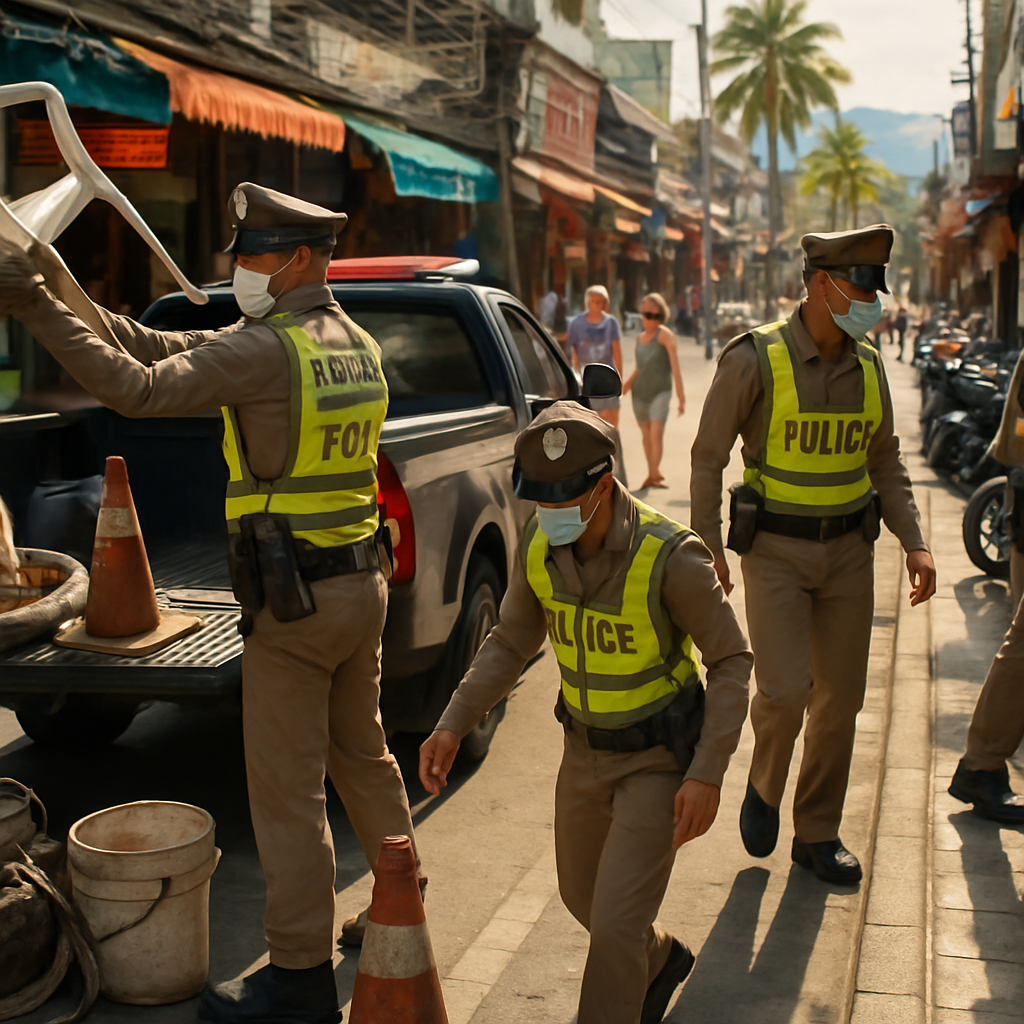
It was a brisk mid-morning sweep in Patong that had locals doing a double take: at 10:30 a.m. on September 10, officers from Patong Police Station set out on a determined mission to reclaim the public way. What began as routine patrolling along Rat Uthit 200 Pi Road in Kathu district quickly turned into a tidy-up operation aimed at one of Phuket’s most persistent urban nuisances — improvised kerbside parking claims.
Leading the charge was Police Colonel Chalermchai Hirasawat, flanked by senior officers including Police Lieutenant Colonel Somporn Surin and Pol. Lt. Col. Chamnan Sapsin, with the traffic unit under Pol. Lt. Col. Charuwat Thiamnakha coordinating movements. The scene was almost cinematic: officers methodically walking the pavement, inspecting each makeshift blockade, and removing anything that wasn’t meant to be on a public road.
The offenders, if you can call them that, were not human but a motley assembly of plastic chairs, rusty traffic cones, buckets, chained tyres and other everyday objects repurposed into claims staked on public kerbside spots. Locals and business owners have long used these improvised markers to ‘reserve’ space right outside their premises — a practice that will now face a sterner reality check.
“This is a public road. No one has the right to claim it for private use,” an officer told reporters as items were gathered and loaded into police vehicles. The confiscated objects were taken back to Patong Police Station and logged as evidence, a clear signal that the authorities intend to treat repeat offenders seriously rather than merely scold them.
The crackdown didn’t come out of the blue. It followed a steady stream of complaints from motorists and tourists frustrated by dwindling access to public parking. For months, residents had been improvising claims — sometimes out of convenience, sometimes to help their businesses — but the side effect was predictable: snarled traffic, blocked pedestrian walkways and rising annoyance among visitors trying to navigate the bustling district.
Officers took the opportunity not only to remove the obstructions but to educate shopkeepers and residents about the legal implications. They cited traffic regulations that explicitly prohibit placing any object that obstructs vehicle or pedestrian movement. In short: a chair on the kerb is not a legal claim ticket.
“We’re making it clear that placing objects to reserve parking is against the law. This is just the beginning. We will keep clearing the roads so everyone has equal access,” another officer said, emphasizing that the operation is part of a wider, ongoing effort.
The officers’ message was practical as well as principled. Public spaces are just that — public. When a small piece of pavement becomes someone’s private parking extension, it erodes access for everyone, including emergency vehicles, delivery drivers, and the many pedestrians who stroll Patong’s busy lanes. The police urged citizens to report illegal obstructions through the Patong Police Station hotline or its social media channels, promising prompt follow-up.
For the average visitor, the clean-up is welcome news. Tourists who arrived expecting sandy beaches, street food and postcard views have sometimes found their patience tested by kerbside dramas. For residents, the operation is the start of a push toward fairer, safer streets — one that balances local convenience with the rights of everyone who uses Patong’s public ways.
There was also a subtle reminder hidden in the logistics of the day: improving access doesn’t require dramatic measures. The enforcement team stuck to removing objects and issuing warnings, collecting evidence where necessary. The idea is to nudge the community toward voluntary compliance rather than escalate conflicts.
Patong Police have warned that similar operations will continue throughout the area in the coming weeks. Those who have claimed spaces with chairs, bins or ropes would be wise to take note: the authorities are prepared to act, and they’re not shy about hauling contraband traffic cones back to the station.
Whether you’re a business owner protecting a delivery slot, a homeowner parking outside your gate, or a tourist circling for a spot, the takeaway is simple: leave the public road public. If you see something blocking the pavement or the kerb, Patong Police encourage you to report it via their hotline or their social media pages so the matter can be dealt with promptly.
As the afternoon sun climbed higher over Phuket, Rat Uthit 200 Pi Road looked noticeably clearer. The plastic chairs and chained tyres were gone, and for a little while at least, the pavement belonged to everyone again.
Reported by: The Phuket News



Comment verification
Step 1 of 3
Verify your email once to publish your comment. Your email is never shown publicly.
Enter the 6-digit code sent to .
Choose the display name shown next to your comments.