Thailand

Phuket Smart City AI Training for Better Public Services

Phuket’s Smart City Plot Thickens: Officials Get a Crash Course in AI Phuket is turning another page in its smart city story — and this one comes with a dash of artificial intelligence. On August 26, the island hosted a…
Phuket Smart City AI Training for Better Public Services

Phuket’s Smart City Plot Thickens: Officials Get a Crash Course in AI

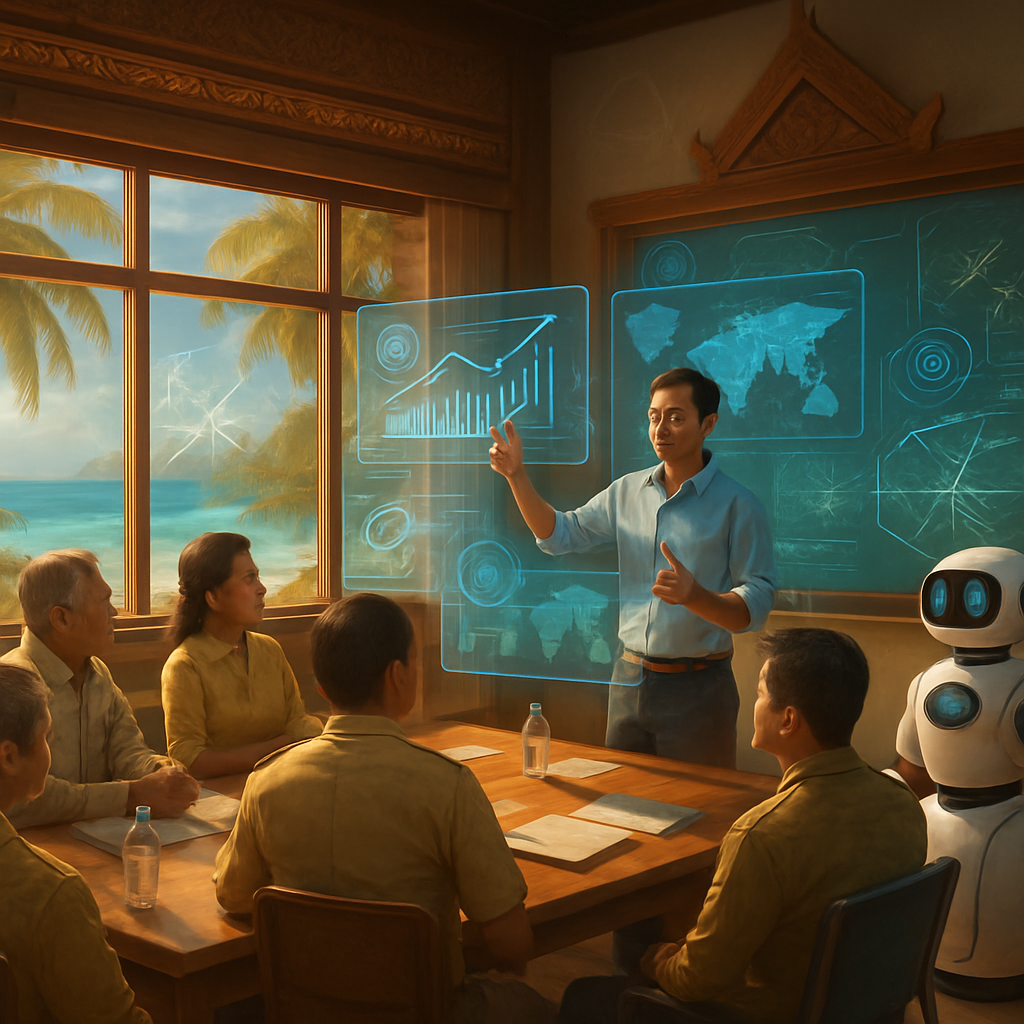
Phuket is turning another page in its smart city story — and this one comes with a dash of artificial intelligence. On August 26, the island hosted a lively, full-day training program at Phuket Vocational College called "Enhancing Knowledge on the Use of Artificial Intelligence in Government Administration." The session gathered a who’s-who of local leadership: Governor Sophon Suwannarat, heads of government agencies, district chiefs and community leaders, all eager to learn how machines can help make life smoother for residents and visitors alike.

Narong On-in from the Phuket Provincial Office didn’t sugarcoat the message: technology is sprinting ahead, and the public sector has to keep up. “Government officials need knowledge, understanding and the ability to apply AI in their work,” he said, highlighting how AI can boost efficiency, streamline processes and ready Phuket for an increasingly digital era.

“This training equips leaders and officials with the knowledge to use AI to simplify tasks, enhance work processes and provide faster, more efficient public services.” — Governor Sophon Suwannarat

Governor Sophon framed the training as a key piece of Phuket’s broader digital strategy. For a province that thrives on tourism, efficient public services aren’t just bureaucratic niceties — they’re essential to sustaining hospitality, safety and infrastructure as visitor numbers climb and expectations rise.

Robots, Reality and a Local Tech Star

The session featured a headline talk from Chalermpol Punnotok, CEO of CT Asia Robotics Co., Ltd., the mind behind Dinso — Thailand and ASEAN’s first service robot. Chalermpol brought practical insight and a little star power, painting a picture of how AI and robotics can move beyond novelty and into everyday public service: queue management, information booths, automated inspections, and even simple companionship roles in community centers.

Chalermpol’s message was clear and pragmatic: robots and AI aren’t here to replace people but to augment public servants, handle repetitive tasks, and free officials to focus on decision-making, strategy and human-centered problems. For an island where rapid service and positive visitor experiences matter, the potential is obvious.

From Training Room to Town Hall: Real-World Outcomes

Officials say the training is more than a one-off seminar. Its immediate aim is to boost the technical capabilities of Phuket’s government workforce, but the wider goals are ambitious. Attendees left with a road map: develop standardised service manuals, introduce consistent digital systems, and pilot AI-backed tools that can scale across departments.

Imagine standardized digital workflows cutting red tape for business permits, AI-assisted analytics to predict maintenance needs on roads and beachfront infrastructure, or chatbots that answer routine queries from tourists 24/7. Those aren't sci-fi scenarios — they're tangible projects a motivated provincial administration can start piloting now.

Why This Matters — Locally and Regionally

Phuket doesn’t operate in a vacuum. The province’s push toward digital governance dovetails with national modernization efforts across Thailand, where governments at every level are experimenting with AI, e-governance and smart city frameworks. For Phuket, success has ripple effects: smoother services help tourism, better planning protects infrastructure, and tech-forward governance attracts investment.

Beyond economics, there’s a sustainability angle too. Digital systems optimize resource use — from electricity to wastewater management — and when done right, they reduce the environmental footprint of urban services. For a tropical island with precious ecosystems and a tourism-dependent economy, smart and sustainable are inseparable goals.

What Comes Next?

The training is one chapter in a longer book. Officials have signaled plans to roll out pilot programs, refine digital standards across departments and craft public-facing services that are faster and more transparent. The hope is to transition from learning and experimentation to formalized policy and scaled implementation.

If Phuket’s leaders keep their foot on the pedal, the island could become a model for regional smart-city governance — a place where tourists still come for sun and sand, but where the daily machinery of government hums quietly in the background, powered by data and guided by people who understand both technology and local needs.

Whether it’s Dinso greeting visitors or an AI dashboard helping a district chief identify infrastructure risks before they become crises, Phuket’s experiment in marrying tradition with technology is well underway — and the whole province seems ready for the next act.


35Comments
Sort by:
PPhuketObserver··1 pts · 4 replies
P
PhuketObserver
Nice coverage of the training, but I worry this will become a shiny pilot that never scales. Training is good, yet real change needs budgets, accountability, and long-term tech governance.
1
OFOld Fisher··1 pts
OF
Old Fisher
All these robots sound fancy, but will they fix the boat landings and the waves that keep washing away nets?
1
BBangkokWatcher··1 pts
B
BangkokWatcher
This is a common pattern across provinces: announce training, launch a pilot, then stall. Without procurement reform, it stays symbolic.
1
PPhuketObserver··1 pts
P
PhuketObserver
Exactly. And if datasets are siloed across departments, the AI will be useless. Integration costs more than flashy demos.
1
Ggrower134··1 pts
G
grower134
I hope they think about energy use too. More servers mean more power and higher bills for small communities.
1
OFOld Fisher··1 pts · 2 replies
OF
Old Fisher
Robots can greet tourists, but cannot mend a broken pier. People forget hands-on fixes.
1
TTourist99··1 pts
T
Tourist99
I loved Dinso in the demo, it felt fun and helpful. As a tourist I want quick info, not paperwork.
1
OFOld Fisher··1 pts
OF
Old Fisher
Tourists come and go. Jobs are for locals. If machines cut positions, who will fix things when storms hit?
1
AAnanya··1 pts · 3 replies
A
Ananya
Good step to upskill officials, but success hinges on data governance, transparent procurement and continuous public engagement. Technical training alone won't address algorithmic bias or privacy risks.
1
PCProf. Chaiwat··1 pts
PC
Prof. Chaiwat
Indeed. Municipal AI without a privacy impact assessment is risky. The province needs clear legal frameworks before deployment.
1
AAnanya··1 pts
A
Ananya
Also consider open-source tools and local capacity building rather than vendor lock-in. That reduces costs and increases accountability.
1
TTechBro··1 pts
T
TechBro
Open-source is idealistic. Vendors offer rapid, tested solutions and SLAs. Phuket needs speed to market to attract investors.
1
LDLarry D··1 pts · 3 replies
LD
Larry D
This will take jobs away from clerks and drivers. AI helps big companies, not the everyday person.
1
CPChalermpol Punnotok··1 pts
CP
Chalermpol Punnotok
The idea is augmentation, not replacement. Dinso and other systems are meant to handle repetitive tasks so humans can focus on higher-value work.
1
LDLarry D··1 pts
LD
Larry D
Talk is cheap. I've seen automation in other towns and the low-skill jobs disappeared. Retraining promises rarely materialize.
1
CPChalermpol Punnotok··1 pts
CP
Chalermpol Punnotok
I hear that concern. In our pilots we budget for retraining and partner with local colleges to transition workers into oversight roles.
1
CPChalermpol Punnotok··1 pts · 4 replies
CP
Chalermpol Punnotok
Glad to see the article highlighting practical uses: queue management, inspections and community assistance. Robots can be a reliable supplement to human teams.
1
DDinsoFan··1 pts
D
DinsoFan
Dinso looks friendly and could actually improve accessibility for non-Thai speakers. That's a real tourist win.
1
SSkepticalCitizen··1 pts
S
SkepticalCitizen
Friendly robots are fine, but who owns the data collected by these machines and for how long?
1
CPChalermpol Punnotok··1 pts
CP
Chalermpol Punnotok
Data ownership is a priority. Our approach emphasizes local storage and department-level access controls, not uncontrolled vendor harvesting.
1
AAnanya··1 pts
A
Ananya
Local storage helps, but you need independent audits and public dashboards to build trust. Otherwise citizens assume surveillance.
1
Ggrower134··1 pts
G
grower134
Will smart systems help water management in the farms near Bang Tao? If not, I'm skeptical of city-focused tech.
1
PCProf. Chaiwat··1 pts · 3 replies
PC
Prof. Chaiwat
A rigorous evaluation framework is required: baseline metrics, independent monitoring and community impact studies. Otherwise, claims of efficiency are anecdotal.
1
PPhuketObserver··1 pts
P
PhuketObserver
Yes, metrics and independent reviewers. Maybe partner with local universities to run pilots and publish findings publicly.
1
PCProf. Chaiwat··1 pts
PC
Prof. Chaiwat
Partnering with academia would reduce bias. It also builds local research capacity so decisions are evidence-based.
1
OFOld Fisher··1 pts
OF
Old Fisher
Will students come to the islands to study us or will we send our kids away for training?
1
TTourist99··1 pts
T
Tourist99
I just want faster permits and less waiting in lines. If AI does that, I don't care about the rest.
1
MPMayor Pak··1 pts · 3 replies
MP
Mayor Pak
As a district official I welcome tools that predict infrastructure failures. Preventive action saves money and protects residents.
1
PPhuketMom··1 pts
P
PhuketMom
Prediction is good, but will authorities act on those predictions or will they get ignored because of politics?
1
MPMayor Pak··1 pts
MP
Mayor Pak
We need clear maintenance budgets tied to predictive analytics. Otherwise forecasts remain academic exercises.
1
BBangkokWatcher··1 pts
B
BangkokWatcher
Budgeting ties back to transparency. Publish your predictive metrics and maintenance logs so citizens can hold you accountable.
1
SSSophon Suwannarat··1 pts · 3 replies
SS
Sophon Suwannarat
Training is the first step and we intend to follow with pilots and standards. Public services must become faster and more transparent for residents and tourists alike.
1
SSkepticalCitizen··1 pts
S
SkepticalCitizen
Promises from officials are easy. Will there be public timelines, budgets and independent audits for these pilots?
1
SSSophon Suwannarat··1 pts
SS
Sophon Suwannarat
Yes, we will publish timelines and pilot outcomes and invite civil society and academia to review the implementations.
1
Ggrower134··1 pts
G
grower134
Make sure changes don't favor big hotels over small vendors when you decide where to deploy services.
1
