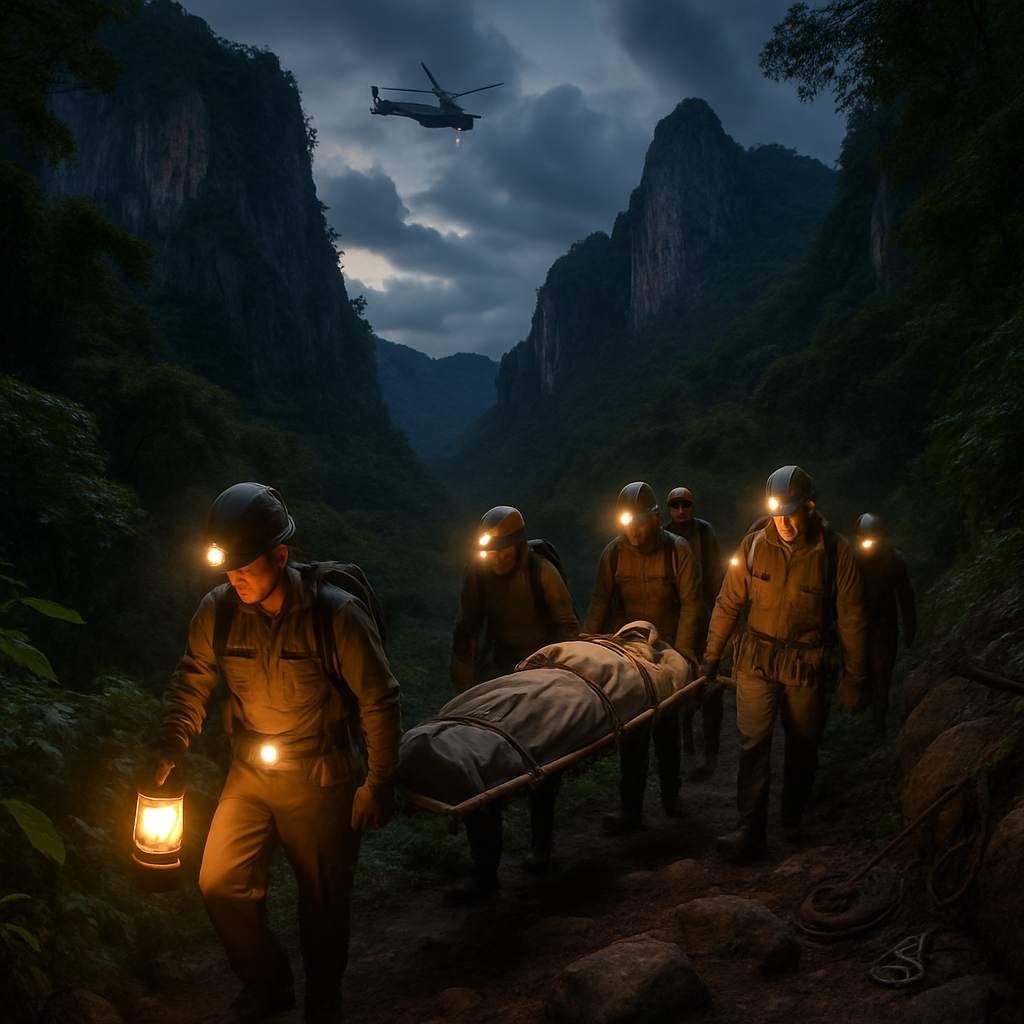
On December 25, what should have been a day of holiday cheer turned tragic at Doi Jawale in Tak province. A 22-year-old tourist, later identified as Sarocha Wijitpanya from Surat Thani, fell an estimated 200 metres into a ravine at the remote mountain attraction in Tha Song Yang district. The fall proved fatal, and local rescuers faced a grueling, daylight-to-dusk recovery mission because the site sits deep in rugged terrain several hours’ walk from the nearest community.
Remote terrain, long trek
Word of the accident reached authorities after local porters raised the alarm. Because Doi Jawale is tucked away in a region of jagged cliffs and thick forest, ground teams could not simply drive in. Officials estimated a 6–7 hour trek on foot to reach the scene — a timeline that turned into more than seven exhausting hours as rescuers threaded their way over steep slopes and tricky footholds to recover Sarocha’s body.
Attempts were made to speed the recovery with air support. Narong Priangkam, manager of the Phetkasem Foundation, said rescuers initially sought helicopter assistance to evacuate the body and get medical and investigative teams on site faster. But aircraft were engaged in other urgent operations and unavailable, so specialized land units stepped in. Units from the 35th Ranger Regiment, national park officers and volunteer rescue teams combined forces and went in on foot.
Who was involved and what happens next
Sarocha’s identity was confirmed by her boyfriend, who reportedly was with her at the time of the fall. Authorities say she was declared dead at the scene. Local disaster prevention officers coordinated with multiple agencies to inspect the area and recover the body for a post-mortem and formal inquiries. As of the latest reports, the circumstances surrounding the fatal fall remain under investigation.
Investigators will likely examine a mix of human and environmental factors: trail markers or lack thereof, weather on the day, footwear and gear, supervision or guide presence, and whether the location carries adequate safety information for visitors. Remote natural attractions often draw adventurous tourists, but their beauty comes with risk — loose rocks, steep drops and minimal communications coverage can turn a misstep into a catastrophe.
Another ravine incident — this time, a bus in Phuket
On the same day authorities were dealing with the emergency in Tak, Phuket faced its own accident involving a ravine. In Kata, a tourist bus operated by OS Tour veered off the road, breached a roadside barrier and plunged into a roughly 15-metre ravine. Several passengers were reported injured and transported for treatment. Local officials opened an investigation into how the driver lost control and whether mechanical failure, road conditions, or driver fatigue played roles.
While the two incidents are separate, they underscore one shared lesson: popular tourist sites — mountain trails or coastal highways — can rapidly become dangerous without proper precautions, infrastructure and emergency readiness.
What visitors and authorities can learn
- Respect signage and marked trails: Many natural attractions have invisible hazards beyond their beauty. Stick to designated paths and heed warning signs.
- Travel with local guides when possible: Knowledgeable porters or guides know the terrain and can significantly reduce risk on remote routes.
- Prepare for limited access: If you plan to visit an isolated site such as Doi Jawale, expect communication blackouts and slow emergency response times. Inform someone of your plans and estimated return.
- Check transport safety: For road journeys, choose reputable operators and ensure vehicles are well-maintained. Drivers need sufficient rest, especially on winding coastal or mountain roads.
Looking ahead
Local authorities in Tak and Phuket are continuing investigations into both incidents. The Doi Jawale case will involve post-mortem findings and inquiries into how a tourist came to fall in such a severe location, while the Kata bus crash prompts scrutiny of operator practices and road safety measures.
For the friends and family of Sarocha Wijitpanya, the holidays have become a time of mourning. For fellow travelers, these events are a sober reminder that awe-inspiring landscapes demand respect and preparedness. As tourism rebounds and adventurers return to Thailand’s natural attractions, the hope is that lessons learned from these tragedies will prompt better safety measures, clearer warnings and faster emergency responses — so future trips end with photos and memories, not sorrow.


















We published this to inform readers and honor the victim; investigations are ongoing and authorities ask anyone with info to come forward.
This is heartbreaking and could have been avoided with better signage and patrols, in my opinion.
Why do people go to dangerous places? It’s sad but also kind of their choice.
Choice is constrained by information asymmetry; tourists often lack accurate risk data and assume beauty equals safety, which is a false equivalence.
Good point — authorities mentioned they will review signage and trail markers as part of the inquiry.
Signage is fine but enforcement matters more; a sign doesn’t stop a selfie-hungry person from climbing a cliff edge.
Exactly, social media fuels this. People chase the perfect shot and ignore safety, even in remote locations.
Not everyone is like that. Many of us respect trails and travel responsibly; blame should be nuanced.
Nuance is necessary, but so is accountability — both for operators and for reckless visitors.
As someone from nearby, I can say locals are tired of tourist negligence. It’s heartbreaking, especially at the holidays.
This points to education; schools and tour operators should teach basic outdoor safety before excursions.
Education is important but without funding for trails and rescues, we keep getting tragedies; budgets matter.
Funding often follows data; more documented incidents could push policymakers to allocate resources to remote rescue teams.
Data-driven policy is ideal, but political will and public pressure are the accelerants for change.
We’re compiling incident data and will publish follow-ups; transparency can help spur action.
Transparency helps, but also involve local communities who know the terrain best when crafting safety plans.
Local guides should be certified and paid fairly. If guides can earn a living, they’ll stay and manage trails properly.
Paid locals could also act as gatekeepers to dangerous spots, preventing access when conditions are bad.
I support local employment schemes, but let’s not forget personal responsibility. Tourists need to prepare better too.
Why are helicopters tied up elsewhere? Sounds like poor emergency coordination at a time when tourism is growing.
Helicopters are scarce and expensive; they often prioritize lives over recovery unless there’s a chance to save someone.
Still, the system should be ready during holiday peaks; expecting volunteers to hike for hours is unacceptable.
Expecting full readiness everywhere is unrealistic, but planning for hotspots during peak season is reasonable and should happen.
I’ve hiked that region; it’s beautiful but treacherous. Porters are heroes for raising the alarm.
Porters risk a lot and often get little recognition or pay. They should be better supported by the authorities.
Reporters noted the Phetkasem Foundation and ranger units were deeply involved; we’ll highlight porter welfare in our next piece.
Can we stop glamorizing dangerous spots on Instagram? If it were less ‘edgy’ fewer people would attempt risky photos.
People will always seek thrills. Banning photos isn’t the answer; better infrastructure and warnings are.
Social campaigns could change behavior over time; combine that with school programs and signage for a layered approach.
So sad. She was young. Why don’t people just stay on the path?
Paths aren’t always obvious in rugged terrain; sometimes markers are missing or worn away.
That’s why maintenance matters. Natural beauty can’t be an excuse for neglect.
This incident highlights the intersection of emergency medicine, public policy and tourism economics; each shapes outcomes.
Could you expand on that? I want to understand how those systems interact in rural Thailand.
Sure: limited funding reduces rescue capacity, tourism demand increases exposure, and without regulation or incentives operators cut corners.
Also geography matters; remote topography makes response times inherently long, so prevention becomes the primary strategy.
As someone who lives in Tak, this family deserves privacy and support, not gossip and blame.
Agreed, but accountability and systemic fixes can be pursued respectfully while supporting the family.
Exactly. We must balance compassion with calls for better safety measures.
I want to add that many tour operators are responsible and enforce safety; spotlighting the bad actors is fair but don’t paint all operators as negligent.
Fair point, but regulation should ensure all operators meet minimum safety standards.
This is a teachable moment; schools could include basic outdoor safety modules and local businesses could give safety briefings before trips.
We’ll reach out to education officials for comment and report back on any programs in development.
Regarding the Phuket bus, driver fatigue and vehicle maintenance are recurring issues on winding coastal roads.
Enforcement of driver hour limits and better maintenance standards would reduce such crashes, but enforcement is patchy.
Passengers need to choose reputable companies and ask about maintenance records; consumer pressure can change operator behavior.
I think involving local communities in trail management would make the most sustainable safety improvements.
Community-based management often yields better local compliance and faster informal monitoring of hazards.
I can’t stop thinking about the boyfriend who identified her. That’s a terrible holiday for their family.
Yes, the human toll is enormous. News coverage should be sensitive and avoid sensationalism.
Agreed. Respect and privacy should be priorities while we discuss policy changes.
Tourism officials should map high-risk attractions and publish clear advisories during bad weather or peak seasons.
Public advisories help, but they need to be visible at trailheads and in booking information too.
And in multiple languages; many tourists miss warnings because they’re only in Thai.
One practical idea: install emergency caches with basic first-aid and communication gear at strategic points on long treks.
Smart idea, though they’d need maintenance and security to prevent misuse. Still worth piloting.