Strategic Victory in Kayah State: Key Road Reopened Amidst Conflict
As the calendar flipped to July, a tense air hung over the verdant landscapes of Kayah State, with strategic movements setting the stage for the days ahead. On July 7th, military columns—an assemblage of focused…
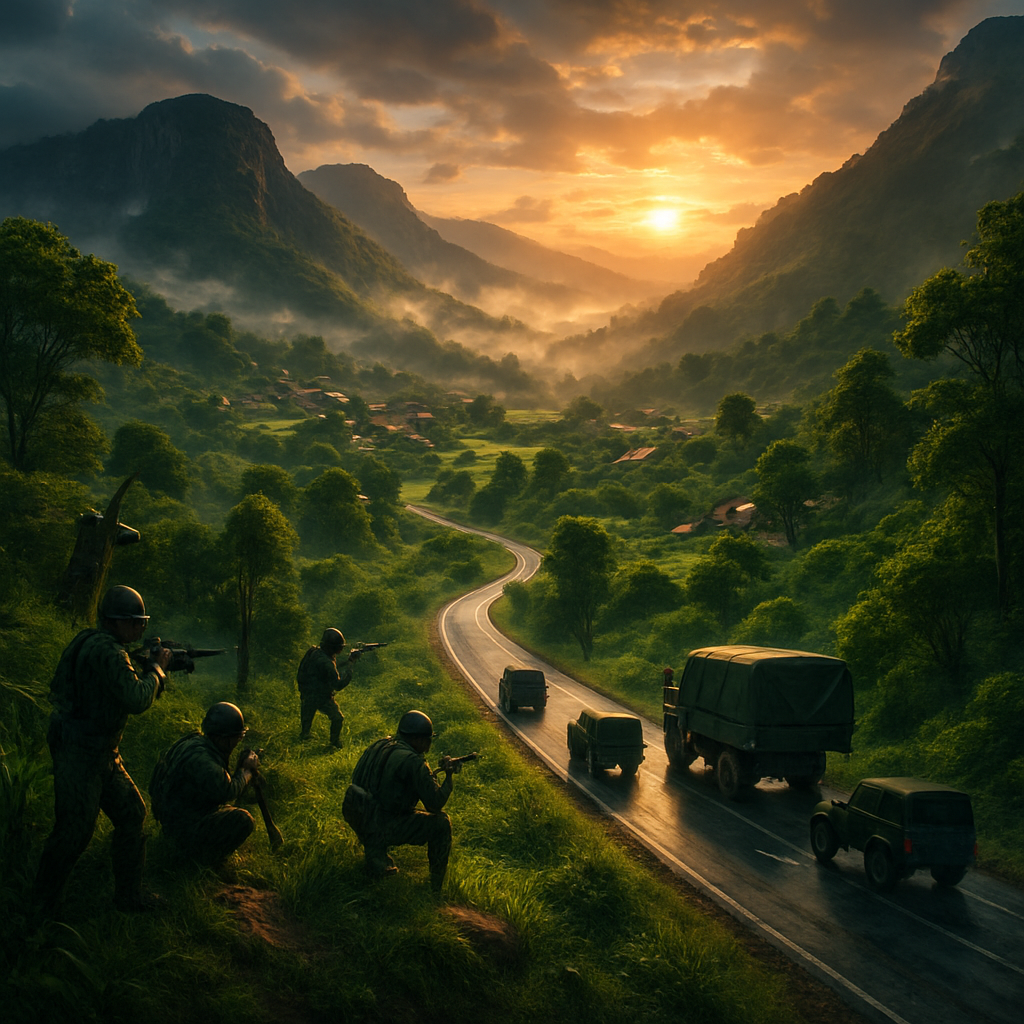
As the calendar flipped to July, a tense air hung over the verdant landscapes of Kayah State, with strategic movements setting the stage for the days ahead. On July 7th, military columns—an assemblage of focused precision—moved methodically into Moebye, bent on securing a vital vestige of a connective lifeline: the stretch of road between Moebye and Loikaw.
The mission at hand was not just any ordeal; it unfolded through the intricacies of terrain that were as challenging as they were beautiful. The villages of Wari Kaw Khu and Song Kaeng rose like sentinels over the land, pivotal in establishing control over the remaining crucial 4.5 kilometers of road. As the Tatmadaw—a formidable force—engaged in their operations, the echoes of skirmishes reverberated through these hills.
The days from July 7 to 11 thrummed with the clamor of battle. Four significant confrontations erupted, each as pivotal as the last. As the dust settled and the smoke curled into the sky, the Tatmadaw emerged having secured the prized road by July 11th afternoon. Hostilities left three insurgents fallen, and a tactical windfall was seized: 15 small arms alongside an assortment of communication devices now lay in military hands. Yet, victory too bore its scars—a few valiant souls were lost, and others injured in the conflict’s ferocious embrace.
Beyond the immediate aftermath, the reverberations of this achievement were destined to ripple far and wide. With the Pinlaung-Pekhon-Moebye-Loikaw road reopened, a new dawn beckoned for the residents of Loikaw. It was as if the very arteries of commerce and connection had been unclogged, allowing vitality to pulse through once more. No longer confined by the blockade of conflict, Loikaw’s citizens could now traverse outwards effortlessly, broadening their horizons via the towns of Hopong, Taunggyi, Aungban, and Kalaw.
With this secured passage, the lifeblood of goods and commodities was set to return at a pace unhampered by the thick fog of war. For many, this victory heralded relief from the relentless pressures that conflict had wrought—shortages, inflated prices, the anxieties of survival. Shelves once sparse were destined now for revival, a promise that the fundamentals of daily life would once more be accessible and affordable. For Loikaw and its surrounding towns, the winds of change were a welcomed force, scattering the seeds of peace and prosperity over a landscape long familiar with strife.
Truly, every victory etched in the annals of July carried with it tales of valor, ambition, and unyielding hope—testaments to a spirited resolve that refused to flicker in the face of adversity. And as the sun set on July 11th, a community stood poised on the brink of rediscovery, its spirit unbroken and its future, anew.
— Transcribed with adaptation from Eleven Media, Asia News Network



Comment verification
Step 1 of 3
Verify your email once to publish your comment. Your email is never shown publicly.
Enter the 6-digit code sent to .
Choose the display name shown next to your comments.