Suriyachai Rawiwan Leads Heroic Efforts in Bangkok SAO Building Collapse Rescue Mission
Tuesday saw a significant leap forward in the intense search and rescue efforts following the catastrophic collapse of the SAO building in Bangkok's bustling Chatuchak district. Helmed by the indefatigable Suriyachai…
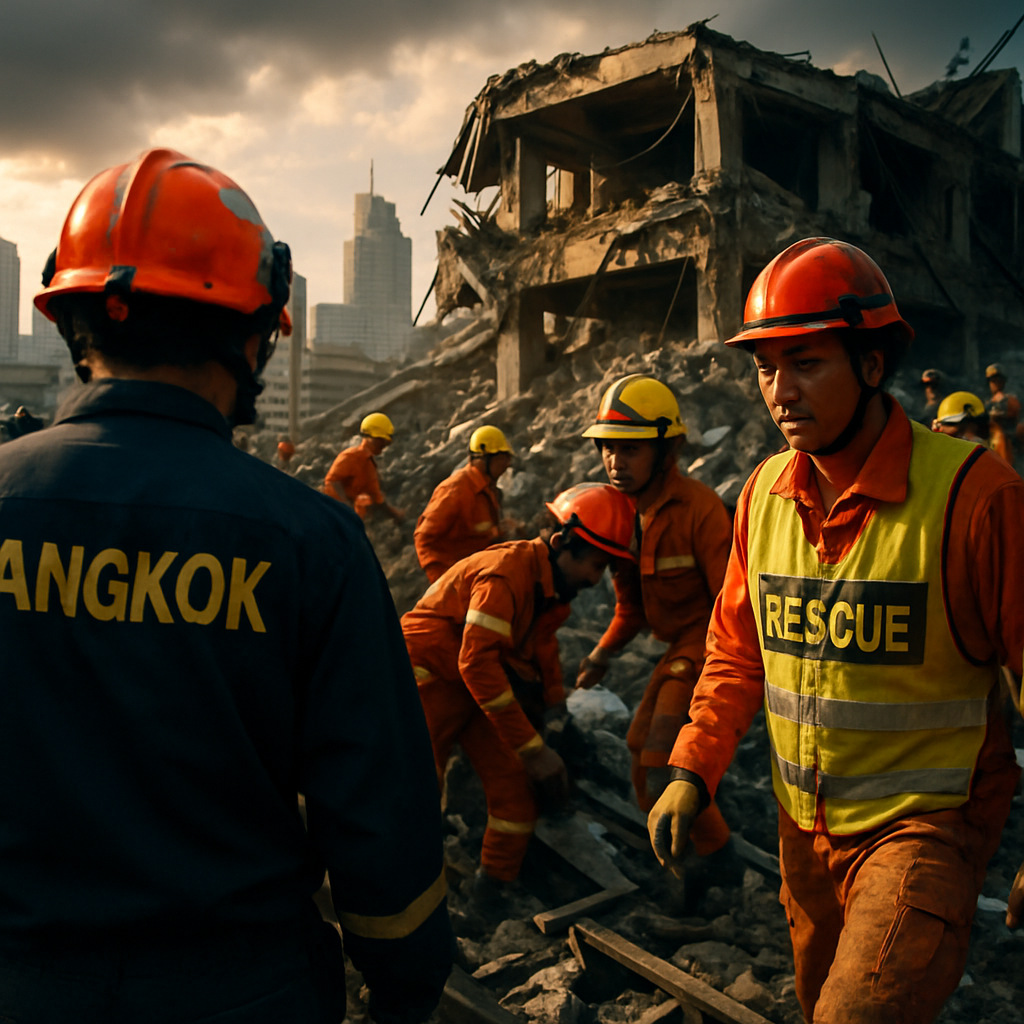
Tuesday saw a significant leap forward in the intense search and rescue efforts following the catastrophic collapse of the SAO building in Bangkok's bustling Chatuchak district. Helmed by the indefatigable Suriyachai Rawiwan, Director of the Bangkok Metropolitan Administration (BMA)’s Disaster Prevention and Mitigation Office, the operation continued to uncover grim truths amidst the rubble.
Although the rescue teams have not unearthed additional survivors or victims since last night through the crack of dawn, hope still flickers in the hearts of those working tirelessly on the site. As of now, the daunting task of clearing the concrete floor of the basement—stretching across an immense 40x40 meters expanse—has reached completion. The focus has now shifted to the imposing collapsed section coiled around parking zone B, standing an ominous 3 meters in height and fanning out 15-20 meters wide, a challenge that demands another 2-3 days of arduous labor.
In an effort to bring closure to terrified families waiting on tenterhooks, officials are set to conduct DNA testing on 280 human body parts housed at the Police General Hospital’s Forensic Institute. These tests will be meticulously cross-checked against the list of 13 individuals yet accounted for. Should identities remain elusive, Suriyachai warns that a reassessment of the missing persons' list may become imperative.
The harrowing events trace back to March 28, when tragedy struck with an 8.2-magnitude earthquake epicenter near Mandalay, Myanmar. It caused the towering, under-construction 30-story structure on Kamphaeng Phet 2 Road to crumble, trapping over a hundred workers beneath its mighty edifice.
As of Tuesday’s update, the BMA somberly reports 109 confirmed victims caught in this disaster, each a poignant reminder of lives intertwined with fate. While 87 have tragically perished, nine were rescued injured, and the fate of 13 continues to shroud in mystery.
Taiwut Khankaew, Director of the BMA’s Office of City Planning and Urban Development, casts light on the colossal magnitude of the collapse. The once-proud 30-story skyscraper boasted a sprawling 50,000 square meters and was graced by 10 elevators. Its collapse sent it leaning precariously toward the adjoining parking structure. Theories suggest that in those gripping moments of terror, some may have fled into the parking area, prompting search efforts to extend until every corner is scoured and every grim story accounted for.
Evacuation recreations suggest a mass exodus toward the fire escape, the solitary lifeline linking the tower to the parking garage. This could explain why most bodies found were huddled in Zone C, believed to be aligned with this escape route.
The basement’s clandestine recesses demand another painstaking 2-3 days of search, while the cumulative operation aims for completion in 4-5 days, with authorities eyeing a May 10 conclusion. Yet, underpinning this timeline is Taiwut’s candid admission: “The BMA lacks extensive experience in such rescue operations, yet our resolve remains unwavering. We will leave no stone unturned, with precise caution, to recover all who lay beneath.”



Comment verification
Step 1 of 3
Verify your email once to publish your comment. Your email is never shown publicly.
Enter the 6-digit code sent to .
Choose the display name shown next to your comments.