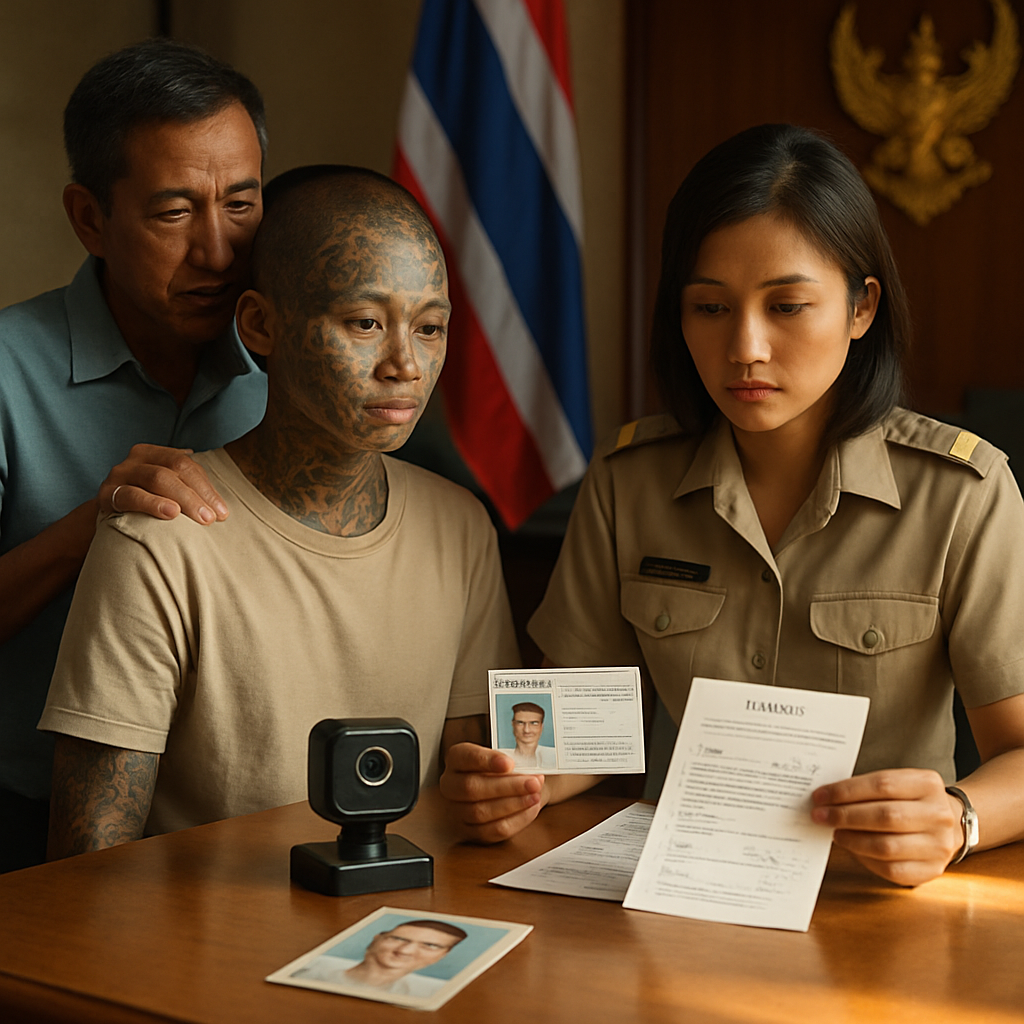
A simple printed notice at a national ID card service point has become an unexpectedly viral public service announcement — equal parts practical tip and gentle reminder that modern ID systems sometimes struggle to keep up with modern life. The sign, which began circulating on social media on December 22, 2025, warns that people whose appearance has changed because of cosmetic surgery or gender transition must bring a witness when applying for or updating an identity card.
The notice — photographed and shared online (photo via The Thaiger) — reads: “Making an ID Card: Individuals whose appearance differs from the database due to cosmetic surgery or gender transition must be accompanied by one guarantor.” It’s short, matter-of-fact and instantly relatable for anyone who’s ever looked at an old passport photo and wondered if that person was actually them.
A lot of the online reaction has been amused. Some users joked that facial-recognition systems have a very low tolerance for reinvention (“Sorry, we don’t do glow-ups”), while others took the sign seriously and thanked the office for the heads-up. Either way, the notice highlighted a growing friction point: what happens when biometric systems — designed to match faces, fingerprints and other data — encounter someone who no longer matches the information stored in the civil registry.
How does this happen? Thailand, like many countries, uses biometric photos and other identifying data in its civil registration system. When a person’s face changes significantly due to cosmetic procedures, aging, injury, or gender-affirming treatments, automatic matching algorithms may fail to confirm identity. In those cases, human officers step in and ask for additional verification — which is where a guarantor comes in.
What is a guarantor? In this context, a guarantor (or witness) is someone who can vouch in person for the applicant’s identity. That could be a family member, friend, or other person who knows the applicant well. The office notice suggests bringing one guarantor to avoid delays if visual or biometric checks are inconclusive.
The sign sparked useful conversations about transparency and accessibility. On the one hand, it’s practical: people planning cosmetic surgery or gender transition who intend to update their ID can now prepare by bringing necessary documents and a guarantor when they visit a district office. On the other hand, the photo reinforced concerns about how biometric tech handles identity changes — and whether policies are sufficiently inclusive and clear for transgender people and others undergoing medical changes.
Officials haven’t issued a formal, nationwide announcement tied to the sign, but the notice functions as a helpful tip: if your face has changed, bring backup. To minimize complications, applicants are advised to bring:
- Any relevant medical or legal documents related to name or gender changes (if applicable).
- A guarantor who can confirm identity in person.
- Additionally, other supporting paperwork such as household registration, previous ID cards, or certificates that might help officers verify identity more quickly.
It’s worth noting that a guarantor requirement isn’t unique to Thailand; many countries have procedures for situations where automated systems can’t confidently match records. What made this sign catch on was the combination of modern tech anxieties and the everyday reality of people changing how they look — whether by choice or necessity.
Social media aside, the post also arrived amid a separate, sobering incident in Bangkok’s cosmetic surgery scene. In Prawet district, a woman reportedly lost consciousness from severe blood loss after undergoing dimple surgery at a beauty clinic. According to reports, she experienced intense pain and heavy bleeding during the procedure; staff told her it was normal and continued. The wound allegedly bled for nearly two months despite multiple follow-ups at the clinic and a hospital. That case has sparked questions about clinic safety, informed consent and the oversight of cosmetic procedures — a reminder that changes to appearance aren’t always simple or cosmetic in name only.
Between the viral sign and the Prawet case, two themes emerge: the world is changing fast — technologically and socially — and official systems and service providers are still catching up. Whether you’re planning elective cosmetic work, undergoing gender-affirming care, or just hoping your new haircut doesn’t ruin your official photo, a little preparation goes a long way.
Practical takeaway: if you expect your appearance to differ substantially from the photo on file, bring documents, consider notifying the district office ahead of time if possible, and attend with a guarantor who can verify your identity. And if you’re considering cosmetic surgery, pick licensed clinics, ask about risks and follow-up care, and insist on clear explanations — your ID isn’t the only thing that should be taken seriously.
In short: when your face evolves, bureaucracy sometimes lags. A friendly guarantor, a few supporting papers and a dose of patience can turn a potentially awkward bureaucracy moment into nothing more than another small life update handled like a pro.


















This sign is practical but bordering on invasive; asking for a guarantor can out someone publicly and put trans people at risk.
I agree, Anna — in a conservative area a guarantor could expose someone to harassment or family rejection.
Exactly, Somchai — there should be safer alternatives like confidential admin review or designated trusted staff.
From an administrative perspective, human verification is often a stopgap because systems weren’t trained for diverse transitions, but policy can and should include privacy safeguards.
But isn’t a guarantor just someone who vouches? If it helps prevent fraud, maybe it’s a reasonable requirement.
It helps against fraud, but the burden falls disproportionately on marginalized people who may not have safe guarantors.
Biometric systems are brittle; real-world use requires contingency procedures and training for staff to handle transitions sensitively.
Agreed — algorithms reflect their training data. If datasets lack diversity, performance drops for groups that differ from the norm.
And beyond datasets, governance matters: transparency about how matches are made and appeal mechanisms for false negatives are essential.
Why not just scrap facial recognition for important documents? Paper checks used to work fine.
This is why I never trust apps that use face unlock. Technology breaks when people change, and people change a lot.
Face unlock is convenient but not secure enough for legal identity; I think multi-factor and human checks should remain.
Exactly, and forcing a guarantor is better than locking someone out completely — though it should be optional and safe.
The Prawet surgery story is horrifying; it shows cosmetic changes come with real medical risks that get minimized by clinics.
This policy sounds like a small administrative fix but it could institutionalize discrimination if not carefully applied.
How would it institutionalize discrimination? Asking for a witness seems neutral on paper.
Neutral on paper, Nina, but in practice staff biases decide when someone ‘looks different’ and that invites profiling.
Plus, think about rural areas where trusted guarantors can’t be easily found; policy needs an alternative path.
If there’s no formal guidance, discretionary practices lead to inconsistent enforcement and legal challenges for rights violations.
We need clear standards: what counts as ‘appearance differs’ and what documentation suffices, otherwise it’s chaos.
Yes, a checklist and confidential procedures would stop arbitrary decisions and protect vulnerable applicants.
Simple civic suggestion: let people pre-notify the office and submit medical/gov paperwork online to reduce public exposure.
Online submission helps, but it depends on trust in digital systems, and not everyone has access or comfort with that.
True, Sam — so offices should offer both confidential in-person options and online ones with strict privacy controls.
I think the guarantor rule is fine if used sparingly. The bigger problem is unlicensed clinics causing harm and then people scrambling to update IDs.
Spot on, Sam — the surgery incident is a reminder that consumer protection and medical oversight are critical.
Back in my day we didn’t have these issues; you changed your name or you didn’t. This feels overcomplicated.
It’s complicated now because identity, medicine, and tech intersect. Clinging to old models won’t solve modern problems.
My 12-year-old niece will change her look every year; we can’t make bureaucracy punish people for natural variation.
If offices already use guarantors for other cases, why is this suddenly controversial? Maybe social media is just stirring it up.
Because social media reveals the human impact — what seems routine can be traumatic for some people who risk outing themselves.
Technically, facial recognition algorithms should report confidence intervals, and any low confidence should trigger private review, not public guarantor demands.
Confidence reporting is good, but without policy on privacy and alternative verification, you’re still leaving people vulnerable.
Right — algorithmic transparency must be paired with procedural safeguards and staff training on bias and sensitivity.
I worry about foreigners or stateless people who might not have a guarantor; they could be denied basic services because of appearance changes.
Sometimes governments need simple rules. If someone looks different, bring someone who knows them. Problem solved.
That simplicity overlooks safety risks and social realities; rules should protect people, not just simplify processing times.
Fair point, Maya — maybe I underestimated how much harm a policy can cause in practice.
I support modernizing systems, but only with human rights checks — tech can’t be the final judge of identity.
Why is it always the vulnerable who have to jump through hoops? If the system fails, fix the system instead of policing people.
That’s the core tension: stopgap measures vs. systemic reform. Both are costly, but people deserve dignity in the meantime.
Minor controversy: what if someone fakes a guarantor? There must be verification of the witness too, otherwise it’s performative.
Then the office should check IDs of guarantors and record their details, but that adds bureaucracy and time.
From a schoolteacher’s view, pupils worry about being forced to out themselves when updating IDs; schools should provide guidance and letters if needed.
Great idea — official letters from institutions could serve as safe guarantors in many cases.
Yes, and that keeps verification private within trusted channels rather than public windows at the counter.
I had plastic surgery and had to bring my sister to update my passport photo years ago; it wasn’t traumatic but it was awkward.
Thanks for sharing, Anonymous — personal stories help policymakers understand the real impact of these rules.
The article highlights a broader issue: identity systems must be designed for change, not just static snapshots of people.
Absolutely — temporal variation is a known problem in biometrics research, and there are proposed methods to handle aging and changes.
Controversial take: maybe requiring a guarantor encourages social support networks and ensures someone sees you through the process.
That assumes everyone has a supportive network, Layla, which isn’t true for many trans or marginalized individuals.
Why are we surprised? Tech always lags behind social change. Policy updates should be faster and include civil society voices.
Civil society inputs are good, but governments also need funding and training to implement better systems.
The Prawet clinic tragedy should be the headline takeaway — cosmetic procedures need stricter regulation to prevent bodily harm.
Some will weaponize this sign against trans people, claiming it’s a neutral bureaucracy move when it actually stigmatizes identity change.
That’s why nuance matters: policy can be neutral in wording but discriminatory in execution, and we must watch both.
If they publish a clear alternative verification pathway (certified docs, sealed medical letters), this could be resolved cheaply.
Yes, standardized document-based alternatives and audit trails would reduce discretionary power and protect individuals.