Udon Thani Expo Draws Audit Over 2.75B Baht Budget
Parliamentary budget monitors led by MP Rukchanok Srinork have questioned the 2.75 billion baht Udon Thani International Horticultural Expo after first-month ticket receipts reached roughly 7 million baht, urging tighter safeguards before Nakhon Ratchasima hosts its 4.281 billion baht expo in 2029.
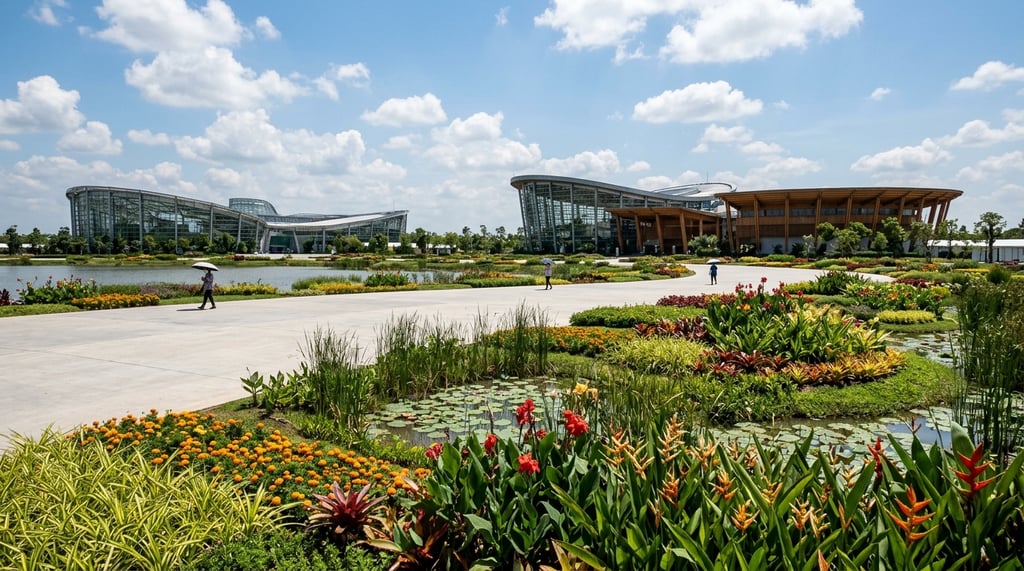
Thailand's House Committee on Budget Monitoring has opened a sharp public debate over how the state plans, prices, and manages international mega-events after a late-November site inspection of the Udon Thani International Horticultural Expo 2026 exposed a wide gap between multi-billion-baht public spending and first-month ticket income.
People's Party list MP Rukchanok Srinork, who chairs the parliamentary budget-monitoring panel, led committee members to the 1,030-rai Nong Dae Wetland venue in Mueang Udon Thani district nearly four weeks after the Category B exposition opened on November 1, 2026. According to figures presented following the inspection, the project carries a core state budget ceiling of 2.75 billion baht, yet paid admission receipts during the opening 27 days reached only around 7 million baht.
Breaking Down the 2.75 Billion Baht Budget and Ticket Gap
Cabinet records compiled by investigative outlet Isranews show that Thailand's bid for the International Association of Horticultural Producers (AIPH) Category B event began with Cabinet principle approvals in November 2021 and January 2022 under the Ministry of Agriculture and Cooperatives. The initial 2.5 billion baht framework later expanded to 2.75 billion baht after additional central-budget top-ups were approved to cover site preparation, operational management, and promotional campaigns. Within that total, roughly 1.73 billion baht went toward construction and supervision, while 589 million baht, representing more than one-fifth of the entire allocation, was earmarked for public relations and communications.
Those capital and marketing outlays now sit beside modest early box-office returns. With standard adult admission set at 199 baht alongside discounted or complimentary entry tiers for local residents, staff, and organised groups, cumulative attendance during the first 25 to 27 days hovered between 176,000 and 180,000 entries. That pace translates to roughly 7,000 entries per day, well below the government's pre-opening forecast of 20,000 to 30,000 daily visitors. Attendance peaked above 13,000 on November 24 during Loy Krathong festivities, according to Ministry of Agriculture and Cooperatives Permanent Secretary Rapibhat Chandarasrivongs.
Rukchanok also flagged administrative circulars encouraging state agencies and local administrative organisations across Thailand to arrange official study visits to the expo. In her assessment, steering government offices to spend separate agency travel budgets to bolster daily headcounts risks recycling taxpayer funds to inflate attendance statistics without generating genuine private tourism inflows.
Missing Dinosaur Props, 80,000-Baht Sculptures, and Botanical Backlash
Beyond headline revenue numbers, the budget committee's walkthrough focused public attention on granular procurement specifications issued under Department of Agriculture landscaping documents. Media reviews of April 2025 cost-estimate sheets cited by Rukchanok highlighted sculpted fruit and vegetable installations, including lime, durian, jackfruit, and mangosteen props, with unit material estimates approaching 80,000 baht apiece, alongside large decorative ceramic planters priced in the tens of thousands of baht.
Even more viral scrutiny followed the committee's search for prehistoric animal sculptures listed in official procurement paperwork. Documents reviewed by lawmakers recorded large dinosaur models priced at 1,999,102 baht each and smaller models at 1,599,282 baht each, in addition to a Thai-dinosaur display zone with smaller figures ranging from 59,973 baht to 399,820 baht. During the on-site inspection, committee members and accompanying site personnel were unable to locate the nearly 2-million-baht sculptures in their expected display areas, prompting questions over both delivery verification and why dinosaur props were commissioned for a wetland horticulture exhibition.
At the same time, Thai plant collectors and horticulture specialists criticised several international garden plots on Pantip and Facebook, arguing that common ornamental plants were placed in mismatched geographic pavilions without rigorous oversight by an accredited botanical curator. Rukchanok noted that some foreign garden teams also encountered visa delays and rushed handover schedules, leaving parts of the grounds looking unfinished during the opening month even as specific domestic zones such as the orchid and cactus collections drew favourable visitor reviews.
How Organisers and the Agriculture Ministry Have Responded
Expo organisers and Udon Thani provincial authorities have pushed back against characterisations that the event is faltering, framing the opening weeks as early operational growing pains that are already being corrected. Following widespread first-week complaints regarding heat, transport bottlenecks, and limited dining options, the organising committee announced a slate of practical fixes: introducing free songthaew shuttle loops from downtown Udon Thani, adding a nearby rail stop, streamlining gate entry, expanding food vendor stalls, and improving links between remote parking lots and the main promenade.
To ease internal mobility across the sprawling 1,030-rai wetland site, organisers borrowed additional electric shuttle trams from the Nakhon Ratchasima Zoo to supplement the expo fleet. Meanwhile, senior Agriculture Ministry officials have pointed to nearly 180,000 cumulative visitors in the first 25 days as evidence of steady regional interest and have scheduled major seasonal programming across December and January, including World Soil Day activities, Udon Thani's 134th anniversary celebrations, and cool-season displays featuring tulips and Siam tulips, to lift turnout during the peak winter travel window.
Relevant divisions within the Department of Agriculture have indicated they are compiling formal documentation to address the committee's specific line-item queries on sculpture pricing and asset placement. Even Rukchanok paired her fiscal critique with an appeal for residents to visit the stronger botanical halls, arguing that since taxpayers have already financed the venue, higher organic turnout is preferable to empty walkways.
Why the Udon Thani Audit Matters for Korat Expo 2029
The sharpest policy warning from the Udon Thani review looks three years ahead to Nakhon Ratchasima. Thailand is already committed to hosting the International Horticultural Expo 2029 Korat Thailand, a larger AIPH Category A1 world exposition scheduled to run for 110 days from November 10, 2029, to February 28, 2030, under a Cabinet-approved budget of 4.281 billion baht.
In September 2026, the Cabinet approved relocating the Korat venue from public forest land in Khong district to the Ministry of Agriculture and Cooperatives' Dairy Cattle Research and Development Center in Pak Chong district. Officials cited a cost-effectiveness study by the Office of the National Economic and Social Development Council (NESDC) showing that Pak Chong offers stronger highway access, utilities, hotel capacity, and medical infrastructure while avoiding new land-acquisition expenses.
Even with a better-connected venue near Khao Yai, budget watchdogs warn that site selection alone will not prevent cost overruns or underwhelming curation if procurement standards, international pavilion timelines, and realistic attendance modelling are not overhauled first. With Korat's allocation standing more than 55 percent higher than Udon Thani's total budget, lawmakers are pressing for a transparent post-mortem on Udon Thani's 589 million baht PR outlay, contractor vetting, and post-expo park maintenance plan before major Korat construction tenders go out.
What This Means for Expats and Travelers in Thailand
For foreign residents in Isan and domestic travelers considering a cool-season trip to Udon Thani before March 14, 2027, the expo remains open daily with improved free shuttles from the city centre, expanded shade and food options, and well-regarded indoor orchid and cactus pavilions. Visiting in December or January offers milder northeastern temperatures and peak winter flower blooms, though visitors should still plan for wide walking distances across the 1,030-rai wetland grounds and check local shuttle schedules in advance.
More broadly, the scrutiny surrounding Udon Thani illustrates a recurring tension in Thailand's regional tourism strategy. Secondary provinces in Isan and the North increasingly rely on state-funded mega-events to diversify visitor flows beyond Bangkok, Phuket, and Chiang Mai, yet big-ticket public festivals often struggle to convert headline budgets into sustained international footfall unless transport connectivity, private-sector marketing, and post-event urban reuse are built in from day one. Taxpayers and long-term residents watching the 4.281 billion baht Korat 2029 rollout now have a concrete benchmark by which to measure whether Bangkok's ministries tighten procurement discipline ahead of Thailand's next global showcase.

Comment verification
Step 1 of 3
Verify your email once to publish your comment. Your email is never shown publicly.
Enter the 6-digit code sent to .
Choose the display name shown next to your comments.