Bangkok Braces for PM2.5 Haze Surge From Dec 1 to 6
Thai air quality officials warn that stagnant winter air will trap PM2.5 pollution across Bangkok and Central Thailand from December 1 to 6, urging residents to monitor Air4Thai and AirBKK.
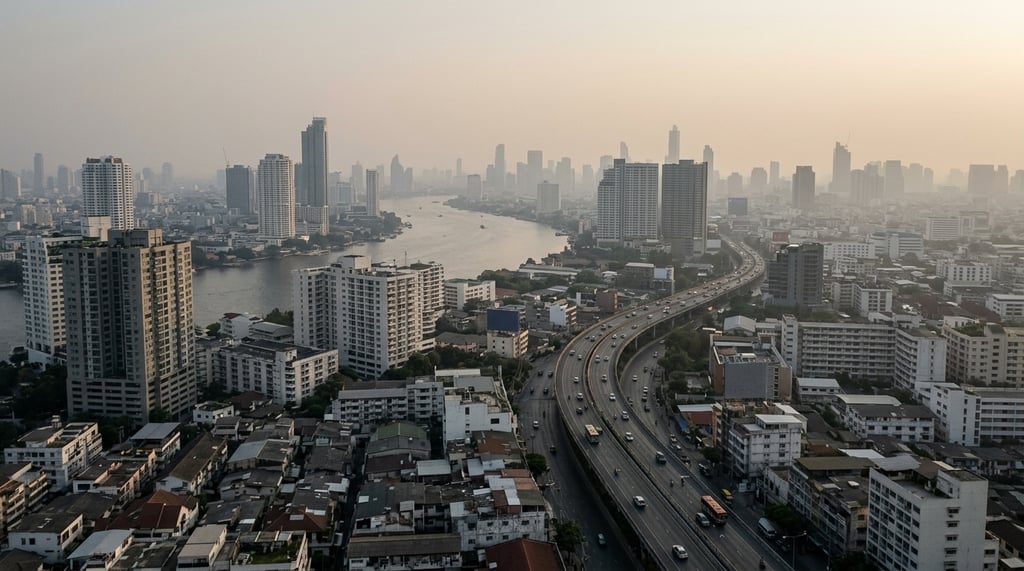
Bangkok and the surrounding Central Plains are entering their annual winter air quality test earlier than many residents had hoped. In a national assessment issued at 5:00 p.m. on November 29, 2026, Thailand's Center for Air Pollution Mitigation (CAPM), operating under the Pollution Control Department (PCD), warned that concentrations of fine particulate matter smaller than 2.5 microns (PM2.5) are forecast to climb steadily across the capital, its metropolitan ring, and the central and western provinces from December 1 through December 6.
The warning arrives during a deceptive lull. As of late Sunday afternoon, national monitoring stations operated jointly by the PCD and the Bangkok Metropolitan Administration (BMA) recorded generally benign conditions across most of the kingdom. Only a single monitoring station in the northern province of Phitsanulok breached Thailand's official daily safety threshold of 37.5 micrograms per cubic meter. Yet meteorologists and environmental officials stress that this late November clarity is temporary, as seasonal atmospheric shifts prepare to lock urban and regional emissions close to street level.
A Regional Split Across the Kingdom
The CAPM seven-day outlook covering November 30 to December 6 highlights a sharp geographical divergence in Thailand's airshed. While Bangkok, its five adjacent metropolitan provinces, and the broader central and western plains face deteriorating dispersion and rising particulate loads starting Tuesday, the rest of the country is projected to enjoy improving or consistently clean air over the same window.
Baseline readings from November 29 illustrate how unevenly particulate matter distributes across the country before the winter inversion deepens. In the Northeast, monitoring stations logged PM2.5 concentrations between 15.4 and 35.8 micrograms per cubic meter, comfortably inside national limits and trending downward through the first week of December. The Eastern seaboard fared even better, posting readings from 14.1 to 28.0 micrograms per cubic meter amid healthy coastal ventilation. Southern Thailand remained the country's cleanest region by a wide margin, registering between 8.1 and 9.6 micrograms per cubic meter, levels that satisfy even the World Health Organization's strict 24-hour guideline of 15 micrograms per cubic meter.
Even in the North, where Phitsanulok's isolated exceedance served as an early reminder of dry-season vulnerability, forecasters expect overall particulate levels to ease between November 30 and December 6. That leaves the capital basin as the primary focal point for public health advisories during the opening week of December.
Why Stagnant Winter Air Traps Bangkok Emissions
The mechanics behind Bangkok's early December haze are well understood, yet they remain stubbornly difficult to mitigate. As cooler, drier air masses push southward from the Asian landmass at the start of the cool season, surface wind speeds drop and atmospheric ventilation rates contract. Temperature inversions form overnight, placing a meteorological lid over the low-lying Chao Phraya River basin that prevents exhaust and industrial plumes from dispersing upward.
Under those stagnant conditions, the capital's baseline emissions quickly compound. Diesel trucks, aging public buses, dense commuter traffic, port logistics, and urban construction generate a constant supply of fine particulates that remain manageable when monsoon winds sweep the basin clean, but accumulate rapidly once the air stalls. In the surrounding central and western provinces, early dry-season agricultural residue clearing can add a secondary layer of smoke that drifts into the metropolitan area whenever light prevailing winds align.
Because Thailand's national standard of 37.5 micrograms per cubic meter is two and a half times higher than the World Health Organization's 24-hour benchmark of 15 micrograms per cubic meter, residents frequently experience eye irritation, scratchy throats, and reduced visibility even on days when official maps still display yellow or moderate ratings. Public health researchers note that prolonged exposure to fine particles small enough to penetrate deep into the lungs and bloodstream carries cumulative cardiovascular and respiratory risks, particularly when multi-day stagnation episodes repeat throughout December, January, and February.
Official Health Advisories and Public Preparedness
In its November 29 guidance, the CAPM urged residents across Bangkok and the Central Plains to treat the December 1 to 6 forecast as an operational cue rather than a distant seasonal reminder. Authorities recommended checking real-time district readings before commuting or scheduling outdoor exercise, relying on the PCD's Air4Thai application and the Bangkok Metropolitan Administration's AirBKK monitoring network, which tracks localized conditions across the city's 50 districts.
For the general public, health officials advise shortening outdoor workouts, limiting prolonged physical labor in open air during peak morning and evening stagnation hours, and wearing properly fitted particulate masks such as N95 or KN95 respirators when street-level readings climb. Residents are also encouraged to watch for early physical symptoms including coughing, nasal irritation, watery eyes, or shortness of breath.
Stricter precautions apply to vulnerable groups, including young children, older adults, pregnant women, and individuals living with asthma, allergies, chronic lung conditions, or heart disease. Medical guidance calls on these groups to avoid extended outdoor exposure altogether during elevated dust episodes and to remain in well-sealed indoor spaces equipped with HEPA air filtration.
What This Means for Expats and Businesses in Thailand
For foreign residents, international schools, and multinational employers in Bangkok, the December 1 to 6 advisory marks the practical start of the annual indoor-air management season. International schools across Sukhumvit, Sathorn, Bang Na, and Nonthaburi typically activate tiered outdoor-recess protocols once local sensors cross moderate thresholds, shifting athletics indoors and running classroom purifiers continuously. Families with young children should verify that home HEPA filters have fresh cartridges before retail demand spikes later in December.
Remote workers and corporate offices face a familiar operational rhythm. Many Bangkok firms now maintain flexible work-from-home triggers when district-level PM2.5 readings enter the orange zone above 37.5 micrograms per cubic meter, reducing commuter exposure while trimming rush-hour tailpipe emissions. Travelers visiting Thailand in early December also have a clear regional takeaway from the CAPM data: while Bangkok and the Central Plains brace for hazy skies, southern beach destinations and eastern coastal resorts remain largely insulated by steady sea breezes and clean air.
The Longer Policy Challenge Ahead
Each winter's first multi-day haze alert renews scrutiny of Thailand's structural air-quality reforms. While real-time monitoring through Air4Thai and AirBKK has improved public transparency, and the BMA has expanded low-emission zone enforcement and vehicle inspections, sustained relief requires coordinated action across transport, industrial standards, and agricultural supply chains. Until stricter emission rules and cleaner farming incentives reduce baseline output across the Chao Phraya basin, Bangkok's winter air quality will remain tightly tethered to the mercy of the wind.

Comment verification
Step 1 of 3
Verify your email once to publish your comment. Your email is never shown publicly.
Enter the 6-digit code sent to .
Choose the display name shown next to your comments.