Chiang Saen Tin Surge Prompts Thai Origin Law
An 18-fold jump in tin exports through Chiang Saen has prompted Thailand to push mandatory mineral-origin traceability laws and halt mining-chemical shipments to Myanmar.
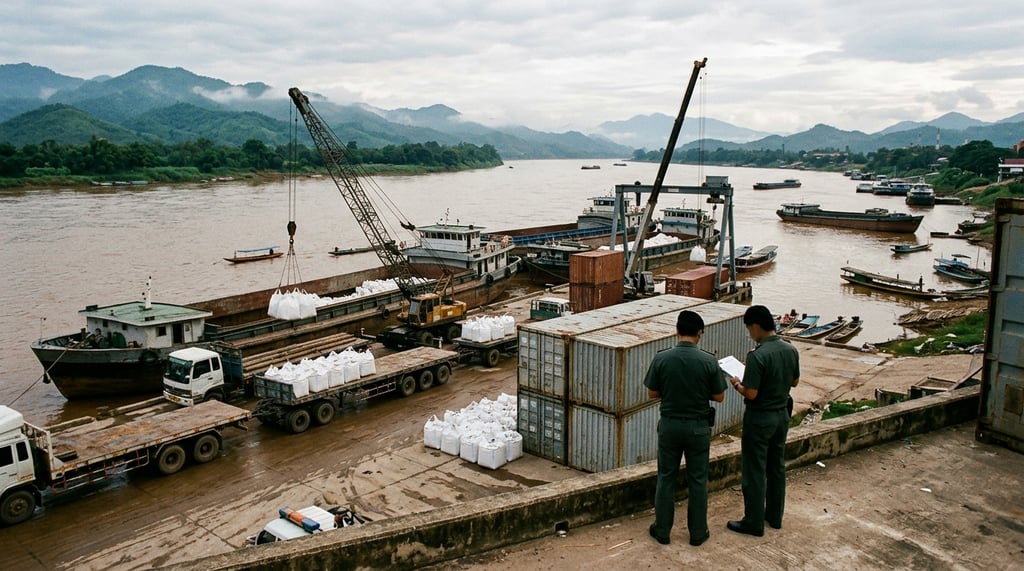
An extraordinary surge in tin shipments moving through northern Thailand has forced Bangkok to confront an uncomfortable trade reality. Over just two fiscal years, tin ore exports cleared through the Chiang Saen customs checkpoint in Chiang Rai province jumped more than 18-fold in volume and more than 35-fold in value, with every tonne in the latest fiscal year bound for China. Combined with over 6,400 tonnes of Myanmar tin ore transiting the same Mekong River gateway to Chinese buyers, the checkpoint now handles more than 8,000 tonnes a year, or over 20 tonnes a day.
On 29 November 2026, Deputy Prime Minister and Higher Education, Science, Research and Innovation Minister Yotchanan Wongsawat inspected the Chiang Saen Customs House alongside Deputy Agriculture Minister Piyarat Tiyapairat and senior customs officials. The visit audited border readiness ahead of a six-month ban on exporting mining precursor chemicals to Myanmar and advanced a push for mandatory mineral-origin traceability legislation covering every import, export, and transit shipment passing through Thai territory.
Anatomy of a Border Transit Loophole
Customs figures point to a regulatory gap rather than a sudden revival of domestic Thai tin mining. Under current law, mineral imports for domestic use require a Certificate of Origin and mining-law clearance, whereas transit cargo crossing Thailand from a neighbouring country to a third market faces no comparable origin-disclosure mandate. Declarations need not specify the upstream mine, concession holder, or ore composition.
Deputy Director-General of Customs Niti Witthayatem told the delegation that customs enforces 30 to 40 statutes for line ministries but holds no unilateral power to halt mineral trade. Without formal notifications from the Industry and Commerce ministries requiring upstream company names, cargo volumes, and certified laboratory assays, border officers can check little beyond basic paperwork.
Hardware constraints compound the legal blind spot. Chiang Saen Customs House has no X-ray container scanner, forcing officers to route suspect boxes roughly 50 kilometres to Mae Sai checkpoint at higher cost to traders. Sending ore samples to Bangkok for composition tests takes seven to ten days. A budget bid for a Chiang Saen scanner is slated for fiscal 2028, while a 2.9-billion-baht procurement for four X-ray units at Chiang Khong, Mae Sot, and Laem Chabang Port will take one to two years.
Even daily traffic patterns drew scrutiny. Despite an annual throughput exceeding 8,000 tonnes of tin, zero mineral or chemical shipments cleared Chiang Saen during the 29 November inspection. Customs said cleared vessels had departed earlier while undeclared barges waited offshore, prompting Yotchanan to order checks on whether brokers paused deliveries or rerouted cargo during heightened oversight.
Conflict Mining and Poisoned Rivers
Behind the customs ledger sits an ecological and geopolitical crisis in southern Shan State. Field reporting by Mongabay in October 2026 documented over 50 Thai-registered companies importing critical minerals from Myanmar for onward sale to China with minimal upstream visibility. A National Security Council survey led by Secretary-General Gen Chaiyaphruek Duangpraphat in late November identified 33 mines in the Kok and Sai river basins affecting Thailand, roughly 60 to 70 percent controlled by the Myanmar military and the remainder by United Wa State Army forces, with several sites expanding 35 to 50 percent alongside a new tin mine.
Chiang Rai communities have borne the environmental cost. Reporting by Thai PBS World showed unregulated Tachileik operations, including 28 Chinese-funded and managed mines extracting gold, lead-zinc, manganese, tin, and antimony, pushing Sai River turbidity to 14,000 NTU, more than double the Provincial Waterworks Authority's 6,000 NTU filtration ceiling. Pollution Control Department tests measured arsenic at 0.25 milligrams per litre, twenty-five times Thailand's 0.01 mg/L drinking-water standard.
From Chemical Bans to Global Traceability
Bangkok is pairing immediate supply-chain pressure with statutory reform. Following coordination between Prime Minister Anutin Charnvirakul, the Defence Ministry, and the National Security Council, a Defence Ministry directive halts exports of four mining precursor chemicals to Myanmar for an initial six months at the turn of November and December, while Commerce and Industry officials weigh additional curbs. Authorities expect a three-to-four-month disruption to upstream mines before operators seek alternative routes.
Longer term, Yotchanan is backing legislation requiring every tonne of imported, exported, and transited ore to disclose mine coordinates, end buyers, and laboratory composition, backed by GPS route tracking and rapid border testing kits. Mae Fah Luang University scholar Suebsakul Kidnukorn urged extending forensic mineral fingerprinting across all Thai-Myanmar crossings and deep-sea ports so traders cannot simply divert shipments toward Mae Sot or Laem Chabang.
On 30 November, Yotchanan plans to present isotopic and chemical fingerprinting evidence to Myanmar officials, request a licensed-mine registry for customs cross-checks, and propose matched sensors across 12 agreed Kok and Sai river monitoring sites. Regulatory divergence remains a sticking point: Myanmar uses a 0.05 mg/L arsenic benchmark against Thailand's 0.01 mg/L drinking-water limit, letting identical readings appear compliant on one bank and hazardous on the other. Bangkok will press for six-month closures of unmitigated mines, coordinate with Beijing following Anutin's talks with President Xi Jinping, and raise mineral traceability with the OECD, the United Kingdom, and the United States in January 2027.
What This Means for Northern Residents and Regional Trade
For residents, farmers, and expatriates in Chiang Rai and northern Chiang Mai, border controls provide the first concrete economic lever against cross-border river contamination that has strained municipal tap water and rattled confidence in local rice and fish. Yet dedicated scanners at Chiang Saen remain years away, and precursor bans buy months rather than a permanent fix without upstream enforcement.
For regional logistics firms, customs brokers, and mineral traders using Thai gateways to East Asia, light-touch transit paperwork is ending. Shippers moving tin, antimony, or rare-earth concentrates through northern crossings or Laem Chabang should expect stricter origin audits, laboratory delays, and closer scrutiny from buyers bound by OECD responsible-sourcing standards.

Comment verification
Step 1 of 3
Verify your email once to publish your comment. Your email is never shown publicly.
Enter the 6-digit code sent to .
Choose the display name shown next to your comments.