Thai Truckers Plan Bangkok Convoy Over 35 Baht Diesel
Thailand's Land Transport Federation plans a December 1 Bangkok truck convoy demanding a 35 baht diesel cap as the Oil Fuel Fund deficit hits 109.5 billion baht.
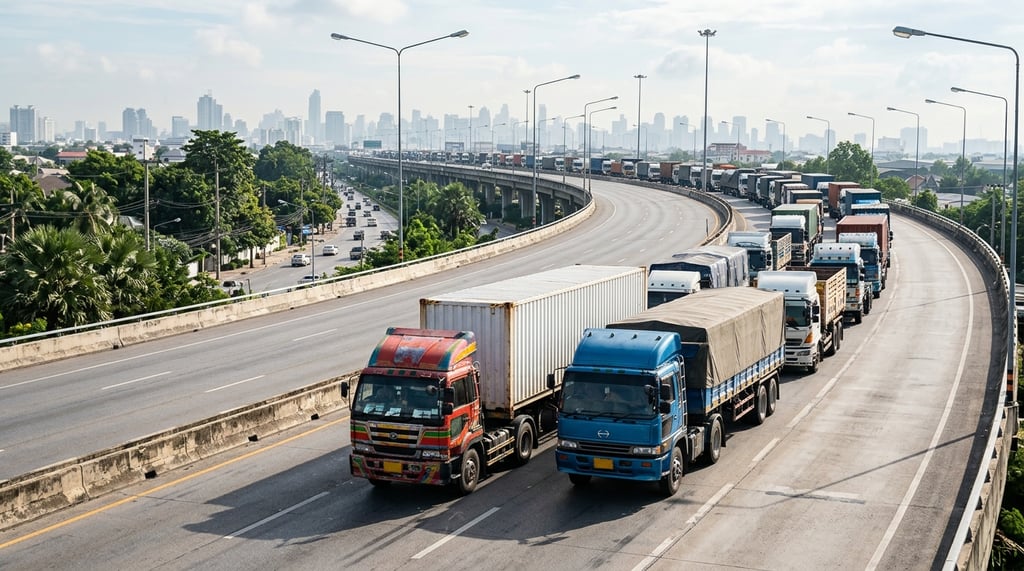
Thailand's freight hauliers are preparing to carry their dispute over fuel costs onto Bangkok's western approaches. The Land Transport Federation of Thailand (LTFT) and 13 allied transport associations have called a highway convoy for Tuesday, December 1, assembling along Borommaratchachonnani Road at 08:00 before moving toward central Bangkok at 09:30 to demand a 35 baht per liter ceiling on diesel. Even after November pump trims brought standard B7 diesel down to 39.34 baht per liter, the remaining 4.34 baht gap exposes a sharp collision between commercial logistics margins and a state Oil Fuel Fund already 109.48 billion baht in deficit.
From November Ultimatum to the Western Approach
The December 1 mobilization escalates a standoff that opened outside the Ministry of Energy on November 4, when LTFT president Thongyu Kongkhan and delegates from 13 freight associations staged the Truck Power V rally. Ministry officials, including Energy Minister Akanat Promphan's secretary Thitiphas Chotidechachainant and spokesperson Pongpol Yodmuangcharoen, accepted a 10-point reform petition and promised formal review. Hauliers initially signaled a 60-day window across November and December, warning that stalled talks could bring 500 to 1,000 lorries into the capital.
Patience faded after a November 21 strategy meeting among the 13 member associations concluded that incremental price trims failed to offset months of elevated operating bills. Organizers set a November 30 deadline and aligned their December 1 action with Kamnan Mano Krueakaew's civic network, the People's Revolutionary Front to Protect the Nation. Staging along Borommaratchachonnani Road for a 09:00 briefing ahead of a 09:30 departure targets a primary freight corridor linking western provinces and industrial estates to inner Bangkok.
Why Recent Pump Cuts Fell Short of Hauliers' Math
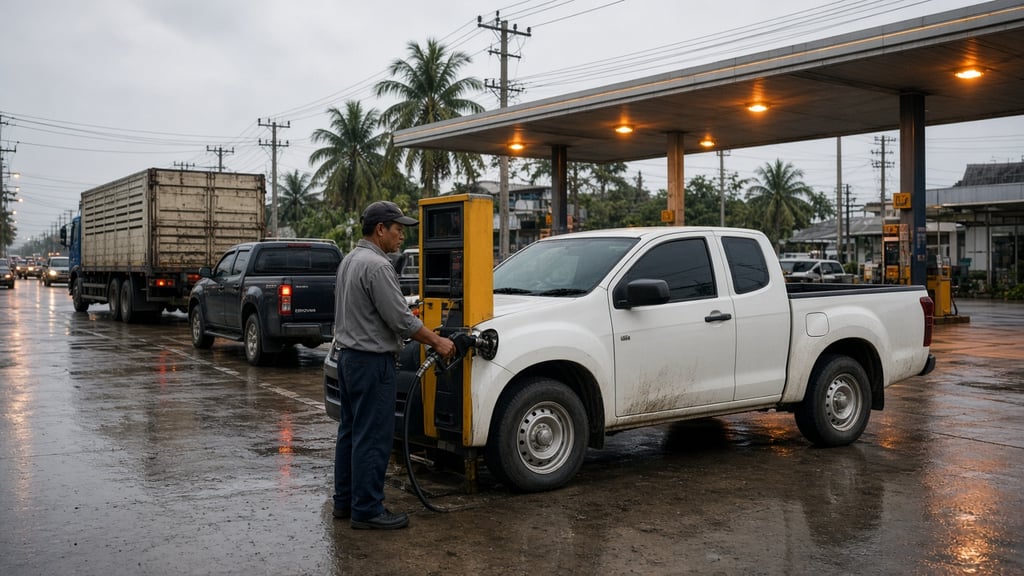
On paper, Thailand's diesel market has cooled from its autumn peak. Elevated Brent crude and Middle East shipping risks pushed domestic B7 diesel past 42.54 baht per liter earlier in the season, squeezing fleets already coping with flood-disrupted regional roads. As global oil retreated to three-month lows in mid-November, PTT Station and Bangchak cut B7 by 1 baht to 40.79 baht on November 11. On November 25, the Oil Fuel Fund Executive Committee approved another 0.60 baht retail cut, bringing B7 to 39.34 baht per liter and B20 biodiesel to 32.90 baht.
For fleet owners, those reductions leave unit costs far above fixed haulage contracts. Ten-wheelers, cold-chain vans, and port drayage rigs overwhelmingly run on B7 rather than B20, making the deeper B20 discount largely irrelevant to heavy freight. With fuel representing 35% to 45% of a Thai trucking firm's variable expenses, paying 4.34 baht above the federation's 35 baht benchmark adds tens of thousands of baht per truck each month. Federation leaders have rejected targeted vouchers limited to licensed hauliers, insisting relief must lower pump costs across agriculture, construction, and household supply chains.
A 109.5 Billion Baht Fuel Fund Constraint
The Ministry of Energy's caution over an immediate 35 baht ceiling reflects stark balance-sheet arithmetic. Official weekly estimates from the Oil Fuel Fund Office (OFFO) for the period ending November 22, 2026 show a net deficit of 109,481 million baht, split between 66,357 million baht in the oil account and 43,124 million baht in liquefied petroleum gas. Total liabilities stood at 144,402 million baht against 34,921 million baht in assets.
When the committee lowered retail diesel on November 25, it simultaneously trimmed the B7 subsidy by 0.29 baht to 0.50 baht per liter and the B20 subsidy by 0.17 baht to 0.62 baht per liter. That calibration restored net daily inflows to roughly 38.02 million baht so OFFO can gradually service debt and refinery payables. Funding an extra 4.34 baht per liter cut solely through the fund would burn more than 250 million baht per day at Thailand's normal diesel consumption, reversing liquidity repair and colliding with Treasury efforts to keep public debt below the statutory 70% of GDP cap.
The Battle Over Thailand's Fuel Pricing Formula
Because the Oil Fuel Fund cannot finance a year-long freeze alone, the LTFT's 10-point platform targets Thailand's underlying pricing formula. Hauliers seek a cut in diesel excise duty to 0.05 baht per liter, abolition of Singapore benchmark referencing and notional freight charges, tighter Gross Refining Margin oversight by the Energy Policy and Planning Office and Energy Regulatory Commission, and Commerce Ministry price-control designation for motor fuel. Their petition also calls for an inquiry into over 700 million liters of allegedly unaccounted fuel and a state-owned strategic oil reserve.
Policymakers trimmed select notional refinery-gate charges in late October, while Department of Special Investigation inquiries into suspected fuel hoarding continue. Deeper concessions carry steep trade-offs: slashing excise duty drains multibillion-baht treasury receipts just as the Budget Bureau enforces tighter spending limits, while statutory caps on refining margins risk deterring investment in cleaner Euro-5 and sustainable aviation fuel capacity.
What This Means for Expats in Thailand
Whether Tuesday's convoy yields a negotiated compromise or escalates further, foreign residents and business operators face immediate effects:
- Western Bangkok Traffic: Expect heavy congestion on December 1 along Borommaratchachonnani Road, Pinklao, Rama VIII Bridge approaches, and Thon Buri links from 07:30 through midday; use BTS or MRT where possible.
- Grocery and Delivery Costs: Diesel moves nearly all domestic fresh produce and parcels. Sustained 39 baht pump prices encourage supermarkets and couriers to keep delivery surcharges elevated through high season.
- Petrol Motorist Bills: The November 25 OFFO cut left gasohol and petrol unchanged, so private petrol car and scooter drivers see no immediate relief.
- Fiscal Watch: Bond investors will track whether Bangkok absorbs fuel relief via excise cuts or holds firm to protect its 70% debt ceiling and baht stability.

Comment verification
Step 1 of 3
Verify your email once to publish your comment. Your email is never shown publicly.
Enter the 6-digit code sent to .
Choose the display name shown next to your comments.