KMITL Students Demand Campus Road Safety Overhaul
Student representatives at KMITL are demanding urgent traffic safety overhauls after three students died in road crashes near the Bangkok campus within a single month.
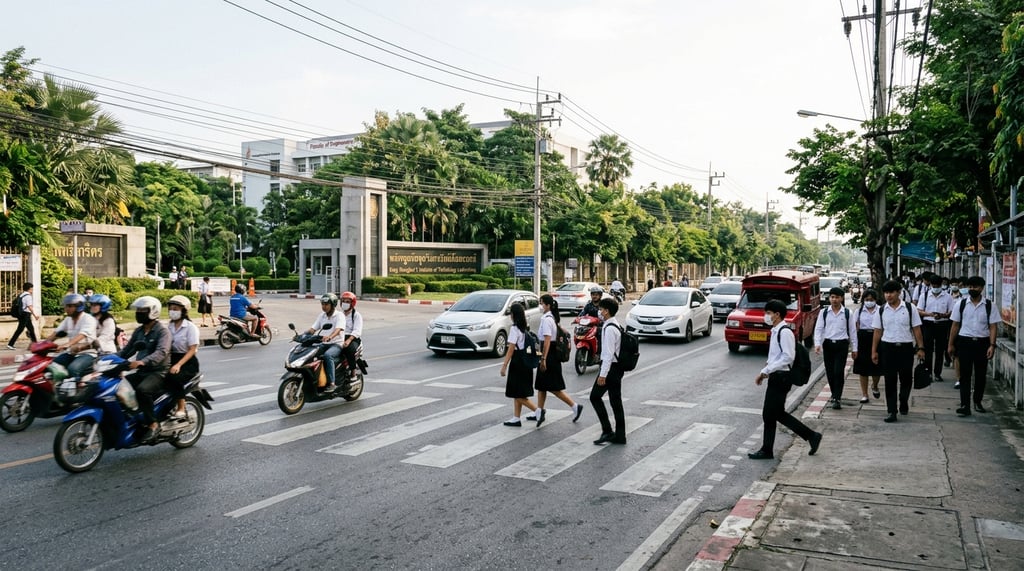
Student representatives at King Mongkut's Institute of Technology Ladkrabang issued an urgent appeal to municipal authorities on 29 November 2026, demanding immediate physical traffic-calming interventions along campus thoroughfares following three student road fatalities within a single month. The petition follows the death of a female undergraduate from the Faculty of Architecture, Art and Design, who sustained fatal injuries on 28 November in an accident along Chalong Krung 1, a heavily congested access route locally known as Soi Geki. The fatal collision occurred less than a fortnight after two third-year engineering students were struck and killed along the same corridor while traveling by motorcycle during late evening hours.
The repeated loss of life within a four-week window has ignited intense grief and administrative scrutiny across the university community in eastern Bangkok. Student leaders and academic administrators argue that local roads surrounding the campus have become structural hazard corridors where pedestrian traffic, high-density motorcycle commuting, and commercial vehicle bypasses intersect without adequate safety buffers. The KMITL Student Council formally called on the Bangkok Metropolitan Administration and the Ladkrabang District Office to move beyond verbal condolences and execute concrete physical interventions, warning that continued administrative delays will inevitably result in further preventable student casualties.
Spatial Anatomy of the Chalong Krung Corridor
The roadway network surrounding KMITL presents an acute urban design challenge typical of peri-urban educational zones across Thailand. Located in eastern Bangkok near Suvarnabhumi Airport, the university hosts over twenty-five thousand students and research staff whose daily routines depend heavily on peripheral feeder streets. Chief among these is Chalong Krung 1, a narrow two-lane corridor flanked by high-density private student dormitories, convenience outlets including Tops Daily, laundromats, and modest eateries catering to campus residents.
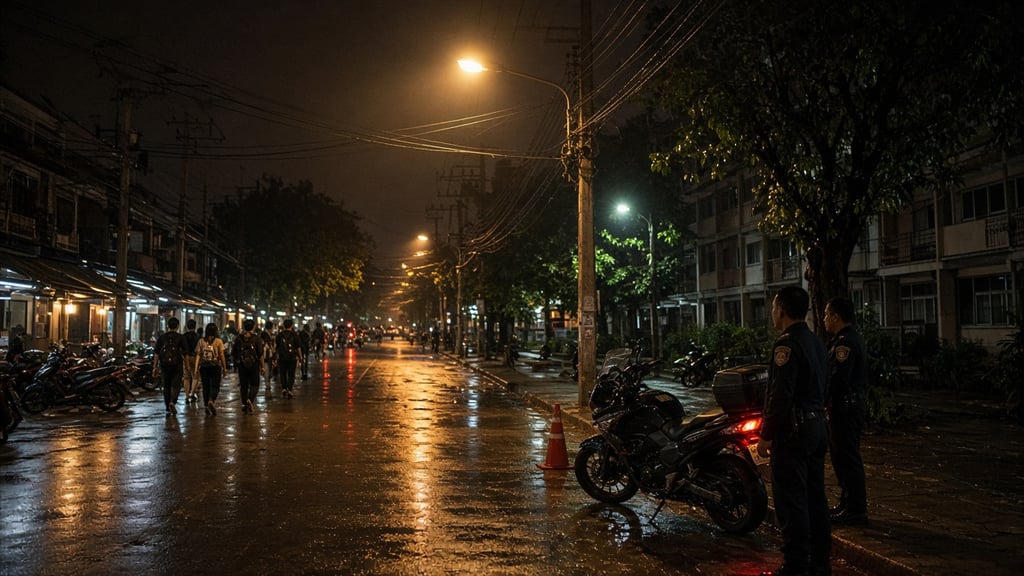
Despite its functional reality as a high-volume residential student village, the corridor lacks fundamental pedestrian infrastructure. Footpaths are either fragmented or entirely absent, forcing thousands of undergraduates to walk directly along the asphalt roadway. Simultaneously, commercial freight haulers, delivery vans, and commuter vehicles utilize Chalong Krung Road and its connecting alleys as shortcuts between Rom Klao Road and the Ladkrabang Industrial Estate. The co-existence of heavy commercial logistics vehicles and lightweight student scooters on poorly lit, un-channeled asphalt produces severe collision risks, particularly during evening hours when commuter visibility drops and vehicle velocities rise.
Administrative Fractures and Jurisdictional Delays
The recurring fatalities have exposed a persistent bureaucratic barrier dividing university leadership from municipal public works agencies. Following the initial fatal collision involving the two engineering undergraduates on 15 November, KMITL President Associate Professor Dr. Komsan Maleesee convened urgent consultations with the Ladkrabang District Office and local traffic police to formulate an emergency safety package. That plan established four immediate structural priorities designed to suppress vehicle speeds and restore pedestrian visibility before the end of the academic term.
The institutional mitigation package specified four concrete measures:
- Speed Caps and Surface Friction: Enforcing a strict 30 kilometre per hour speed ceiling along Chalong Krung 1, marked by prominent thermoplastic road stencils, reflective roadside signage, and transverse rumble strips placed before major intersections.
- Corridor Re-channelization and Enforcement: Re-striping the carriageway to preserve a single continuous traffic lane with dedicated right-turn bays, paired with coordinated Ladkrabang police speed checkpoints and automated radar cameras operating throughout evening and nighttime hours.
- Sightline Obstruction Removal: Pruning overgrown roadside trees, setting back boundary fences near commercial intersections including the Tops Daily junction, painting stop bars, and installing convex traffic mirrors to eliminate blind turning angles.
- Pedestrian Crossing Upgrades: Installing high-intensity overhead streetlights and repainting high-visibility zebra crossings at the soi entrance to protect pedestrians crossing between academic facilities and residential quarters.
However, because the physical thoroughfare falls under the statutory authority of the Bangkok Metropolitan Administration rather than internal university maintenance budgets, implementation required multi-agency sign-offs that failed to materialize before the second fatal collision occurred on 28 November. The KMITL Student Council publicly highlighted this jurisdictional lag, contending that inter-agency deliberation without immediate temporary speed tables directly compromised student safety.
The Systemic Vulnerability of Two-Wheeled Commuters
The crisis at KMITL reflects a broader public health challenge across Thailand. Data from the World Health Organization indicates that Thailand consistently experiences one of the world's highest road mortality rates, registering approximately 25.4 fatalities per 100,000 citizens and claiming roughly 18,000 lives annually. Crucially, riders of motorized two- and three-wheelers comprise over 80 percent of those casualties, representing the most vulnerable demographic on the kingdom's transport network.
In suburban university districts, this epidemiological burden falls heavily on youth. Outer Bangkok lacks comprehensive last-mile mass transit networks. While the Airport Rail Link serves Ladkrabang station, the final three kilometres connecting the rail terminus to inner campus gates and peripheral dormitories must be completed via motorcycle, songthaew, or bicycle. Economic realities dictate that tens of thousands of undergraduates rely on small-displacement motorcycles as their primary transport mode, exposing young riders to daily interaction with heavy regional freight traffic on corridors engineered without dedicated cycling or motorcycle lanes.
Re-Engineering University Perimeters for Vision Zero
Urban planning specialists and transport engineers emphasize that resolving corridor safety around KMITL requires shifting from punitive behavioral appeals toward modern Safe System engineering principles. Vision Zero methodologies recognize that human error on roadways is inevitable, but fatal trauma can be engineered out of the transport environment through structural speed mitigation.
On streets such as Chalong Krung 1, where vehicular traffic directly interfaces with high-density student pedestrian flows, raised speed tables and continuous sidewalk platforms are substantially more effective than passive warning signs. When vehicles are physically constrained to 30 kilometres per hour by raised asphalt crossings, the probability of a fatal pedestrian or motorcycle collision drops below ten percent, compared to over eighty percent at speeds exceeding 50 kilometres per hour. Integrating automated number-plate recognition cameras, physical lane chicanes, and dedicated pedestrian lighting corridors provides proven protection for university populations without requiring permanent police deployments.
What This Means for Expats in Thailand
For international faculty, foreign exchange students, corporate researchers, and expatriate motorists living or traveling through eastern Bangkok and the Ladkrabang district, this development highlights several practical considerations:
- Heightened Caution in Campus Zones: Motorists navigating Chalong Krung Road, Rom Klao Road, and surrounding dormitory alleys should maintain speeds well below 30 kilometres per hour, anticipating unpredictable pedestrian crossings, student scooters exiting blind soi intersections, and delivery couriers.
- Defensive Scooter Riding Practices: Expatriates and foreign exchange students using motorcycles must wear certified full-face helmets, maintain functional headlamps at all times, and avoid using narrow perimeter alleys during late-night hours when freight trucks and commercial pickups use residential corridors to avoid arterial traffic signals.
- Reporting Local Road Hazards: Residents and commuters who observe missing streetlights, dangerous potholes, obstructed pedestrian crossings, or blind corners in Bangkok can submit photographic reports directly to the Bangkok Metropolitan Administration through the Traffy Fondue digital municipal service.
- Support for Physical Infrastructure Upgrades: International academic staff and residential associations can reinforce student safety appeals by participating in campus safety committees and advocating for municipal traffic calming investments around educational institutions.
Comment verification
Step 1 of 3
Verify your email once to publish your comment. Your email is never shown publicly.
Enter the 6-digit code sent to .
Choose the display name shown next to your comments.