Thailand Pushes 20% Cut to Domestic Airfare Caps
Thai regulators and cabinet ministers have asked domestic airlines to trim maximum regulated ticket ceilings by 20 percent for the 2027 New Year travel peak, while confronting a thornier gap: offshore booking platforms that escape local price caps.
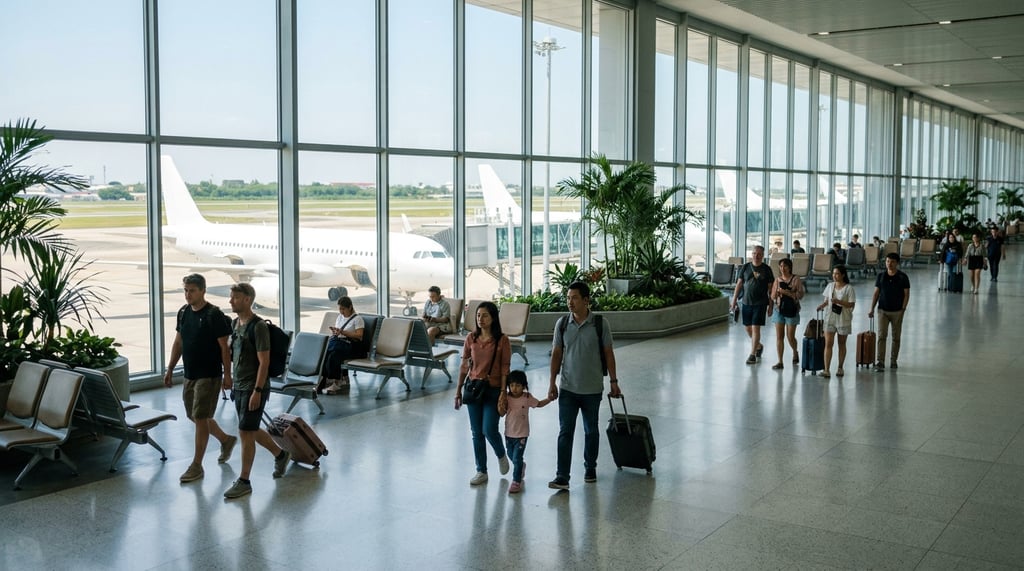
Every December, Thailand's domestic aviation market runs into the same collision between holiday demand and finite narrow-body fleets. This year, the political pressure arrived early. On November 27, Prime Minister's Office Minister Supamas Isarabhakdi and Deputy Transport Minister Phattarapong Phattaraprasit convened senior officials from the Civil Aviation Authority of Thailand (CAAT), the Office of the Consumer Protection Board (OCPB), and the Department of Internal Trade alongside executives from the country's major domestic carriers to rein in New Year 2027 ticket prices.
The headline outcome is a request for airlines to trim their regulated maximum fare ceilings by 20 percent for the upcoming holiday rush, paired with seasonal promotional blocks and additional flight slots coordinated by CAAT. Carriers operating domestic routes, including Thai Airways, Thai AirAsia, Thai Lion Air, Nok Air, Thai Vietjet Air, and Bangkok Airways, agreed to take the proposal back for internal review, with Deputy Transport Minister Phattarapong scheduled to meet CAAT the following week to lock in seasonal rules and longer-term measures.
The Arithmetic Behind a Ceiling Cut
A 20 percent ceiling cut sounds like a blanket holiday sale, yet aviation pricing does not work that way. Under Thailand's distance-based fare regime administered by CAAT, domestic base fares cannot exceed 9.40 baht per kilometre on low-cost carriers or 13 baht per kilometre on full-service airlines. Those limits govern the highest fare bucket sold directly by an airline when a cabin is nearly full, not the average ticket bought weeks in advance.
Apply a 20 percent reduction to CAAT's official domestic route table and the relief is real for late bookers, though far from cheap. On the 566-kilometre Bangkok to Chiang Mai corridor, a low-cost carrier's legal ceiling of roughly 5,320 baht one way would ease to about 4,256 baht, while a full-service cap of 7,358 baht would step down to 5,886 baht. On the 698-kilometre Bangkok to Phuket route, the budget ceiling of roughly 6,561 baht would decline to 5,249 baht, and on the 773-kilometre Bangkok to Hat Yai run it would fall from about 7,266 baht to 5,813 baht. On the 489-kilometre Bangkok to Koh Samui sector, a 20 percent trim lowers the full-service ceiling from 6,357 baht to roughly 5,086 baht. Because airport passenger service charges, value-added tax, checked luggage, and seat selection sit outside the base fare cap, the checkout total still climbs quickly.
Why Holiday Fares Still Shock Travellers
Public anger over domestic airfares did not start with New Year bookings. Earlier in November, outrage flared during the Loy Krathong and Yi Peng festival after last-minute Chiang Mai tickets surfaced online at 20,000 to 30,000 baht, drawing sharp criticism from political figures and ordinary commuters alike. Yet CAAT's own monitoring consistently finds that Thai-licensed airlines rarely breach statutory ceilings on their direct websites.
The gap lies in distribution and fleet capacity. When direct non-stop seats sell out during a four-day holiday, third-party aggregators stitch together multi-leg itineraries, layer on dynamic service margins, or resell inventory swept up through automated booking scripts. Thai regulators openly acknowledged after the November 27 talks that offshore Online Travel Agencies are the primary source of extreme price spikes. Adding to the squeeze, regional carriers are still operating tighter narrow-body schedules than in 2019 as global aircraft delivery backlogs and engine maintenance checks constrain spare jets.
The Offshore Platform Jurisdiction Gap
Addressing third-party markups is far harder than leaning on six domestic airlines in a Bangkok conference room. CAAT licenses airlines and can audit their reservation systems, compel them to display maximum fare tables on their homepages and sales counters, and approve extra night flights. It holds no direct authority over foreign-incorporated booking platforms operating servers abroad.
To close that loophole, OCPB Secretary-General Ronnarong Phoolpipat and Minister Supamas outlined plans to send formal notices pressing overseas OTAs to register legal entities in Thailand, which would bring them under Thai consumer-protection statutes and dispute mediation. Officials conceded, however, that legal action against offshore sellers must be evaluated case by case and carries no fixed implementation deadline. Until cross-border registration rules have teeth, consumer advice remains the government's main lever.
What This Means for Expats in Thailand
Foreign residents, retirees, and regional commuters planning late-December or early-January trips inside Thailand should treat the 20 percent ceiling push as a guardrail on peak fares rather than a reason to delay booking:
- Book directly with the carrier: CAAT, OCPB, and the Transport Ministry all advise buying through official airline websites, mobile apps, or airport counters rather than foreign OTAs, especially when seat inventory tightens.
- Verify non-stop routing before paying: Aggregators often display expensive connecting tickets once direct flights fill up; double-checking that an itinerary is point-to-point avoids hidden markups.
- Check the official route ceiling: Passengers can cross-check any domestic corridor against CAAT's published distance table before completing payment, and airlines have been asked to post ceilings prominently on their homepages.
- Watch for extra holiday slots: CAAT is coordinating additional flights on busy northern and southern trunks; setting fare alerts for newly loaded late-night or early-morning departures can beat standard daytime peaks.
Voluntary Goodwill Versus Structural Supply
Thailand's latest airfare intervention follows a familiar playbook: ministerial persuasion ahead of a politically sensitive holiday, paired with temporary ceiling trimmings and extra slots. If carriers ratify the 20 percent cap cut next week, late-booking families flying home to Chiang Mai, Phuket, or Hat Yai will see tangible relief compared with full statutory limits.
Over the medium term, however, price caps cannot manufacture aircraft seats. Sustainable domestic fare moderation depends on expanding narrow-body fleet capacity, smoothing regional airport slot bottlenecks, and establishing enforceable rules for foreign booking intermediaries. Without those structural fixes, every Songkran and New Year rush will test the same ceiling all over again.
Comment verification
Step 1 of 3
Verify your email once to publish your comment. Your email is never shown publicly.
Enter the 6-digit code sent to .
Choose the display name shown next to your comments.