Parit Details 9 Procedural Flaws in EC Senate Ruling
People's Party lawmaker Parit Wacharasindhu detailed nine evidentiary flaws in the Election Commission's ruling clearing Bhumjaithai in Senate collusion.
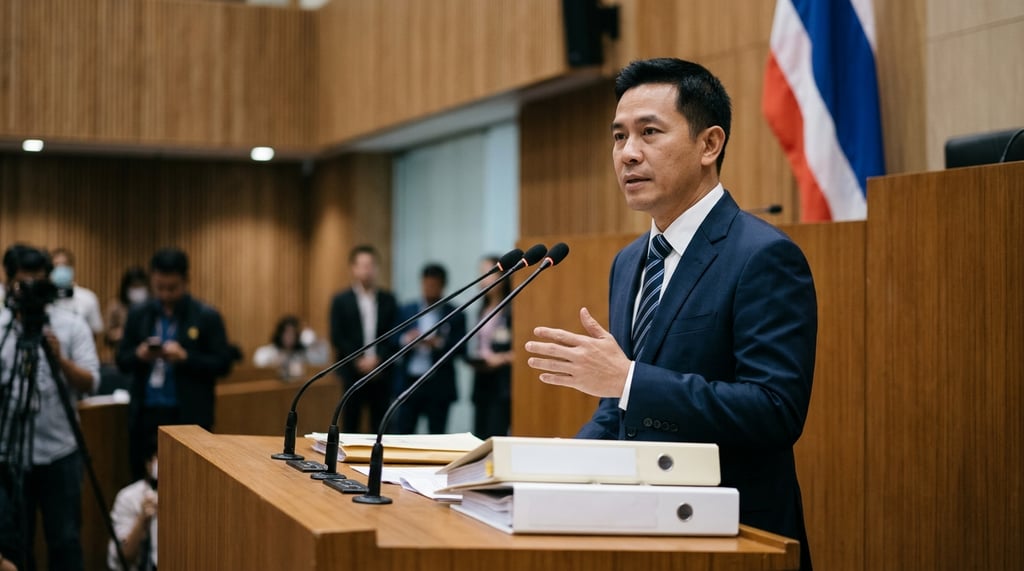
Scrutiny of Thailand's upper-house selection escalated as People's Party lawmaker Parit Wacharasindhu released a forensic nine-point critique of the Election Commission's 114-page ruling on senatorial collusion. The regulatory decree recommended criminal charges against 77 lower-tier participants while clearing Bhumjaithai Party leadership and dismissing petitions against more than one hundred seated senators linked to organized voting rosters.
Presenting his analysis as parliamentary opposition whip, Parit contended that the regulator applied contradictory evidentiary standards, disregarded available banking trails, and insulated political principals from judicial review. Rather than treating the selection anomalies as an organized enterprise, the agency fragmented the inquiry into isolated local infractions, preventing systemic review before the Supreme Court.
Unexamined Communications and Dismissed Financial Trails
The foremost procedural vulnerability highlighted in the opposition dossier concerns the Election Commission's avoidance of primary communication records. On page 46 of its ruling, the commission acknowledged direct telephone contact between senior Bhumjaithai executives and registered candidates, including individuals later indicted. However, investigators neither subpoenaed detailed call durations nor compared call frequencies during balloting against historical baselines, accepting unverified assertions that conversations touched only on personal matters.
Financial evidence encountered similar administrative resistance. During an executive session on January 12, commissioners voted four to three to refuse supplementary financial transaction records compiled by the Department of Special Investigation. Regulators defended the exclusion by stating that the case remained with an inquiry sub-committee. Yet once the case reached the full commission, commissioners never exercised their statutory authority to request the frozen banking data.
This evidentiary gap extended to provincial files. In Nakhon Phanom, where investigators possessed audio of a candidate offering material inducements, the agency omitted recorded references specifying party affiliations. By excising political designations from formal summaries, the regulator avoided establishing institutional linkages between local vote collectors and national party headquarters.
Selective Credibility and Dismissed Physical Evidence
The commission's handling of witness testimony revealed stark disparities. Investigators relied heavily on retracted statements from three protected witnesses who initially detailed coordinated lodging and voting directives. When those witnesses later reversed their depositions, the commission accepted the withdrawals without probing financial inducements or coercion, using the retractions to terminate inquiries into ministerial figures.
Conversely, credible testimony implicating leadership faced abrupt dismissal. A protected witness reported observing Prime Minister Anutin Charnvirakul and Buriram United chairman Newin Chidchob at a Bangkok hotel meeting with senatorial hopefuls immediately following the national vote. Regulators discarded this testimony because the witness lacked prior knowledge of pre-circulated voting rosters, an exacting prerequisite with no statutory foundation.
Forensic anomalies in physical ballots were similarly set aside. Despite documentation revealing identical handwriting across multiple ballots within specific occupational groups, the commission accepted claims from polling supervisors that such uniformity represented coincidence. By prioritizing official assertions over physical examination, investigators bypassed clear indicators of centralized ballot marking.
Asymmetrical Burdens and Conflated Legal Standards
Underpinning the ruling is what legal analysts describe as an asymmetrical burden of proof. The commission accepted blanket denials from seated senators affiliated with the blue coalition as sufficient grounds to dismiss complaints. Yet when lower-ranking candidates presented identical denials, the agency rejected them and proceeded with formal indictments.
Most critically, the ruling conflated the evidentiary threshold for criminal indictment under Section 77 of the Senate Organic Act with the civil standard governing Supreme Court petitions under Section 62. The statutory framework explicitly empowers the commission to petition the Supreme Court whenever reasonable grounds exist to believe an election was not honest and fair. By requiring criminal-grade certainty before filing civil petitions, the commission effectively shielded seated lawmakers from judicial interrogation.
What This Means for Expats in Thailand
The institutional battle surrounding senatorial legitimacy holds tangible implications for foreign residents and enterprises in Thailand:
- Legislative Stasis on Constitutional Reform: An entrenched senatorial bloc ensures that opposition bills to amend the 2017 Constitution or reform independent regulatory agencies will face insurmountable vetoes in the upper chamber.
- Heightened Scrutiny on Public Procurement: With parliamentary inquiries constrained at the agency level, opposition lawmakers are redirecting investigative resources toward ministerial budget allocations, concessions, and major state contracts.
- Predictable Policy Continuity: Exonerating Bhumjaithai executives preserves coalition stability, entrenching existing policy frameworks across public health, infrastructure, and transport.
- Judicial Precedent and Regulatory Risk: For international firms navigating Thai administrative law, the ruling demonstrates wide agency discretion, reinforcing the necessity of strict compliance and risk management.


Comment verification
Step 1 of 3
Verify your email once to publish your comment. Your email is never shown publicly.
Enter the 6-digit code sent to .
Choose the display name shown next to your comments.