Gen Z activists plan Constitution Day Parliament rally
Youth activists across Thailand are organizing a Constitution Day assembly outside Parliament in Bangkok on December 10, staging a mock legislative debate and an open-air banner charter drafting session to demand the replacement of the 2017 constitution.
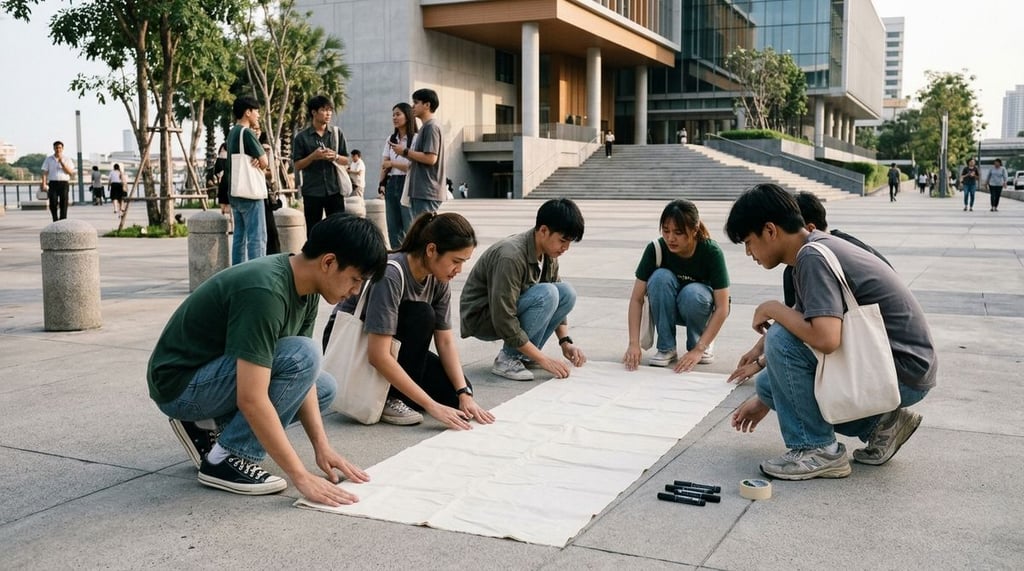
A coalition of Thai youth groups and student activists has called a symbolic political mobilization outside the National Assembly complex in Bangkok for December 10, timing the demonstration to coincide with national Constitution Day. Led by the Ramkhamhaeng Plod Aek student organization alongside allied university networks, the planned eight-hour assembly marks an intentional shift in tactical focus. Rather than staging marches through central commercial corridors, organizers are converging directly on Lan Prachachon, the designated public plaza fronting the Kiakkai parliament compound in Dusit district.
Operating under the campaign hashtags #ม็อบGenZ and #อย่าไว้ใจหนู, the organizers intend to mount an interactive civic program featuring an open-air mock parliament and a collaborative constitutional drafting workshop on fabric banners. The dual activities are designed to register public discontent over perceived legislative stalling on charter reform following the national referendum on February 8, 2026, when over 60 percent of voters backed replacing the military-drafted 2017 constitution. By staging a citizen no-confidence debate on the doorstep of the legislature, student leaders seek to challenge conservative parliamentary factions that currently dictate the pace of institutional revision.
Mobilization Architecture and the Kiakkai Convergence
The selection of December 10 carries deep historical resonance in Thai constitutional history. The date marks the promulgation of the Kingdom's first permanent constitution in 1932, a milestone student movements have long used to evaluate democratic progress. Choosing Lan Prachachon outside the modern parliamentary complex provides both a physical and symbolic arena. The plaza sits adjacent to the legislative chambers, enabling demonstrators to address parliamentary proceedings without trespassing on secured government property.
The core of the afternoon program centers on two complementary civic exercises. First, student organizers will construct a mock parliamentary chamber where grassroots speakers, young professionals, and civil society representatives will conduct an informal no-confidence debate on executive performance, judicial independence, education reform, and youth living costs. Second, organizers will unroll continuous fabric banners across the plaza, inviting attendees to write down specific constitutional clauses, rights guarantees, and institutional checks, producing a tactile counter-charter authored by the public.
The Politics of Charter Impasse and the 2017 Precedent
Underpinning the assembly is enduring friction regarding the 2017 constitution. Enacted during the post-coup administration of the National Council for Peace and Order, the charter embedded safeguards that preserve conservative influence over the legislature, regulatory bodies, and independent courts. The charter's amendment mechanism under Section 256 imposes high procedural barriers, requiring not only an overall parliamentary majority but also the concurrence of at least one-third of the Senate.
That constitutional arithmetic became a central dispute following the February 2026 referendum, where over 60 percent of voters supported drafting a new constitution. Yet legislative progress toward an elected Constitution Drafting Assembly has encountered persistent delays within joint parliamentary committees. Conservative legislators have insisted on insulating Chapters 1 and 2 while debating whether assembly members should be directly elected or partially appointed through institutional quotas, frustrating reformist expectations.
The Blue Camp and Shifting Parliamentary Arithmetic
The specific rhetoric adopted by the mobilization reflects a targeted political focus. The campaign slogan #อย่าไว้ใจหนู, which translates colloquially as do not trust the mouse, directly references the personal nickname of Prime Minister Anutin Charnvirakul, leader of the Bhumjaithai Party. The movement's companion banner, 7 UP: Break Free from the Blue Regime, explicitly challenges the political dominance of the conservative blue faction that consolidated executive authority following recent parliamentary realignments.
Bhumjaithai's emergence as the primary anchor of government policy, backed by strong alignment across Senate committee chairmanships, has transformed the party into the focus of youth discontent. Student activists argue that while the coalition publicly acknowledges the necessity of charter reform, its maneuvers have diluted reformist drafts to preserve conservative veto powers. By focusing on the blue bloc, organizers aim to highlight perceived contradictions between government rhetoric and legislative voting records on democratic governance.
What This Means for Expats in Thailand
For expatriate residents, international business professionals, and foreign visitors navigating Bangkok, the planned assembly presents several practical considerations:
- Traffic and Transport: Localized vehicle diversions are expected along Samsen Road, Thahan Road, and the Kiakkai intersection from early afternoon until late evening on December 10. Commuters travelling through northern Bangkok should avoid road transport and utilize the MRT Blue Line to Bang Pho station or Chao Phraya Express boats to Kiakkai Pier.
- Public Safety: Recent youth-led demonstrations have maintained disciplined conduct focused on creative performance, satire, and public speeches. While metropolitan police will establish perimeter cordons around Parliament grounds, previous gatherings have concluded without violent clashes or severe security incidents.
- Economic Stability: Financial markets have treated localized civic demonstrations as standard domestic political expression. The Thai baht and domestic bond yields remain insulated from single-day symbolic rallies, with international investors focusing on export performance, tourism receipts, and monetary policy.
- Policy Environment: The debate surrounding constitutional replacement influences Thailand's institutional governance over the medium term, establishing the legal architecture within which foreign residents, multinational corporations, and long-term visa holders operate.
Civic Expression and Institutional Boundaries
The December 10 mobilization highlights the evolving strategic choices confronting Thai youth activism. Having observed the legal attrition that disrupted earlier protest waves, student organizers are deploying concentrated, issue-specific demonstrations within legal boundaries. By focusing on constitutional authorship on Constitution Day, the movement seeks to sustain public sympathy while exerting moral pressure on elected lawmakers.
Whether symbolic street assemblies can alter the legislative trajectory remains uncertain given institutional safeguards entrenched in the 2017 constitution. However, by turning the People's Plaza into an open civic forum, organizers are ensuring that the debate over Thailand's constitutional future cannot be conducted solely behind closed committee doors. As Parliament prepares for subsequent amendment debates, the December 10 mock parliament will offer a clear barometer of grassroots sentiment regarding the constitutional reform process.
Comment verification
Step 1 of 3
Verify your email once to publish your comment. Your email is never shown publicly.
Enter the 6-digit code sent to .
Choose the display name shown next to your comments.