Thailand Opens State Rail Tracks to Private Trains
Thailand will publish updated 2027 State Railway of Thailand track-access rules in December, clearing the way for private tourist, passenger, and freight operators to apply from January under a three-tier tariff approved by the SRT board.
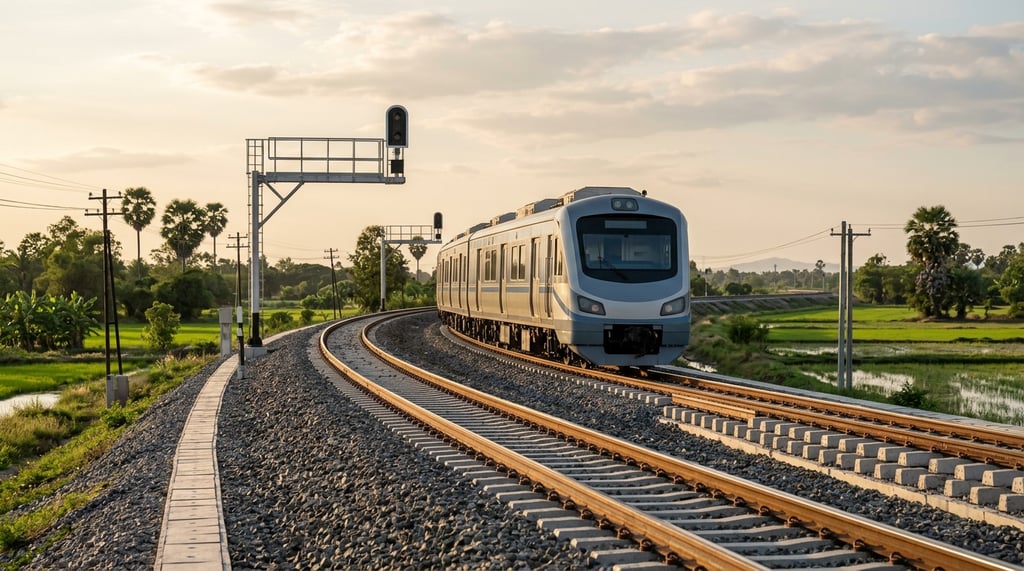
For more than a century, the State Railway of Thailand (SRT) has held an exclusive grip on the steel tracks crisscrossing the kingdom. That monopoly is now entering its formal dismantling phase. On November 29, Deputy Government Spokesperson Ploytalay Laksameesangchan confirmed that the SRT will publish its revised 2027 Network Statement in December, allowing private firms to apply for track slots in January 2027 across passenger, tourist, and freight corridors.
The calendar converts the Rail Transport Act B.E. 2568 (2025), effective since March 27, 2026, from statutory intent into commercial rules. Section 70 compels state infrastructure managers to disclose network capacity, technical standards, and access terms. Section 73 exempts track-sharing deals from Thailand's slow Public-Private Partnership process, substituting direct licensing from the Department of Rail Transport (DRT) and standardized SRT access contracts.
Pricing the Steel: How the Three-Tier Track Tariff Works
Open-access rail reform turns on pricing. Set track charges too high and private rolling-stock investors stay away; set them too low and the state infrastructure manager cannot fund ballast, sleepers, and signalling. At its September 25, 2026 board meeting, the SRT approved a three-tier Track Access Charge reflecting both track wear and commercial yields across each segment.
Shared passenger services will pay 7.38 baht per car-kilometre, a modest floor aimed at keeping fares competitive with interprovincial coaches and budget flights. Commercial tourist trains face 46.02 baht per car-kilometre, capturing higher margins from heritage and luxury excursions. Freight trains will pay 0.12326 baht per tonne-kilometre to lure bulk cargo off congested highways. The 2027 Network Statement updates the 598-page baseline manual released in June 2026, tying those rates to specific line capacities and timetable terms.
Why Tourist Trains Are First Out of the Station
Although all three segments open for expressions of interest in January 2027, Bangkok has split the rollout into two tracks. Tourist operators move first: the SRT plans to review route rights and appoint a selection committee in January, issue formal invitations in February, and sign initial access contracts by April 2027. General passenger and freight signings follow in September 2027.
The sequence is practical. Running daily intercity commuter or sleeper fleets demands large capital outlays, maintenance depots, crew rosters, and ticketing platforms. Tourist operators already hold booking channels, overseas agency ties, and compact trainsets. Luxury rail operators such as the Eastern & Oriental Express have long run bespoke itineraries on Thai metre-gauge tracks under special permits, and DRT Director-General Pichet Kunadhamraks has identified experienced rail-adjacent groups as the likeliest first licensees. Starting with tourist trains lets regulators test slot allocation, dispatching, and safety audits before denser commercial traffic enters the grid.
The Hardware Bottleneck Behind Liberalisation
Thailand's open-access push rests on fiscal arithmetic as much as competition policy. Over the past decade, the state has spent hundreds of billions of baht laying double-track lines across northern, northeastern, eastern, and southern corridors. Yet the SRT remains constrained by legacy debt and chronic rolling-stock shortages, leaving new dual tracks underused outside peak hours simply because the state carrier lacks locomotives and carriages.
Inviting private balance sheets to supply trains while the state owns and maintains the steel mirrors European structural separation. It also creates a direct path for Thai industrial groups moving heavy bulk goods. Firms with existing rail logistics footprints, including cement maker TPI Polene (TPIPL) and contractor Italian-Thai Development (ITD), were cited by the DRT earlier in 2026 as early candidates able to field freight stock once licences open. Shifting cement, aggregates, and export containers from diesel trucks onto rail would trim road upkeep costs and cut logistics expenses across the Eastern Economic Corridor.
What This Means for Expats in Thailand
Foreign residents, retirees, and regional travellers will not board private commuter trains at Krung Thep Aphiwat Central Terminal tomorrow, but the 2027 licensing round signals concrete travel changes:
- Leisure corridors lead: With tourist contracts targeted for April 2027, boutique scenic services should arrive before everyday commuter rivals, likely focusing on Hua Hin, Kanchanaburi, Ayutthaya, and Chiang Mai.
- Higher onboard standards: Private operators chasing discretionary travellers have clear incentives to offer dependable air-conditioning, dining cars, luggage racks, and smoother digital booking.
- Gradual highway relief: If industrial freight operators secure slots in late 2027, heavy haulage along southern and northeastern highways could slowly migrate to rail, easing road pressure on weekend drives out of Bangkok.
- Tiered pricing: Private tourist and express trains will price nearer boutique hospitality or short-haul flights than subsidised third-class state fares, while SRT keeps its public-service obligation on budget lines.
Freight, Licensing, and the Real Test in 2027
Publishing tariffs is the straightforward part of railway reform. The institutional test starts in January 2027, when the DRT must issue operating licences, certify private drivers and rolling stock, and police neutral timetabling. Whenever a track owner also runs its own trains, rivals worry about unfavourable off-peak slots or secondary priority during disruptions.
Thailand's legal answer is an independent allocation committee under DRT oversight. Whether that governance holds when a private freight consist or tourist express competes with a delayed state train will decide how much private capital commits to Thai steel. If contracts close on schedule in April and September 2027, Thailand can finally convert its double-track outlays into a competitive, multi-operator rail network.
Comment verification
Step 1 of 3
Verify your email once to publish your comment. Your email is never shown publicly.
Enter the 6-digit code sent to .
Choose the display name shown next to your comments.