Thailand Opens Ban Phaeo Motorway Ramps on Rama II
Thailand opened widened two-lane entry and exit ramps at the Ban Phaeo interchange on Motorway M82 a day early to relieve Rama II holiday congestion ahead of New Year travel.
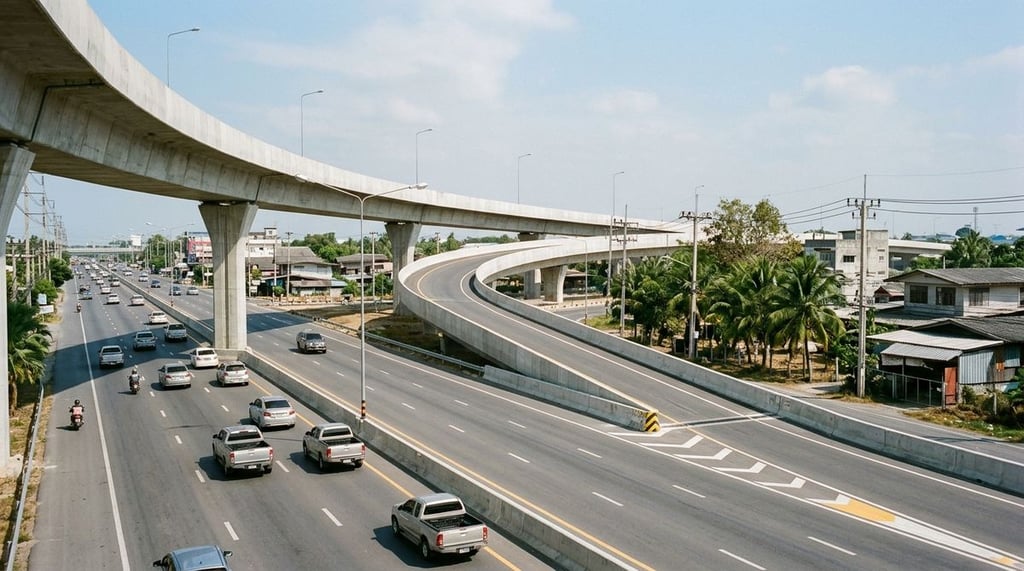
Thailand's Department of Highways reopened the entry and exit ramps at the Ban Phaeo interchange on Motorway M82 on 29 November 2026, delivering expanded elevated access twenty-four hours ahead of schedule. The reopening follows an intensive seven-day engineering intervention that doubled the capacity of the elevated off-ramp from a single lane to two dedicated traffic lanes. Highway police and provincial road marshals in Samut Sakhon formally cleared the ramps for vehicular traffic at 13:30 local time, giving holidaymakers and commercial freight haulers an upgraded bypass over one of the kingdom's most notoriously gridlocked transport corridors.
The physical upgrade targets a chronic pinch point along Highway 35, widely known as Rama II Road. For decades, the highway has served as the sole direct southern trunk route connecting Bangkok to the upper peninsula, coastal industrial zones, and the holiday havens of Cha-am and Hua Hin. Perpetual construction works, severe bottle-necks, and frequent industrial transport delays along the corridor have long frustrated drivers and regional logistics operators. By completing the ramp re-engineering before the end-of-year travel surge, transport authorities are moving aggressively to forestall catastrophic tailbacks as hundreds of thousands of vehicles exit the capital in late December.
Re-engineering the Ban Phaeo Bottleneck
The engineering intervention at Ban Phaeo addresses operational friction exposed during the motorway's introductory trial phase. When highway authorities first opened the 25-kilometer elevated corridor between Bang Khun Thian and Ban Phaeo for round-the-clock trial operations, vehicles descending from the elevated deck encountered an immediate bottleneck. The original configuration funneled elevated traffic into a single off-ramp lane before feeding vehicles back into the surface lanes of Highway 35. During peak Friday afternoon departures and holiday weekends, outbound traffic queueing to exit at Ban Phaeo spilled back onto the elevated mainline, negating the speed benefits of the elevated viaduct.
To eliminate this friction point, the Samut Sakhon Highway District coordinated with maintenance divisions in Bang Thorat and Mahachai to implement a total temporary shutdown of the Ban Phaeo toll plaza area from 23 to 29 November. Contractors worked continuous shifts to reconfigure approach geometry, reinforce outer shoulders, repave surface friction layers, and redraw lane markings across both inbound and outbound ramps. The accelerated completion allowed highway engineers to restore access on Sunday afternoon rather than holding the closure through Monday morning, smoothly assimilating heavy weekend return traffic into the capital.
Corridor Architecture and Elevated Network Linkages
Motorway M82 represents one of the most complex infrastructure undertakings executed by the Department of Highways. Unlike traditional bypasses carved through rural greenfields, the M82 alignment is built as an elevated concrete viaduct suspended entirely above the existing multi-lane surface alignment of Rama II Road. This dual-deck structure separates long-distance arterial traffic from local industrial movements, U-turn bridges, and access roads serving Samut Sakhon's dense cluster of seafood processors, cold-storage warehouses, and manufacturing plants.
The broader master plan links the western terminus at Ban Phaeo with the central urban core through strategic expressway integrations. At its eastern origin in Bang Khun Thian, the M82 corridor is designed to interface seamlessly with the Expressway Authority of Thailand's Rama 3 to Dao Khanong and Western Outer Ring Road elevated system. Once both segments achieve full integration, motorists will be able to travel from central Bangkok elevated expressways straight into Samut Sakhon without descending to ground level, bypassing dozens of ground-level traffic signals, commercial intersections, and flood-prone drainage depressions.
Toll Free Trial Economics and M-Flow Transition
For motorists, the current operational model offers substantial financial and temporal advantages. The Department of Highways is maintaining full 24-hour toll-free access across the entire completed alignment, allowing four-wheel passenger vehicles, commercial vans, and heavy goods vehicles to utilize the elevated viaduct at zero user cost. This open-access arrangement is intended to induce traffic diversion from the congested ground-level Highway 35 lanes while construction teams finalize auxiliary toll plaza structures and ramp plazas at Samut Sakhon 1 and Samut Sakhon 2.
The trial phase also functions as an operational testbed for eventual electronic revenue collection. The Department of Highways intends to operate the M82 corridor using M-Flow, Thailand's automated multi-lane free-flow electronic toll system that uses high-speed automated number-plate recognition cameras instead of physical toll booths. Full commercial operations and statutory toll tariffs will take effect following the procurement and execution of an integrated public-private partnership operation and maintenance concession, targeted for formal commissioning around 2029. Until that commercial handover, state funding covers all roadway upkeep and monitoring.
Freight Flows and the Southern Logistics Spine
Beyond holiday passenger cars, the re-engineered Ban Phaeo interchange holds immense economic consequence for Thailand's supply chains. Samut Sakhon serves as the processing and wholesale capital of Thailand's marine fishery and seafood export industry. Every evening, hundreds of temperature-controlled reefers and heavy container lorries depart processing hubs in Mahachai to haul shrimp, squid, and canned seafood northward toward Bangkok distribution centers and eastern export docks at Laem Chabang. Concurrently, southern agricultural produce moves north while manufactured consumer staples head south to Hua Hin, Surat Thani, and Songkhla.
Ground-level congestion on Rama II has historically imposed heavy friction costs on these freight flows, driving up diesel consumption, causing missed shipping windows, and increasing refrigeration idling costs. The expanded two-lane exit at Ban Phaeo prevents freight trucks from forming dangerous queues that block fast-moving lanes on the elevated deck. By establishing a high-capacity transition back to the ground network toward Samut Songkhram and Ratchaburi, the interchange ensures reliable arterial velocities for commercial haulers operating on tight delivery schedules.
What This Means for Expats in Thailand
For foreign residents, corporate executives, and international travelers navigating western Bangkok and southern travel corridors, the completion of the Ban Phaeo ramp upgrade brings several immediate practical benefits:
- Significant Time Savings to Hua Hin: Foreign residents driving to Cha-am, Hua Hin, or Pranburi for the weekend can now bypass approximately 25 kilometers of ground-level friction. Using the elevated M82 corridor between Bang Khun Thian and Ban Phaeo reliably shaves 30 to 45 minutes off travel times during peak Friday evening and Sunday afternoon corridors.
- Strict Speed Restrictions and Enforcement: Motorists must respect the posted trial speed limits of 80 kilometres per hour for passenger vehicles and 65 kilometres per hour for heavy vehicles. The elevated viaduct is monitored by automated overhead cameras and Highway Police patrols, with speeding fines issued electronically to vehicle registered addresses.
- Prohibition on Two-Wheel Transport: Expatriates who commute on motorcycles or scooters must note that all two-wheeled vehicles, regardless of engine displacement, remain strictly banned from the elevated M82 deck. Motorcyclists must continue utilizing the surface frontage roads of Highway 35.
- Optimal Entry Points for Holiday Departures: When departing Bangkok during the upcoming New Year holidays, drivers should access the elevated M82 at Bang Khun Thian or Phanthai Norasing rather than waiting to join mid-corridor, ensuring complete elevated passage over the industrial bottlenecks of Mahachai.
No comments yet. Be the first to join the conversation.