Thailand Takes ACMECS Chair to Curb Haze and Scams
Thailand assumes the 2027-2028 ACMECS chairmanship from Myanmar, launching a cross-border scam task force, six river stations, and a five-year Mekong master plan.

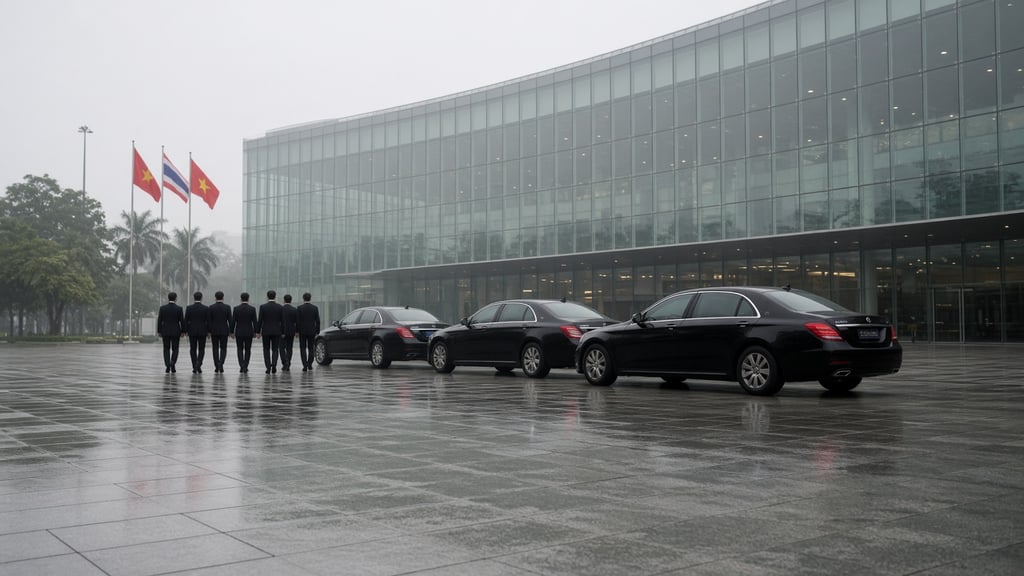
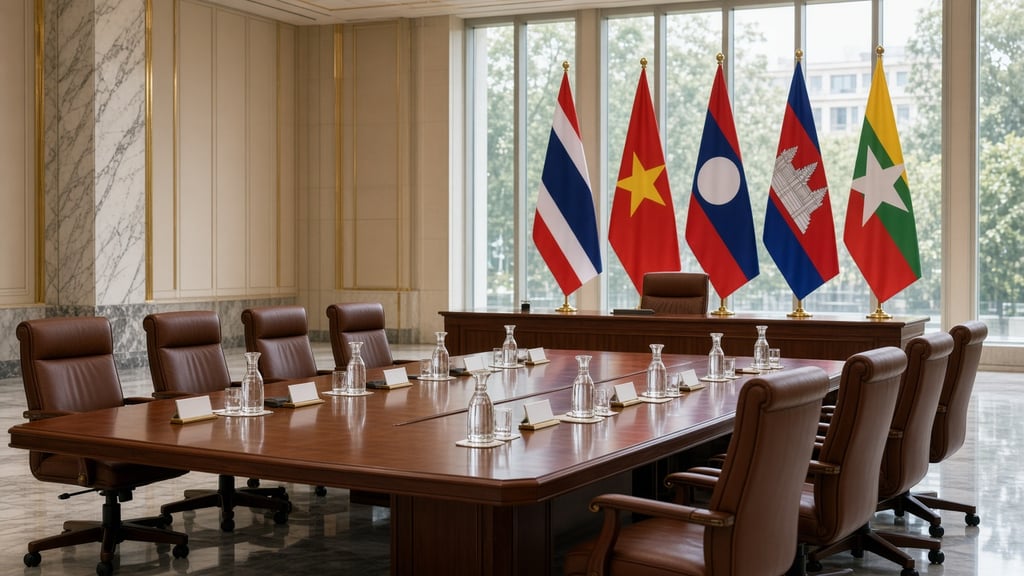
When Southeast Asian leaders gather for subregional summits, communiques rarely outlive the flight home. At the 11th Ayeyawady-Chao Phraya-Mekong Economic Cooperation Strategy (ACMECS) Summit in Hanoi on November 28, however, Thailand sought to turn a largely ceremonial rotating presidency into an operational instrument for border security and environmental enforcement. Receiving the 2027-2028 ACMECS chairmanship from Myanmar, Prime Minister Anutin Charnvirakul laid out five concrete deliverables that tie Thailand's domestic political vulnerabilities, notably seasonal air pollution, toxic river runoff, and industrial-scale cyber-fraud compounds along its frontiers, directly to the five-nation Mekong agenda.
For Bangkok, the stakes are immediate rather than diplomatic. Northern provinces from Chiang Rai to Chiang Mai have endured recurring PM2.5 smog episodes and recent alarm over contaminated sediment in the Kok and Sai rivers, while cross-border scam syndicates operating in lawless pockets of neighbouring states have ensnared tens of thousands of victims and foreign nationals. By aligning its incoming ACMECS chairmanship with Thailand's scheduled ASEAN chairmanship in 2028, Anutin's administration is attempting to construct a two-tier diplomatic corridor capable of compelling neighbours to share data, police financial flows, and co-fund regional infrastructure.
Policing Rivers and Skies Across the Myanmar Frontier
The most tangible deliverable unveiled by Government Spokesman Aekapob Pianpiset following Anutin's bilateral talks in Hanoi concerns transboundary environmental degradation. Thailand and Myanmar agreed to establish six joint water-quality monitoring stations along the Kok and Sai rivers, two waterways that feed directly into northern Thailand's agricultural heartland and border districts. Under the arrangement, both governments committed to joint sampling, transparent data exchange, and source-level remediation rather than reactive downstream alerts.
Alongside river monitoring, both capitals pledged tighter coordination on transboundary haze and agricultural burn hotspots. For years, northern Thailand's dry-season air quality crisis has exposed the limits of unilateral domestic bans on crop burning when prevailing winds carry smoke from across the Shan State and Lao highlands. In Hanoi, Thailand paired its enforcement pitch with an economic incentive, promoting the conversion of agricultural residue into biomass energy so smallholders across the subregion have a commercial alternative to open-field burning.
A Regional Task Force Against Cyber-Fraud Syndicates
Security cooperation formed the second pillar of Thailand's summit push. Anutin formally proposed creating an ACMECS Taskforce on Online Scams to synchronize cross-border law enforcement and track illicit financial trails moving through regional banking and digital-asset channels. Thai officials linked the proposal to broader international engagement with the United Nations Office on Drugs and Crime (UNODC) through the Bangkok Blueprint, framing Mekong cyber-fraud not as a localized border nuisance but as a transnational financial threat.
The urgency reflects the scale of recent enforcement operations. In his address to Mekong leaders, Anutin noted that Thai authorities have dismantled major scam operations and assisted in repatriating more than 10,000 individuals representing nearly 50 nationalities. During bilateral discussions, Myanmar's leadership responded by committing to stricter border screening of travellers and tighter interdiction against both cyber-scam networks and narcotics trafficking. Whether those pledges translate into sustained crackdowns in autonomous border enclaves remains the central test of the new task force.
Wiring the Mekong for Trade, Rail, and Clean Energy
Beyond crisis management, Bangkok used the Hanoi platform to press for deeper physical and digital integration across the five Mekong economies. Anutin advocated closing missing links in cross-border road and rail corridors, streamlining customs procedures, and expanding digital markets alongside artificial intelligence adoption to raise subregional productivity. Energy security also featured prominently, with Thailand pitching joint clean-energy initiatives anchored in agricultural by-products and cross-border power integration.
Those multilateral ambitions were reinforced by bilateral diplomacy with host nation Vietnam. Following talks between Anutin and Vietnam's leadership, both sides agreed to raise their bilateral trade target above USD 25 billion. To reach that threshold, Bangkok and Hanoi committed to a Three Connects strategy linking supply chains, overland logistics corridors running through Thailand, Laos, and Vietnam, and expanded air connectivity. The two governments also moved to broaden security cooperation and integrate cross-border digital payment systems, while Vietnam pledged full diplomatic backing for Thailand's upcoming ACMECS tenure.
Rebuilding ACMECS Institutions Ahead of 2028
Historically, ACMECS has struggled with an implementation gap: ambitious declarations have often faltered for lack of dedicated financing and permanent administrative muscle. Thailand's fourth summit outcome aims directly at that structural weakness. Anutin proposed drafting a new five-year ACMECS Master Plan beginning in 2028, prioritizing water-resource governance, haze mitigation, transnational crime suppression, and digital transformation.
To ensure the blueprint does not gather dust, Bangkok is pushing to operationalize an ACMECS Development Fund and establish a Bangkok Steering Committee bringing together member-state embassies and external development partners, alongside a stronger ACMECS Secretariat working closely with the Mekong Institute. Because Thailand will simultaneously hold the ASEAN chairmanship in 2028, officials in Bangkok see a rare strategic window to fuse subregional Mekong priorities with broader Southeast Asian funding and diplomatic leverage.
What This Means for Expats and Businesses in Thailand
For foreign residents, retirees, and regional investors operating in Thailand, the Hanoi outcomes carry practical implications well beyond diplomatic protocol. Residents in Chiang Mai, Chiang Rai, and the broader north have long treated the February-to-April burning season as an annual health migration; if the six joint river stations and biomass-conversion incentives gain traction, they could offer the first verifiable cross-border environmental data sharing with Myanmar in years. At the same time, tighter border screening and cross-border financial tracking under the proposed anti-scam task force point toward stricter banking compliance, identity verification, and scrutiny of irregular border crossings near Mae Sot and Chiang Rai.
For corporate treasurers and logistics operators, the Thailand-Vietnam push past USD 25 billion in bilateral trade, coupled with digital payment linkages and Thailand-Laos-Vietnam overland corridors, signals faster supply-chain integration across mainland Southeast Asia. Execution, however, will depend on whether Bangkok can turn its 2027-2028 chairmanship into measurable compliance from neighbours facing internal conflict and fiscal strain.

Comment verification
Step 1 of 3
Verify your email once to publish your comment. Your email is never shown publicly.
Enter the 6-digit code sent to .
Choose the display name shown next to your comments.