Thai-Myanmar Hanoi Pact on Rivers and Scams
Prime Minister Anutin and Myanmar's president, meeting in Hanoi on the ACMECS sidelines, agreed joint river sampling, closer haze monitoring, and tighter checks on people crossing into Myanmar.
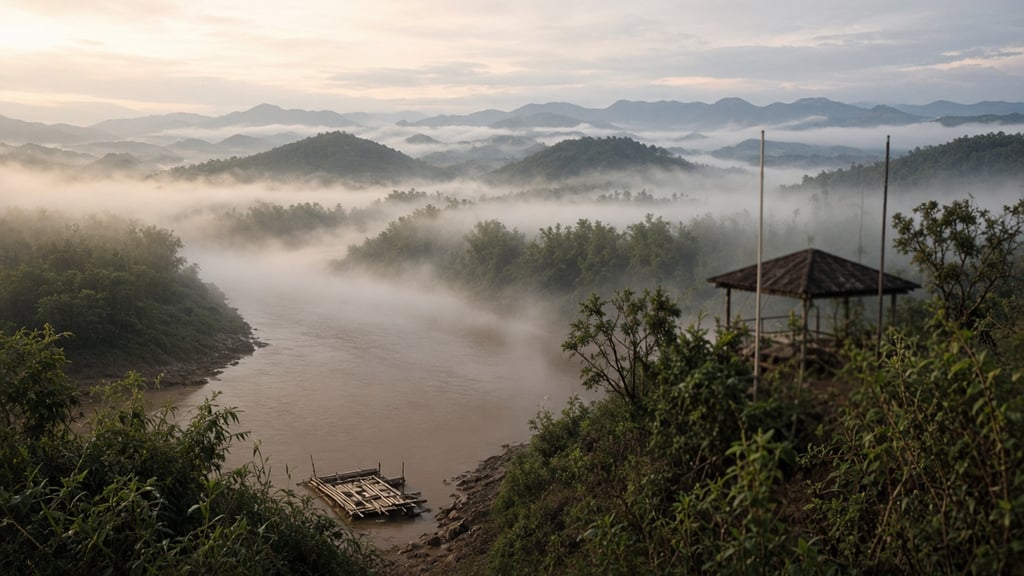
HANOI - Prime Minister Anutin Charnvirakul used a sideline meeting at the 11th Ayeyawady-Chao Phraya-Mekong Economic Cooperation Strategy summit on 29 November to lock in a three-track understanding with Myanmar's president: joint tests on poisoned northern rivers, closer watch on cross-border PM2.5 hotspots, and tighter screening of people crossing into Myanmar to disrupt online scam networks.
Government spokesman Ekkapop Pienphiset briefed reporters after the talks at the Melia Hanoi hotel. Anutin, who also holds the interior portfolio, pressed for faster work on the Sai and Kok rivers, which drain from Shan State into Chiang Rai and Chiang Mai, and thanked Naypyidaw for sending a working-group team to Bangkok last week. Myanmar's president said his government was ready to cooperate, presented its own tests of three rivers as within Thai and international limits, and objected to Thai reporting that, in his view, had overstated the contamination risk.
The Hanoi readout sits on a more detailed technical meeting four days earlier. On 25 November, Thailand's natural resources permanent secretary, Ravievan Puridet, and Myanmar counterpart Hla Maung Thein co-chaired the first Joint Working Group on transboundary river quality at the Ministry of Foreign Affairs in Bangkok, under a terms of reference signed on 6 August covering water monitoring, source tracing, early warning, public-health impact, and policy coordination.
Kok and Sai tests, and a river left off the map
Government House said both sides endorsed a one-year starter plan and listed 12 joint collection points: four on each bank of the Kok and two on each bank of the Sai. The first paired sampling round is pencilled in for December 2026 or January 2027, depending on field access, with results swapped at least twice a year. Later rounds may take in sediment, fish, farm soil, and vegetables, before a three-year action plan. Myanmar offered to host the second working-group meeting in Naypyidaw.
The science is already contested. Thailand's Pollution Control Department reported arsenic and other heavy metals in water and sediment from the Kok and its tributaries, and from the Sai, Ruak, and Mekong, in tests run between March and September 2025. At the Bangkok working group, officials noted that Myanmar still uses a looser arsenic threshold of 0.05 milligrams per litre, while Thailand applies the World Health Organization guideline of 0.01 milligrams per litre. Thai delegates said they would keep public health as the test of success rather than argue over those numbers.
Naypyidaw's Hanoi line, that three rivers already meet Thai and international standards, will be hard to sell in Chiang Rai. Local monitors have for more than a year pointed to open-pit gold and rare-earth workings in southern Mong Hsat, inside territory dominated by the United Wa State Army, only a few dozen kilometres from the Thai border. Myanmar's president told Anutin that the central government does not support illegal mining or unsanctioned mineral exports. Investigators have repeatedly said the Wa, not Naypyidaw, control the upstream pits, which is why a sampling deal can map the damage without automatically shutting the source.
Ranong's Kra Buri river is not in the signed framework at all. On 28 November, Democrat deputy leader Sathit Wongnongtoey visited Ban Hat Tun in Pak Chan, Kra Buri district, where villagers have complained of arsenic for six to seven years. Deputy Prime Minister Yoschanan Wongsawat had already told parliament the river is not on the negotiating table. A field kit used by residents trained by Chiang Mai University researchers showed arsenic at about 2.5 times the 0.01 milligrams per litre drinking guideline, while the Pollution Control Department has said its own Kra Buri readings stayed inside its limits. Villagers told the MPs the water looked unusually clear that day, as it often does when senior guests arrive. Armed Myanmar troops with rifles and a rocket launcher appeared on the opposite bank during the stop. Sathit said he would take the file to parliament on 3 December.
Bangkok is not waiting for Naypyidaw on every domestic lever. The Department of Groundwater Resources is drilling deep wells for 14 villages in Mae Sai. Officials are drafting tighter import and export permits for six minerals (antimony, lead, gold, rare earths, copper, and tin) so neighbour-bound shipments need proof of legal mine origin. A pollution-control-zone process is open for the Thai bank of the Kok. Anutin also said the Defence Ministry would, on 30 November, move to block exports of precursor chemicals used in ore processing.
Haze hotspots and a harder look at outbound travellers
On PM2.5, Anutin described Thailand's farm-burning penalties and efforts to turn leftover maize cobs into fuel. Myanmar's president warned that hotter weather this year could raise forest-fire risk and said Naypyidaw would watch hotspots more closely. That pledge follows an earlier haze operations room set up in Taunggyi in May, after similar posts in Tachileik, Kengtung, and Naypyidaw. Northern residents have heard hotspot promises before. Mae Sai has repeatedly posted some of the country's worst fine-dust readings in the burning season, when fires in Myanmar, Laos, and Thailand stack on the same air mass.
The third track is the scam economy. Anutin asked Myanmar to tighten checks on people crossing from Thailand into Myanmar, to intercept recruiters and workers heading for cyber-fraud compounds, and to squeeze related drug traffic. He said Thai outbound screening is already strict. Myanmar's president said his side would cooperate. The request matches a 12 November visit to Naypyidaw by Deputy Prime Minister and Foreign Minister Sihasak Phuangketkeow, who raised online crime, border stability, and the then-pending river working group. In the ACMECS plenary, Anutin also floated a five-country law-enforcement cell to follow illicit money. Thailand takes the ACMECS chair from Myanmar for 2027-2028.
Whether any of this bites depends on who actually controls the river headwaters, the haze belt, and the compound towns. A sampling roster and a Hanoi handshake do not, by themselves, close a Wa pit, stop a March burn, or empty a fraud hall. Chiang Rai farmers already treat the Kok as unsafe for swimming and, in some stretches, for irrigation. Mae Sai villages are waiting on wells. Kra Buri is still asking to be put on the map.
What This Means for Expats and Travelers in Thailand
Visitors heading to Chiang Rai, Mae Sai, Chiang Saen, or Mae Ai should not treat river water, village taps fed from the Kok or Sai, or locally caught fish as a given. Follow provincial health notices, use bottled or properly filtered water, and ask hotels which source they draw from. The 14 Mae Sai wells are a local supply project, not a tourist guarantee. Dry-season travellers (roughly December to April) should pack N95-grade masks and assume Mae Sai and Chiang Rai will again see hazardous PM2.5 spikes even if hotspot diplomacy improves on paper.
Land crossings into Myanmar, especially Mae Sai-Tachileik, are likely to feel slower as both sides talk up screening against scam-compound traffic. Carry a passport, keep your own bookings, and treat unsolicited job or casino offers along the frontier as a police matter. Ranong and Kra Buri travellers should apply the same caution to untreated river water until the south is added to the official sampling grid. None of this is a travel ban. It is a reason to plan around water, haze, and border queues rather than assuming a summit communique has already cleaned the rivers.
No comments yet. Be the first to join the conversation.