Korea extends K-ETA to 2027, Thailand excluded
South Korea extended its K-ETA waiver for 22 countries and territories through 31 December 2027. Thai passport holders still need pre-travel approval.
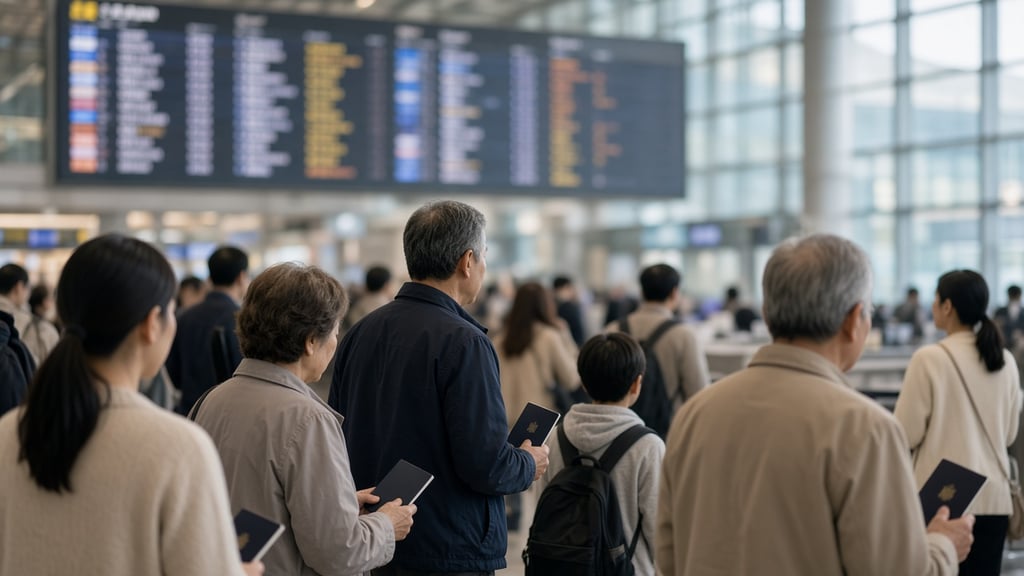
South Korea's Justice Ministry has rolled the temporary Korea Electronic Travel Authorization waiver forward by another year, keeping the same 22 countries and territories off the K-ETA queue through 31 December 2027, Korea Standard Time. Thailand is not on that list. Holders of ordinary Thai passports who travel visa-free for tourism, family visits, or short business still have to apply on the official K-ETA portal and wait for a decision before they board.
The ministry posted the extension on 23 November 2026. The new window runs from 1 January 2027 to 31 December 2027. It covers only nationalities already exempt. Eligible travellers who scan a passport photo page during an application see a pop-up confirming they can skip the fee. Korea.net, the government's English newsroom, repeated the 22-country scope on 25 November, naming the United States, the United Kingdom, Japan, and Australia as examples.
Who is on the 22-country waiver, and who is not
The core list, published by Korean diplomatic missions and restated this week across Thai travel desks, is unchanged: Japan, Taiwan, Hong Kong, Singapore, and Macao in Asia; Canada and the United States, including Guam, in the Americas; the United Kingdom, Germany, France, Italy, the Netherlands, Spain, Poland, Sweden, Finland, Norway, Belgium, Denmark, and Austria in Europe; and Australia and New Zealand in Oceania. Some Korean missions also name Switzerland and Liechtenstein as extra exemptions. Thailand appears on none of those notices.
K-ETA is not a visa. It is a paid pre-screening that visa-free visitors must finish before departure. The official fee is 10,000 won, plus a separate online payment charge, and the portal says most results arrive within 72 hours. An approval is usually valid for three years, or until the passport expires, whichever comes first. Travellers aged 17 and under, or 65 and above, sit outside the K-ETA rule. Approval still does not guarantee entry. Immigration officers at Incheon, Gimpo, or Jeju can refuse a landing.
Why Seoul still screens Thai passports
Thai visitors already travel to Korea visa-free for stays of up to 90 days. The missing piece is the K-ETA waiver, not the visa. Justice Ministry officials have treated that gap as a labour-control tool. In June 2024 they told Korean reporters it would be difficult to add Thailand, pointing to a high stock of undocumented Thai residents, known in Thai as phi noi, or little ghosts: people who enter as tourists and stay on to work in farms, factories, and fisheries.
Ministry figures released then put 145,810 Thais in Korea without a valid visa or permit as of late May 2024, 35.1 percent of 415,230 undocumented foreign residents, ahead of Vietnam, China, the Philippines, Indonesia, and Cambodia. In late 2023 the same ministry said about 78 percent of Thais then in Korea were in an irregular status. Korea's culture ministry had asked for a temporary Thai waiver to stop a slide in arrivals. Thai visitors from January to April 2024 numbered about 119,000, down 21.1 percent year on year while overall foreign arrivals jumped. Justice officials declined, arguing that waiving pre-screening for a high-overstay nationality could lift illegal stays.
Bangkok has kept talking to Seoul about the screening, not about jumping onto the 22-country list. On 18 May 2026, Thailand's ambassador, Tanee Sangrat, met Korea Immigration Service commissioner Cha Yongho. The embassy said they discussed a decline in Thais living in Korea illegally, a voluntary return programme, and changes to K-ETA checks meant to cut wrongful refusals of genuine visitors while still targeting illegal work.
Thai desks, agencies, and the old boycott
For outbound Korea packages sold in Bangkok, Chiang Mai, and Phuket, nothing in this week's notice changes the paperwork. Travel desks still collect passport scans, hotel addresses, and card payments for the official 10,000-won filing, and they still tell clients to submit at least 72 hours before the flight. Group tours remain exposed to a familiar snag: if one member of a family or a concert trip is refused, the rest of the booking can collapse. Agencies that once advertised Korea as a last-minute long-weekend hop now treat K-ETA as a gate, not a formality.
That caution has a social history. In October 2023 a Thai hashtag calling for a Korea travel boycott trended on X after visitors described K-ETA refusals and secondary inspection at Korean airports. Forums still argue the same split: genuine tourists say they are paying for a filter that does not stop phi noi, while others say Korean employers who hire off the books are the demand side Seoul has never fully shut down. This year's extension, like the ones before it, leaves that argument in place through the end of 2027.
What This Means for Expats and Travelers in Thailand
If you hold a Thai ordinary passport, apply on k-eta.go.kr, not on a lookalike agency site. Budget 10,000 won plus card fees, keep the hotel address exact, and do not assume a same-day approval. If you hold a United States, United Kingdom, Japanese, Australian, Singaporean, or other listed passport and you are flying from Suvarnabhumi or Don Mueang, you can skip K-ETA until 31 December 2027, but you will need Korea's free e-Arrival Card in the three days before landing unless you buy a voluntary K-ETA to skip the card. Mixed-nationality couples should not share one process: a British spouse can walk up with a passport, a Thai spouse cannot. An approved K-ETA is not a work permit. Overstay and illegal employment are still the reasons Thailand was left off the list.



No comments yet. Be the first to join the conversation.