DES Proposes National CCTV Board for 14 Cities
Thailand's digital ministry cleared a draft National CCTV Board, chaired by the prime minister, to set camera standards and link public and private footage across 14 smart-city areas.
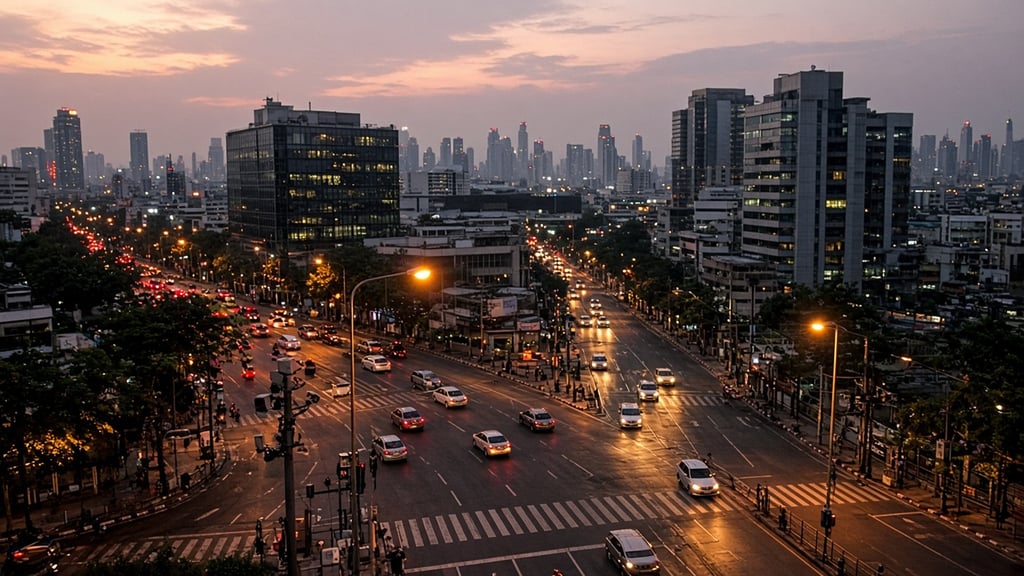
Thailand's Ministry of Digital Economy and Society has cleared a draft order to create a National CCTV Board, chaired by the prime minister, that would set camera standards, approve projects, and integrate public and private camera data sharing to raise national safety. The same sitting endorsed smart-city emblems for 14 areas, including Phuket, Pattaya, Hua Hin, and Bang Sue in Bangkok, before the file goes to the national digital board and then Cabinet.
Digital Minister Chaichanok Chidchob assigned ministry inspector Theerawut Thongphak to chair the 2/2569 meeting of the Digital Economy and Society Promotion and Development Committee, held in Building C at the Government Complex on Chaeng Watthana Road. BDE secretary-general Wetang Phuangsup told the session the draft committee would write policy, plans, and technical standards for closed-circuit systems nationwide and would have the power to approve CCTV projects.
A board built to stitch public and private feeds
Under the draft order, the board would not only catalogue state cameras. It would also push government agencies and private operators to use footage together. That is why the interior permanent secretary would sit as secretary: municipalities, police, malls, and estate cameras still live in separate silos, and the ministry wants one rulebook for how those silos connect.
The proposal is not yet law. The promotion board will send the draft to the National Digital Economy and Society Committee, then Cabinet. Until then, no new duty binds a 7-Eleven, a condo, or a hotel to join a national grid. The same board asked BDE and depa in June 2026 to study shared CCTV for city management and safety. In August the national digital board told the smart-city subcommittee to certify emblems on services people actually use, not on gadgets alone.
Fourteen emblems, two company-led precincts
The meeting also approved a smart-city drive framework and 14 emblem applications. The list mixes tourist towns, commuter suburbs, and two precincts run by companies rather than city halls: Mae Hia (Chiang Mai), Phuket City, Kho Hong (Songkhla), Pak Phriao in Saraburi, Takhli (Nakhon Sawan), Hua Hin, Rangsit, Nakhon Ratchasima City, Umong and Ban Klang in Lamphun, Khon Kaen town municipality, Muang Thong Thani in Nonthaburi (Impact Exhibition Management), Bang Sue in Bangkok (SRT Asset), and Pattaya City.
Three emblems would be renewed: Lampang's provincial office, Buak Khang in Chiang Mai, and Nikhom Phatthana in Rayong. depa's Smart Living and Smart Mobility dimensions already cover crime watch and safer travel, which is why a camera board and an emblem batch landed on the same agenda.
Safety goals, and cameras that fail after the fact
The stated purpose is national safety: one policy, one standard, and projects that can talk to each other. A 2022 nationwide CCTV plan framed the same job as deterrence, investigation, and traffic control, and earmarked about 20 percent of then-listed cameras (75,476 devices) for a central link. The 2026 draft names private operators as partners rather than afterthoughts.
Buying has not paused. GovRadar's e-GP tally for fiscal 2569 counts 2,688 public CCTV projects worth 7,995 million baht as of 7 November 2026, most of them small awards. A national board could stop incompatible hardware. It does not keep poles powered. In a 2025 r/Thailand thread on Pattaya cameras, residents said footage is rarely watched, files are overwritten, and critics say many cameras fail after incidents, leaving police to knock on 7-Eleven doors. Pantip users describe the opposite problem after a crash: private sites refuse clips without a police record, citing the Personal Data Protection Act.
What the draft does not say about PDPA
The 27 November readout did not attach PDPA safeguards, retention limits, or a ban on live facial matching. That silence is not a waiver. The Personal Data Protection Act B.E. 2562 still treats images that identify a person as personal data. Face templates used to recognise someone are biometric data under section 26, which generally requires explicit consent unless a statutory exception applies.
In September 2026 the National Cyber Security Agency, with the Thai Intelligent CCTV Association, published voluntary playbooks for ordinary cameras and AI-enabled systems. Smart-city kits are treated as high-risk. Installing a camera for premises security does not automatically authorise facial recognition, tracking people across areas, or analysing personal characteristics. Cabinet could later write those limits into the board's terms. It has not done so yet.
What This Means for Expats and Travelers in Thailand
If you live or pass through Phuket, Pattaya, Hua Hin, Chiang Mai's Mae Hia, Rangsit, Khon Kaen, Korat, Muang Thong Thani, or Bang Sue, expect more talk of shared feeds. A smart-city emblem is a certification, not a new criminal power. Until the order is signed, a condo or hotel is not obliged to join a national grid. Ask the juristic person who holds the recorder, for how long, and who may replay it.
Do not assume a pole camera will save a police report. Keep incident numbers, and be ready for shops to insist that only officers may collect footage. If a mall or event uses face-scan gates, treat that as a separate, higher-risk process than ordinary recording. Thailand's PDPA still gives you notice and purpose-limitation rights. The new board, as drafted, has not rewritten them.
No comments yet. Be the first to join the conversation.