Bangkok Climbs to 29th in Global Cities Index
Bangkok ranks 29th of 158 cities in Kearney's 2026 Global Cities Index, up four places from 33rd and back in the global top 30 after six years.
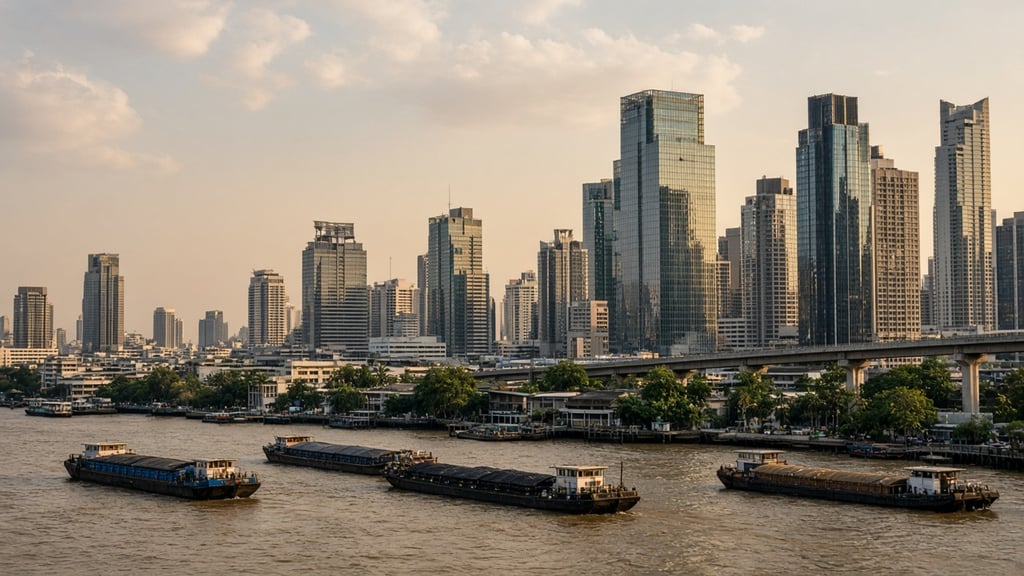
Bangkok has moved back into the world's top 30 cities for global connectivity, placing 29th of 158 urban centres in Kearney's 2026 Global Cities Index. The capital rose four places from 33rd in the previous edition, its third straight annual improvement and its first top-30 finish in six years.
The 16th Global Cities Report, published by the consultancy under the title Connected in a Fragmenting World, measures conditions through the end of 2025. New York, London, Paris, Tokyo, and Singapore again filled the first five places. Beijing, Shanghai, Hong Kong, Los Angeles, and Madrid completed the top 10, leaving Asia-Pacific with five of those ten slots.
How Kearney scores a global city
The index is not a livability poll and it is not a tourist popularity contest. Kearney scores each city from 0 to 100 on 31 publicly sourced indicators, then weights those results across five dimensions. Business activity, covering capital flows, market dynamics, and the presence of major global firms, accounts for 30% of the total. Human capital, covering education levels and talent mobility, also accounts for 30%.
Information exchange, a measure of internet and media access, and cultural experience, covering museums, sporting events, and international exhibitions, each carry 15%. Political engagement, including embassies, policy think tanks, and political events, makes up the remaining 10%. A city's rank is the weighted sum of those dimensions, which is why a strong visitor season can still sit beside a middling human-capital score.
Where Bangkok sits among Southeast Asian peers
Singapore remains the region's clear outlier at 5th, unchanged from 2025 and now inside the global top five for a third consecutive year. Bangkok at 29th is the only other ASEAN capital inside the top 30. Kuala Lumpur slipped four places to 59th. Jakarta edged up one place to 70th. Manila fell two places to 80th. Ho Chi Minh City recorded one of the sharper moves further down the table, jumping 10 places to 84th as it shifted toward higher-value manufacturing and digital-economy investment.
Bangkok's own path has been uneven. It stood at 35th in 2021, dropped as low as 45th in 2023, then recovered to 34th in 2024 and 33rd in 2025 before this year's four-place lift. Across the 2023 to 2026 window that is a 16-place climb, putting the city just ahead of Mexico City at 30th and still well behind the locked-in elite of New York through Singapore.
What City Hall says is driving the rebound
Bangkok Metropolitan Administration officials presented the result on 27 November as evidence that day-to-day city services are starting to register on international scorecards. Advisers to the governor pointed to the Traffy Fondue complaints platform, which has logged more than 1.5 million resident reports with more than 1.2 million marked resolved, alongside more than 2.8 million trees planted and more than 1,100 kilometres of upgraded footpaths.
City Hall also cited public open-data releases and the BMA OSS online service system as part of a wider package of more than 261 policies covering the economy, education, innovation, the environment, and inequality. Officials treated the ranking as a useful signal of international connection rather than an end in itself, and said the real test remains whether residents experience a more liveable city with more equal access to opportunity.
A separate Resonance Consultancy World's Best Cities ranking for 2026, released in November 2025, had already moved Bangkok to 22nd from 32nd on a different mix of livability, culture, and prosperity measures. The two lists are not interchangeable, but both now place the Thai capital higher than a year earlier, and both still flag public transit, air quality, and infrastructure as unfinished work.
What This Means for Expats and Travelers in Thailand
For foreign residents, the Kearney result is less a quality-of-life medal than a business-connectivity reading. Higher scores on business activity and human capital typically track with denser clusters of regional headquarters, professional services, and international schools, which is the slice of Bangkok most relevant to corporate assignees and long-stay remote workers. It does not, by itself, settle arguments about traffic, fine-particle air, or flood risk.
Travelers and new arrivals should treat the top-30 return as confirmation that Bangkok still functions as mainland Southeast Asia's busiest meeting point after Singapore, not as proof that everyday costs or visas have become easier. Corporate visitors will find the usual Sathorn, Silom, and Sukhumvit office geography intact. Independent movers should still budget for the gap between a strong cultural-experience score and the lived reality of commuting, cool-season haze, and neighbourhood differences that no citywide index captures.
No comments yet. Be the first to join the conversation.