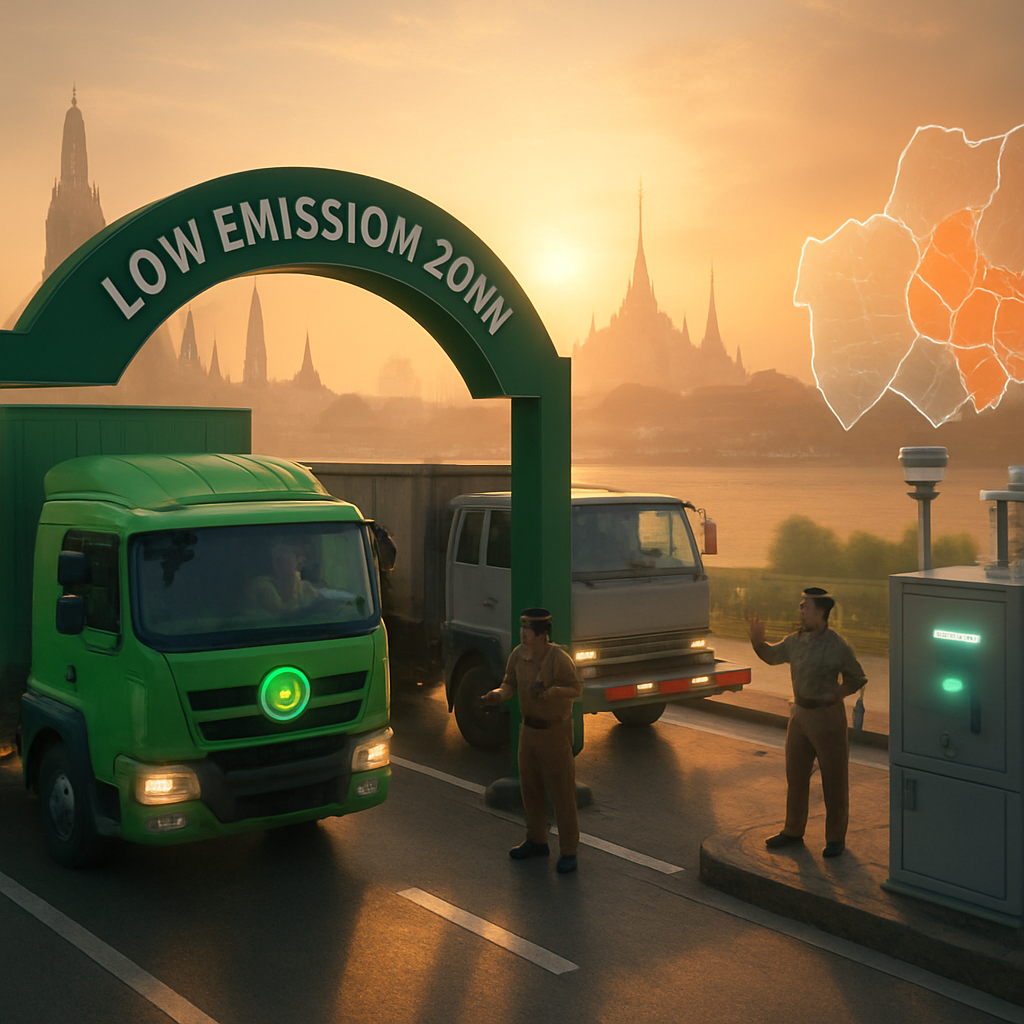
On a brisk Friday in Bangkok—December 19—Deputy Governors Jakkapan Piwngam and Tavida Kamolvej took the helm of a committee meeting that could reshape how the city breathes. The topic on the table: rolling out Low Emission Zones (LEZ) across Bangkok to tackle the stubborn winter haze and the tiny, dangerous particles known as PM2.5.
What the committee decided (and why it matters)
The committee hashed out the guidelines and enforcement playbook for an LEZ program aimed at cutting pollution from heavy vehicles. According to the Bangkok Metropolitan Administration (BMA) Disaster Prevention and Mitigation Division, the plan is ambitious: enforce LEZ measures across 50 districts in fiscal year 2026. The targeted offenders are large vehicles—those with six or more wheels—whose diesel engines are a well-known source of particulate pollution.
But the ban won’t kick in at the whim of a politician. The BMA tied restrictions to hard air-quality triggers. If average PM2.5 readings climb into the red zone—above 75.1 micrograms per cubic metre—in at least five districts, and forecasts predict the condition will persist for two days, the BMA will move to restrict entry of six-wheeled and larger vehicles. There’s an alternative threshold tied to citywide ventilation: if PM2.5 reaches orange or red in five or 15 districts respectively and the ventilation rate (VR) drops below 3,000 square metres per second, that too can trigger the restrictions. In short: bad air + poor dispersal = temporary vehicle limits.
Forecasts, wind direction and the science of when to act
The committee didn’t stop at raw numbers. It agreed to base notices on two-day PM2.5 forecasts, and to factor in wind direction and other environmental variables. That makes the policy smarter and slightly less draconian—measures are applied when forecasts and meteorology indicate pollution will persist or worsen, not just on a single bad reading. This approach aims to be both effective for public health and fair to logistics operators who rely on road access across the capital.
Lessons from the pilot on Ratchadaphisek
Bangkok’s LEZ is not entirely untested. In January 2025 the city ran a pilot in the Ratchadaphisek Ring Road area (January 23–24) that limited truck access to vehicles on the BMA’s “Green List.” Green List entries included electric vehicles (EVs), those running on natural gas (NGVs), and trucks meeting Euro 5–6 emissions standards. The results were encouraging: about 404 fewer trucks entered the restricted zone each day during the pilot, and PM2.5 concentrations in the area fell by 15.6% compared with surrounding areas.
Those benefits came with friction. During the short trial, 1,547 trucks violated the rules, leading to 498 complaints and only 28 fines. The discrepancy between violations and penalties highlights an enforcement bottleneck and points to the need for better compliance mechanisms and clearer communication with drivers and fleet operators.
Green List growth and registration details
Preparing for a wider rollout, the BMA expanded its Green List program. In fiscal year 2025, more than 57,936 six-wheel and larger vehicles were registered under the scheme—an important pool of compliant trucks ready to enter LEZs even when restrictions apply. Registration remains open for the next intake from October 20, 2025, to March 31, 2026. The BMA also requires annual vehicle maintenance checks per its guidelines to keep vehicles eligible and ensure the Green List remains a meaningful signal of low emissions.
What drivers, businesses and residents should know
For fleet managers and truck drivers, the message is clear: get on the Green List (or upgrade to cleaner technology) to avoid being shut out when the city hits the pollution thresholds. For residents, the LEZ plan signals a serious attempt to reduce particle pollution—one of the biggest short-term threats to public health in Bangkok. The measures are designed to be surgical: temporary restrictions when pollution and meteorology combine to create dangerous conditions.
The road ahead
Bangkok’s plan is pragmatic and evidence-driven—tying access restrictions to PM2.5 thresholds, forecasts, and ventilation metrics gives the city a flexible tool to protect public health without unnecessary disruption. The pilot results show the potential for meaningful improvement in air quality, but also underscore the challenges of enforcement and public compliance.
As the BMA prepares to scale up LEZ coverage across 50 districts in fiscal 2026, expect more refinements: improved registration systems, clearer signage and communications, and perhaps stronger penalties or automated enforcement to reduce violations. If the city can marry smart rules with reliable enforcement, Bangkok could make tangible progress against a pollution problem that affects millions—and, importantly, the lungs of the city.
















Be First to Comment