Nvidia pauses Thailand AI server shipments
Nvidia paused AI server shipments to Thailand, Malaysia, Singapore and Indonesia while partners sort a new US licensing rule. Bangkok calls the shock short-term.
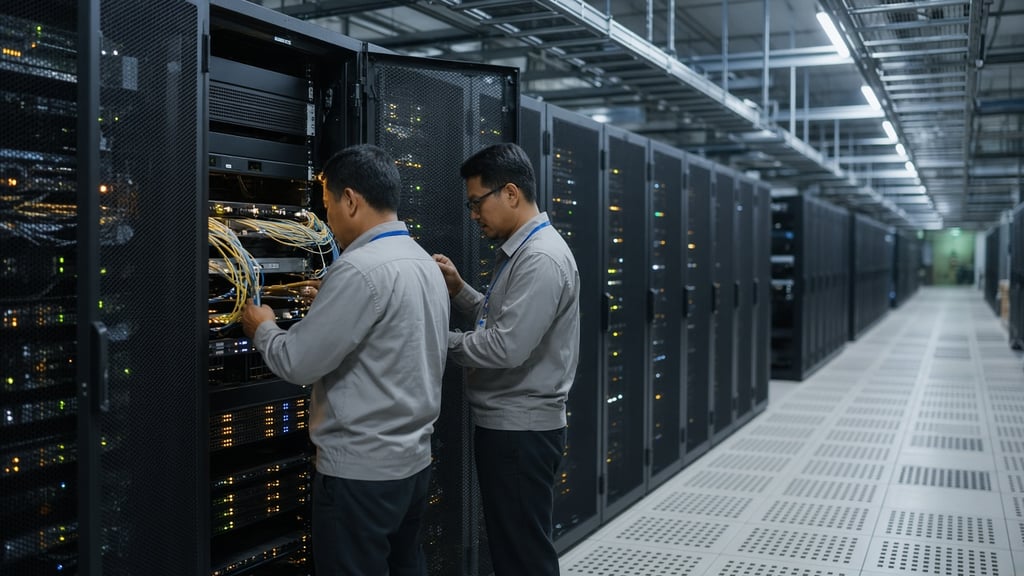
Reports that Nvidia has told manufacturing partners to stop delivering AI servers to Thailand have landed in the middle of Bangkok's data-centre investment boom. Ministries, distributors and operators are now trying to separate a licensing pause from a market ban.
Nvidia instructed partners including Dell and Super Micro to withhold servers that use its advanced chips bound for Thailand, Malaysia, Singapore and Indonesia, according to people briefed on the instructions who spoke to international business media on 26 November. The chipmaker and the server makers have not issued a public statement. The pause followed a US Commerce Department interim final rule that took effect on 19 November, requiring licences for specified advanced processors shipped to those four ASEAN markets and to Brazil.
What Washington actually restricted
The rule is not a blanket embargo. Licences are required for exports, reexports and in-country transfers of covered advanced computing items to or within the five countries. Shipments to companies headquartered in the United States, or whose ultimate parent is US-headquartered, can proceed under an exemption if monthly reporting is filed. A separate control targets overseas data centres that remotely supply large volumes of computing power to firms headquartered in Country Group D:5 or Macau, which includes China. Existing arrangements of that kind have 90 days from the effective date to obtain a licence.
Washington's stated aim is to close a loophole. Chinese companies blocked from buying top-end US chips at home have rented capacity in Southeast Asian halls instead. The Institute for Progress has estimated that remote data centres already supply about 24% of China's AI computing power, and that about 75% of China's overseas AI compute would sit in Southeast Asia by the end of 2026. Thailand was added because US officials judged the diversion risk higher than normal, not because Bangkok was named as a prohibited destination.
Bangkok's first read of the shock
Thailand's Commerce Ministry flagged the supply risk on 18 November, before the Nvidia pause became public. Deputy Prime Minister and Commerce Minister Suphajee Suthumpun said a preliminary review found that US chips in the categories under examination accounted for about 0.7% of Thailand's total chip imports. She asked officials to include chip leasing and computing services sold to overseas customers, and said Bangkok would seek clarification from Washington on licences and exemptions. Vice Minister for Commerce Kirida Bhaopichitr said Thailand would scrutinise data centres importing high-end chips and act against any that re-export them. She warned that new projects that fail to secure US approval may not finish construction, while existing facilities already offering AI services could be less exposed.
Industry Minister Varawut Silpa-archa struck a similar short-term, long-term split on 27 November at the Eco Innovation Forum 2026, hosted by the Industrial Estate Authority of Thailand and the Federation of Thai Industries. He accepted that AI and data-centre work could feel a near-term shock, and argued that Thailand's place in the regional supply chain is a reason to build more of the critical parts at home rather than wait for the next licence cycle. That line tracks a case already made by Thai tech founders. Bitkub founder Jirayut Srupsrisopa, known as Topp, has previously said Thailand still sits on other countries' energy, chips and cloud layers, and has urged ASEAN governments to pool capital for regional AI infrastructure instead of treating each new data hall as a finished industrial strategy.
Operators split on how hard the pause bites
The Board of Investment has been selling Thailand as a data-centre location. In the first nine months of 2026 it recorded 1,954 investment-promotion applications worth 1.707 trillion baht, up 28% from a year earlier, including 111 AI-supply-chain projects worth more than 1.2 trillion baht. Those figures measure investor interest, not chips already in racks. International coverage this month put more than 60 data centres in operation in Thailand and about 30 under construction. Neither Reuters nor the Financial Times named a Thai buyer or put a value on halted Thai orders.
An authorised Nvidia distributor in Bangkok, Ingram Micro Thailand, told local business reporters on 28 November that it had not received a formal stop-order from Nvidia and that existing pipeline orders remained scheduled. Enterprise GPU systems such as Nvidia's DGX line already carry 20 to 36 week lead times. The mixed signals matter. A compliance freeze at the OEM layer can delay new AI clusters even if channel distributors still see paperwork moving. US-owned hyperscalers with a reporting exemption may keep receiving hardware. Local operators that sell training capacity to Chinese clients face the harder test, because remote access is now a controlled activity, not a quiet workaround.
Singapore and Malaysia moved faster on the public record
The pause sits beside a separate US Entity List action. Commerce documents published around 23 November named seven firms, including Megaspeed (Thailand) Co Ltd, registered at Siam Piwat Tower in Pathum Wan, as presenting a risk of diverting advanced computing technology. Listing is an American export-control tool, not a Thai court finding. Singapore's Prime Minister Lawrence Wong said on 24 November that Singapore does not enforce US export law but will not let companies use the city as a circumvention route, and that chips Megaspeed bought from Nvidia had not entered Singapore. Malaysia, which has had extra controls on high-performance US-origin AI chips since July 2025, said its investment agency would warn data-centre operators not to lease space to the seven listed firms.
Bangkok has not yet issued a comparable public note on the Thai-registered Megaspeed entity. Singapore explained what it knows and what it does not. Malaysia named the operators it wants landlords to avoid. Thai agencies have assessed import shares and promised talks with Washington. Investors will watch which of those three styles of answer arrives with the next licence application.
What This Means for Expats and Travelers in Thailand
Everyday consumer cloud tools used by remote workers in Bangkok, Chiang Mai, Phuket and Pattaya are unlikely to vanish overnight. The immediate pressure sits on new GPU clusters, not on a laptop signing into a US software account. People who rent local AI capacity to train models or host private company data in a Thai hall should ask their provider whether the cluster is US-parent exempt, already licensed, or waiting on a 90-day filing. Businesses that planned to stand up a Thai AI room in 2027 should budget extra time and a second vendor path. US-headquartered clouds with reporting exemptions are the more resilient option for now. Independent regional hosts that market cheap training hours to overseas clients are the more exposed option. That split will show up as longer wait lists and higher rental prices before it shows up as a dark screen on a tourist's phone.

No comments yet. Be the first to join the conversation.