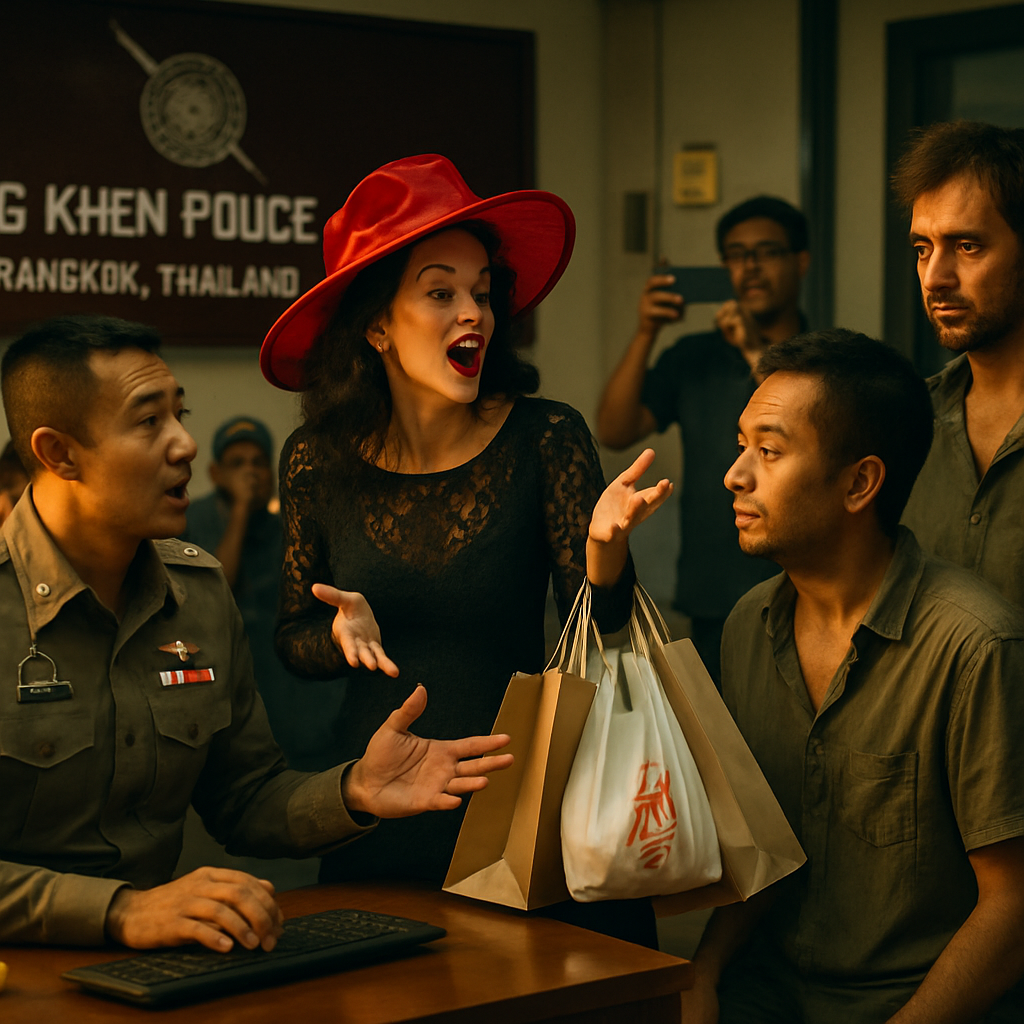
Bangkok’s internet got another dose of the delightful and the downright bizarre this week when a short TikTok clip from Bang Khen Police Station made the rounds. In the video, a woman files an unusual formal complaint: she accused a man she nicknamed “Colonel Sanders” and a homeless man of trying to strangle her outside Zeer Rangsit shopping mall and then following her all the way to Kasetsart University. The footage—posted by the on-duty officer on TikTok under @tonkhow_copnurse on January 5—quickly turned into a viral curiosity.
The scene: dramatic, fashionable, and a little surreal
The complainant arrived in full dramatic mode: a black lace dress, a red hat, and flawless makeup, as if she’d stepped straight out of a music festival or an emotional rom-com. She told the officer that the alleged assailant’s name was “Phu Phan” (Phu Phan translates to “Colonel” in Thai) and that his surname was “Sanders.” According to her, this Colonel character instructed a homeless man to “control” her. It’s the sort of accusation that makes you blink, laugh, and wonder if you’re in the middle of a performance art piece—or a very strange day at the police station.
Officer vs. oddity: a calm, humorous approach
The responding officer seemed to suspect the woman might be intoxicated or struggling with her mental health. Rather than escalate the moment, he chose a calm, almost playful approach: he listened, asked questions, and pretended to enter her complaint into the police computer system. When he asked to see her ID, she insisted she had lost it and offered—rather than a legal document—her Facebook handle: “I’m a crazy person, I’m insane.”
After the formalities, or the theatrical semblance of them, the officer escorted her out of the station. She left carrying multiple shopping bags and a McDonald’s plastic bag. In a lighthearted exchange, the officer teased her about picking McDonald’s over KFC; she replied with comic disdain for KFC’s founder—“No, I don’t like KFC. I have an issue with its founder.” He complimented her dress and makeup and wished her well before they parted ways.
Viral reaction: giggles, skeptics and a few sympathies
The clip generated a heap of comments and memes. Viewers split into camps: some believed it was a genuine if eccentric police encounter; others smelled staged content made for social media engagement. Jokes rolled in fast—suggestions that the woman had been “hired by McDonald’s to slander a rival,” quips about who would run KFC if Colonel Sanders were arrested, and a cheeky tip that the suspect “was wearing white and had grey hair.”
Not every viewer was laughing, though. Several commenters expressed concern and sympathy for the woman, noting she looked well-dressed but possibly unwell, and urged authorities and bystanders to consider mental health and safety first. Fans of internet humor, meanwhile, kept piling on punchlines about fast-food feuds and theatrical police work.
Did it really happen—or was it TikTok theater?
One of the most persistent questions is whether the interaction was authentic or staged. The officer who posted the video has not clarified whether the incident was real or created for entertainment. That silence has only amplified speculation, transforming the short clip into a Rorschach test for internet audiences who prefer either a tidy truth or a clever stunt.
Whatever the reality, the video captures a few things that are undeniably modern Bangkok: the omnipresence of TikTok as a platform for official and unofficial moments, the blending of comedy and concern in public responses, and a willingness—by bystanders and officers alike—to treat odd public encounters with a dash of levity rather than immediate alarm.
Takeaway: strange, human, and uncomfortably entertaining
At its heart, this viral clip is a small, human story—part spectacle, part possible cry for help, part prank, and entirely internet-ready. It’s a reminder that the social media age can turn even routine police logbook moments into widely shared cultural flashpoints. If nothing else, it gave the internet a new punchline and a fresh debate about authenticity online.
Whether you laughed, winced, or felt concerned, the video succeeded in one thing: it got people talking—about mental health, online performance, and the curious way that modern life can flip a standard police visit into a viral mystery. As the comments keep proving, sometimes the best response to internet oddities is equal parts humor and empathy. And maybe a side of fries—McDonald’s, apparently, over KFC.
















This reads like a perfect TikTok skit, but I also worry about the woman’s wellbeing; are we applauding viral content at the cost of someone’s health?
Of course it’s staged — cops love views and people love drama. Why would a real victim give her Facebook handle instead of ID unless it was for clout?
Or maybe it’s a real cry for help that got monetized. Either way, the system benefits from clicks, not care.
We should be careful: viral recording by police blurs public health practice with entertainment. There are ethics questions about consent, documentation, and duty of care.
Exactly — even if staged, the officer’s reaction reflects a policing culture that opts for lightheartedness over follow-up mental health checks.
I felt sad watching the clip; she looked put together but unwell, and making memes out of that feels wrong to me.
I agree, sympathy first. Jokes later. This could be someone in crisis and not a content piece.
Sympathy is fine, but the officer also has to balance public safety and procedure. The lack of clarity from the police about authenticity is a problem.
If Colonel Sanders really showed up in Thailand I’d pay to see that mugshot. This whole fast-food feud theory is peak internet nonsense.
I laughed so hard. Colonel Sanders chasing people is funny, but real people get hurt in jokes sometimes.
Reduce this to satire if you must, but the clip is more revealing about modern media rituals than any single quirky complainant.
Prof Blake, are you saying we should analyze memes instead of helping people? Because that’s what’s happening.
She looked like she was dressed for a party, not a police report. I hope someone checks on her later.
Many Bangkok locals treat odd public moments as community business; I hope a neighbor or shop owner followed up with help.
This is a fascinating convergence of performance art, surveillance culture, and procedural bureaucracy. The performative complaint fits into a longer history of public eccentricity becoming spectacle.
Calling it performance art elevates it. Maybe it’s just an attention economy trick, not art.
Not all spectacle is art, but the modalities are worth studying — why we laugh, why we share, and what institutions tacitly permit.
This smells like a setup. Officer posts video, gets likes, queued for promotion. Everyone plays their part. It’s capitalism in cop-form.
Not every viral thing is a conspiracy. Sometimes people are just strange and society reacts.
Strange, sure — but the incentives for staged content are real and growing. Don’t ignore the pattern.
Her makeup and dress were immaculate — either she was dramatic on purpose, or that’s anxiety’s strange veneer. Either way, fashion becomes part of the narrative now.
Exactly — being well-dressed doesn’t mean someone is fine. Clothes hide a lot.
And police must not assume wellness based on appearance; mental health training is crucial for front-line officers.
There’s a policy angle here: should police be posting unverified encounters online? That could breach privacy and undermine trust.
Public-facing officers need clear guidelines. Social media can educate, but it can also trivialize and retraumatize subjects.
Clear rules would be great, but who enforces them when the platform rewards virality?
Leadership and internal oversight. Without them, platforms set the norms, not police ethics committees.
All I know is: McDonald’s wins again. Viral clip proves fries > buckets in internet lore.
As someone living near Kasetsart, I saw people comment they recognized the area; local context matters and could reveal more than jokes.
Min, if locals know the area, someone should check CCTV or mall staff. That’s how you verify a story before memes spread.
Agree, Joe — but CCTV access is uneven and often controlled by private entities reluctant to cooperate without legal prompting.
Back in my day, police handled weirdness quietly. Now everything’s on camera and people make careers from chaos.
Technology reconfigures civic rituals; the archival impulse of recording reshapes accountability and spectacle simultaneously.
Fancy words, Prof. We just got more noise and less common sense.