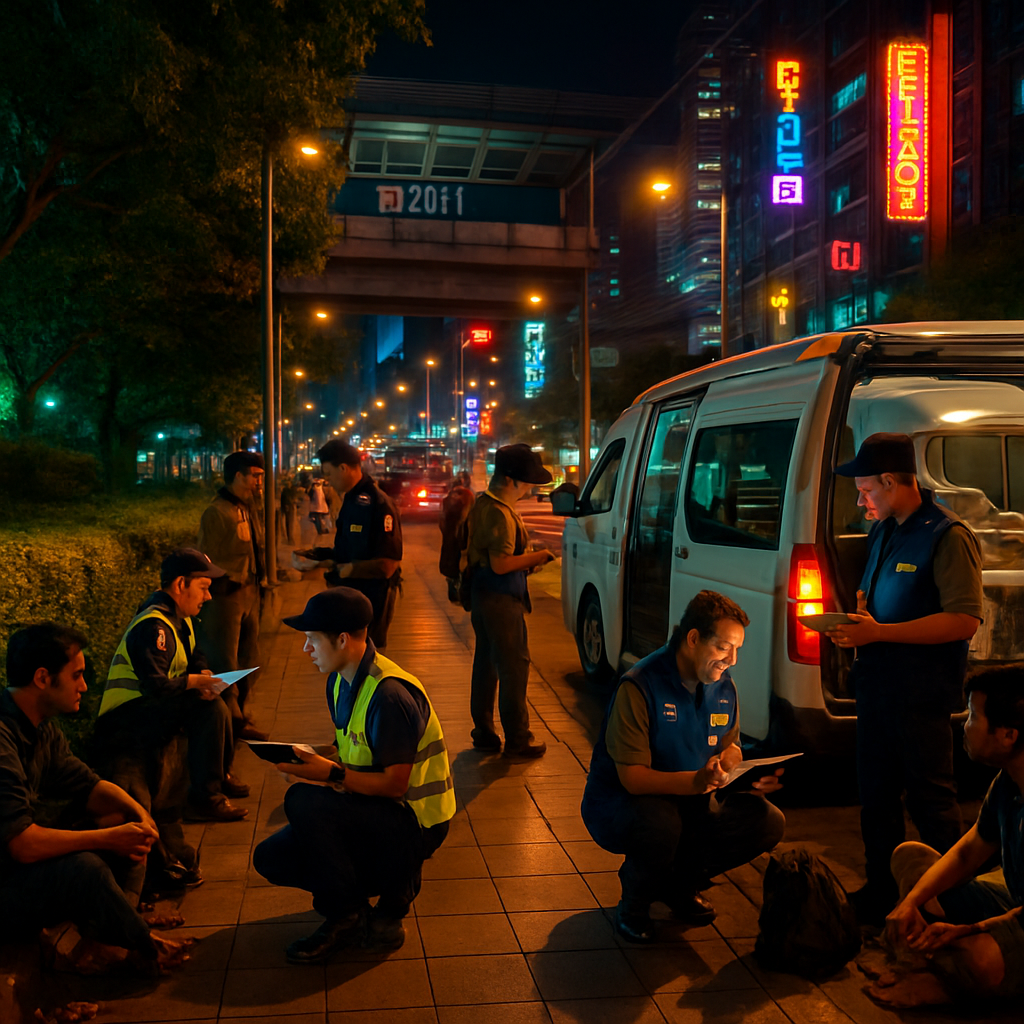
In the glow of neon and the hum of late-night traffic, Bangkok authorities rolled out a coordinated operation on the evening of December 23 along one of the capital’s busiest arteries. From BTS Nana station down to the green fringe outside Benjasiri Park, teams of city officials, social welfare workers and local police canvassed pavements and public nooks where people had been sleeping, part of a wider effort to manage homelessness in the Sukhumvit commercial and tourist strip.
The sweep began at around 10pm and was described by officials as more than a simple eviction: it was an assessment-driven push to connect vulnerable people with state welfare, shelters and vocational training — while also reminding everyone that public spaces must remain safe and accessible for pedestrians, shoppers and visitors. The agencies involved included the Bangkok Metropolitan Administration, the Ministry of Social Development and Human Security, and district offices from Khlong Toei and Watthana.
On the ground, teams worked methodically. Individuals using sidewalks as temporary accommodation were spoken to one-on-one, their personal details recorded and entered into a new database designed to track needs and follow up over time. That database, officials said, is intended to move the response away from short-term displacement and toward long-term, sustainable support — everything from temporary shelter placements to training programs aimed at helping people secure regular incomes.
Responses from those approached were mixed. Some accepted offers of assistance and agreed to enter the shelter system or to receive information about vocational courses; others declined. Under the Homeless Protection Act, officials emphasized, assistance is meant to be voluntary. Yet the law also gives authorities the power to regulate the use of public space. For people who refused welfare services, officers issued warnings and asked them to vacate the area to restore order and safety in the bustling Sukhumvit corridor.
The operation underscores the delicate balancing act Bangkok faces: how to combine compassion with enforcement in a high-traffic economic zone. Sukhumvit is more than just a transport link — it’s a magnet for tourists, shoppers and nightlife, and keeping sidewalks clear is often framed as a matter of public safety and the city’s image. But officials repeatedly framed this sweep as a step toward more structured assistance rather than a purely punitive exercise.
Collecting information on-site is a practical approach for authorities who want to tailor interventions. Knowing a person’s circumstances — whether they have family nearby, health concerns, or an interest in job training — helps social agencies follow up with targeted support rather than relying on repeated, disruptive clearances. Municipal officers said the data would be used to strengthen future homelessness interventions and to coordinate services across agencies and districts.
Still, the human element remains central. For some people living on the streets, offers of help are welcomed; for others, shelters feel unsafe or unsuitable, and informal networks on the streets provide a fragile sense of community and autonomy. Officials acknowledged those realities and tried to present options — from state welfare benefits to vocational skills courses — while making it clear that the use of public walkways cannot be indefinite.
Observers have noted that this operation mirrors similar efforts elsewhere in Thailand. A recent sweep at a busy Pattaya intersection, for example, highlighted how enforcement can be blended with outreach: authorities there also paired clearing actions with offers of social services. Those comparative efforts suggest a national conversation about how best to manage visible homelessness in tourist and commercial zones without simply displacing people from one corner of the city to another.
For Bangkok, the December 23 operation may be remembered less for dramatic headlines than for the small, cumulative steps it represents: documenting needs, offering alternatives, and insisting on public access. Whether that approach reduces homelessness in the long term depends on sustained follow-up, coordination between agencies, and resources to expand shelter capacity and job-training programs.
As the city moves into the new year, officials say they will use the data gathered during the operation to map cases and plan next steps. If the goal is genuinely sustainable change, that will require more than one-off sweeps — it will demand patience, persistent outreach and a willingness to understand why some people choose life on the margins over formal services.
In the meantime, Sukhumvit’s sidewalks have been cleared and the city’s message is clear: Bangkok is trying to marry compassion with order, and the success of that strategy will hinge on whether offers of support turn into long-term solutions for the people who need them most.


















A data-driven outreach is a step forward if the city really follows up, but I worry about how that database will protect people’s privacy and avoid just shuffling them around.
We saw the vans last night; it felt organized but also like they were rushed.
Collecting data can enable targeted interventions, but without clear governance and accountability it risks surveillance and mission creep. Ethical frameworks and independent oversight should be part of this rollout. Otherwise the database could be repurposed for crowd control rather than care.
They took my friend off the bench once and he got angry. He said shelters are scary and he likes his street friends.
I agree with Dr. Anya — transparency about data use is essential, and civil society should be allowed to audit outcomes.
From an operational view, coordination reduced duplication last night and helped link some people to temporary shelter beds.
This is about tourists and image, not compassion. They want the sidewalks clean for photos.
I disagree that it’s only image-driven; public safety and pedestrian access are real issues, but yes the timing in tourist areas is telling.
Look around Nana — you can tell they prioritized the flashy stretch.
If people refuse services then perhaps fines or restricted zones are needed; voluntary offers don’t always work.
The policy dilemma here is classic: balancing public order with social inclusion. Success metrics should include recidivism into street sleeping and long-term employment outcomes, not just cleared sidewalks.
Exactly, measure outcomes over months, not minutes after a sweep.
Additionally, cross-referencing health, housing, and employment databases (with consent) could allow personalized case management rather than one-size-fits-all referrals.
Where will funding come from though? Training programs need sustained budgets, and districts are always short.
They told my uncle to move and he felt scared, he doesn’t like shelters.
As someone who walks Sukhumvit every week, I appreciate clearer sidewalks, but the voluntariness seems token if warnings and displacements follow refusals.
Voluntary approaches must be meaningful: offer real alternative housing and wraparound services. Otherwise it becomes coercive in practice.
There’s also an equity issue: which neighborhoods get outreach and which get heavy-handed enforcement? Low-income districts often see more punitive actions with fewer supports.
Right, and tourists rarely see the follow-up work needed to keep people off the streets permanently.
I support the intent but fear execution will criminalize poverty. Data can help, but only if paired with housing-first solutions.
Housing-first would be ideal, but where do you put everyone when shelters are full and rents are high?
Precisely why long-term planning and budget commitments are necessary; temporary shelter alone won’t solve it.
The city must ensure public safety but also respect dignity; forced removals feel wrong to me.
They took my sleeping mat and said no here. I cried, they did not care.
I’m sorry, that’s awful to hear.
Why isn’t there more involvement from NGOs who know these communities? Government teams alone can’t build trust quickly.
NGOs were present in coordination meetings; however, urgent operations sometimes prioritize government staff for liability reasons. Partnership expansion is on the agenda though.
Good to hear, but public reports should name the NGOs and roles so people can verify follow-up.
Transparency and accountability must be central. Publish anonymized data and quarterly impact reports so citizens can see whether sweeps reduce homelessness or simply relocate it.
Anonymized dashboards would help advocates and researchers, yes, and build public trust in the program.
Also include user satisfaction surveys from those offered services; that feedback loop is essential.
This sounds like a pilot for national policy, and I’m skeptical governments can scale compassion without big budget increases.
Scaling requires not just money but institutional reform: training staff in trauma-informed care, inter-agency data sharing protocols, and community engagement strategies.
So more bureaucracy, which means slower help for people now.