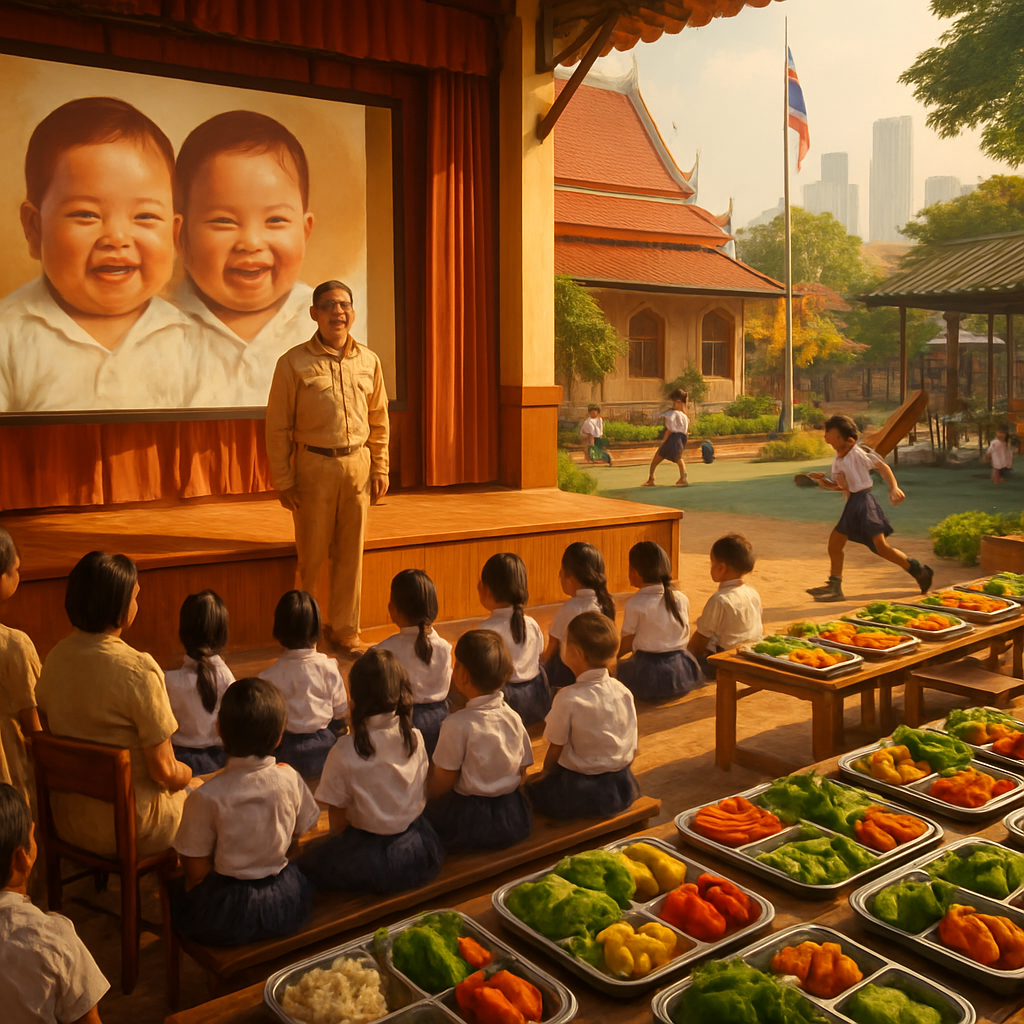
When Bangkok Governor Chadchart Sittipunt stood at a podium on December 11 to launch a new childhood-obesity initiative, the audience didn’t just get policy speak and program timelines — they got a blast from the past. Behind him, projected above the stage, was a grainy childhood photograph of two delightfully chubby boys. The boys were later identified as Chadchart and his twin brother, Chanchai Sittipunt. The image halted scrolling thumbs and lit up Thai social media, but the campaign it introduced is no joke: “Don’t let children become obese” is the city’s fresh, ambitious push to shape healthier futures for Bangkok’s youngsters.
A coalition of partners — and a memorable image
The campaign is a collaboration between the Bangkok Metropolitan Administration (BMA), the Thai Health Promotion Foundation, the Royal Danish Embassy in Thailand, Novo Nordisk Pharma, and Nudge Thailand. It sits under the wider “Bangkok: City for Better Health” policy and aims to change the urban environment, public policies, and everyday habits that influence health for people of all ages.
Why the childhood photo? Chadchart explained that the picture was meant to humanize the issue. It helped steer attention away from statistics alone and toward the real people who will live with policy decisions decades from now. Social media, naturally, had plenty to say — much of it amused and affectionate. Comments ranged from playful (“You weren’t obese, you were just storing energy to work for Bangkok later”) to admiring (“What a great example — an overweight boy who grew up to become Bangkok governor.”) The image sparked conversation, which is exactly what a public-health campaign needs to get off the ground.
What the curriculum will do
At the heart of the initiative is a new health curriculum to be introduced across Bangkok schools. The Education Department will pilot the curriculum in selected BMA schools — 21 schools in the trial (intervention) group and 19 schools serving as a control group — before expanding the program to all 437 BMA schools by the 2027 fiscal year. The BMA plans to collect data both before and after the rollout to measure the curriculum’s effectiveness, ensuring the program is driven by evidence, not just good intentions.
Teachers are expected to play a central role. Not only will teachers deliver lessons and promote healthier habits among students, but they are also being encouraged to lead by example and look after their own health. The approach recognizes schools as whole communities where role models, food options, physical activity, and policies collectively shape children’s lifelong habits.
Numbers that matter
Governor Chadchart reminded listeners that this is a long game. “Childhood obesity is a major issue today. Children are the adults of the future,” he said, noting that about 50% of Bangkok adults are obese and estimating that more than 20% of children may be affected. The governor emphasized measurable results over flashy headlines: real, long-term shifts in health behaviors and outcomes are the goal, even if visible change takes time.
Public reaction: laughter, support, and curiosity
The nostalgic photo prompted a mix of reactions online. Many found the image endearing: “The chubby kids in the background are so cute!” Others poked gentle fun at the irony of the governor’s past, or wondered about the twin dynamic: “Who is Chadchart, and who is Chanchai?” A few commenters even asked whether Chadchart had secured Chanchai’s permission to share the private picture — an understandable curiosity in an era where personal images go viral in minutes.
Beyond the laughs, many parents welcomed the campaign. Several expressed hope that the curriculum would encourage healthier eating, more physical activity, and better lifestyle habits in schools — places where children spend large parts of their day and often consume several meals. For families juggling busy schedules and the temptations of fast food and screen time, school-led initiatives can provide structure, education, and practical tools.
Why this matters for Bangkok
Urban settings present unique challenges and opportunities for public health. From food environments dense with street snacks to limited safe spaces for exercise in some neighborhoods, city life shapes health choices. Bangkok’s new campaign recognizes that tackling childhood obesity requires more than classroom lessons — it needs healthier school lunches, playgrounds and active-transport options, supportive policies, and community buy-in.
Importantly, the campaign commits to measuring outcomes. By using pilot schools, control groups, and baseline data collection, Bangkok is aiming to create a replicable, evidence-based model. If the results are promising, the planned citywide expansion by 2027 could set a template for other urban centers in Thailand and beyond.
From chubby cherub to champion of change
The viral photo of young Chadchart and Chanchai provided an unexpected, humanizing splash of color at the campaign launch. But the story behind the image is serious: it’s about a city trying to give its children better tools and environments to live healthier lives. Whether the conversation it sparked is remembered for its memes or its measurable impact, Bangkok’s move to confront childhood obesity with curriculum, policy, and community action is a step worth watching — and, hopefully, one that will help turn today’s “chubby” headlines into tomorrow’s healthier generations.


















I actually liked the photo — it made the campaign feel human and not just another government report.
Humanizing is fine, but using personal childhood photos in a public health ad feels exploitative unless the other twin agreed.
Fair point about consent, but the governor said it was to steer attention toward people, not stats. Context matters here.
Consent is essential ethically, but from a behavior-change perspective the image is a classic nudge — it reduces abstraction and can motivate policy support.
A nudge from a politician still needs consent. Otherwise it teaches kids that ends justify the means.
This feels like state overreach — next they’ll tell parents what snacks they can buy at home.
Public schools already shape kids’ choices all the time; teaching nutrition doesn’t equal banning home choices.
But where do you stop? Today it’s school lunches, tomorrow it’s tax on fried food. Slippery slope.
Evidence shows environmental changes are effective. Policy can nudge healthier defaults without draconian bans.
As a parent I want my kids to learn healthy habits at school, especially since we both work full-time.
Thanks for the support, Maya. We designed the pilot to balance school influence with family involvement and feedback.
Appreciate the response. Will parents be consulted during the pilot so changes make sense at home too?
Kids just need to play outside more. Why overcomplicate things with new curriculums?
Play is vital, but structured lessons teach food literacy and long-term habits that recess alone won’t change.
Okay, but schools are already overworked. Are teachers given time and training to do this well?
The pilot includes teacher training and supports. If you ask many teachers, they want tools not extra burdens.
I’m glad they included controls and baseline data, but watch closely for pharma influence given Novo Nordisk’s involvement.
Exactly — when big pharma funds something it usually hides profit motives behind public health language.
Skepticism is healthy. But partnerships are common; transparency about data access and conflicts is what matters.
Agreed. Independent evaluation and public data will keep the program credible, not demonize partners automatically.
School lunches need reform, not just lessons. Kids can’t learn when they’re hungry or fed junk food.
Absolutely — combining curriculum with healthier meal standards multiplies the effect and models real choices.
So when will menus change? Pilot results should include nutrient analyses, not just BMI.
I’m still stuck on whether Chanchai consented to that photo going viral. It’s a private family moment used for politics.
Thai law around public figures allows some leeway, but ethical campaigning should still ask family members first.
Laws aside, it sets a tone — politicians can weaponize personal images and get applause for it.
The commitment to measurable outcomes is promising; too often programs lack follow-up.
We need details: sample size calculations, outcome measures beyond BMI, and plans for missing data in follow-ups.
Yes, and process evaluation too — understanding how the curriculum is delivered matters as much as results.
Also consider cluster effects since schools are the unit of intervention; analysis must reflect that.
I like the idea if we get better playgrounds. Homework about food sounds boring though.
Curriculum can be hands-on: cooking demos, garden projects, active games — not just worksheets.
Cool, I would join a school garden club. That sounds fun.
Shaming people with photos is not how you build public trust. Focus on infrastructure, not memes.
The photo was nostalgic, not shaming, but I hear your concern about tone and dignity.
Tone matters. People resent being lectured about weight while cities lack safe parks and affordable healthy food.
If they’re piloting in 21 schools, I hope they include socioeconomic diversity so results generalize across Bangkok.
Exactly — selection bias can doom external validity. The protocol should stratify by neighborhood income and access.
Cultural food habits are key. Any curriculum must respect Thai food culture while promoting healthier preparations.
Local recipes can be modified to reduce fats and sugars without losing identity; chefs and moms should be involved.
This smells like a PR move before budget talks. Photo + pilot = easy headline, but will funding follow long-term?
The pilot is funded by the partnership and city budget commitments through 2027. Transparency on funding will be published.
Promises are easy; I’ll wait for the line items in next year’s budget documents.
I’m worried about stigma. Children labeled ‘obese’ can be bullied; the curriculum must avoid blaming and teach empathy.
Programs that pair behavior change with social-emotional learning reduce stigma and improve engagement.
Good, include parents and students in messaging so it’s about health, not appearance.
Why involve Denmark and pharma? Is this an international experiment on Bangkok kids?
International partners often provide technical expertise and funding; that can be good if local needs lead design.
I just want transparency. Foreign influence shouldn’t override local priorities.
If half of adults are obese, we need systemic fixes: transport, zoning, and food retail regulations, not only school lessons.
Agreed. This curriculum is one lever among many; urban planning reforms must align with health policy.
Teachers leading by example is ideal, but burnout and low pay mean many won’t have the bandwidth to be role models.
Investing in teacher wellbeing and incentives is part of the plan; without that, implementation will fail.
Show me the incentives then. Empty words don’t change daily realities.
One more thing: memes aside, if this becomes a model for other cities, Thailand could lead in urban health.
Scaling requires rigorous evaluation and adaptability; if done right Bangkok’s approach could be influential.